
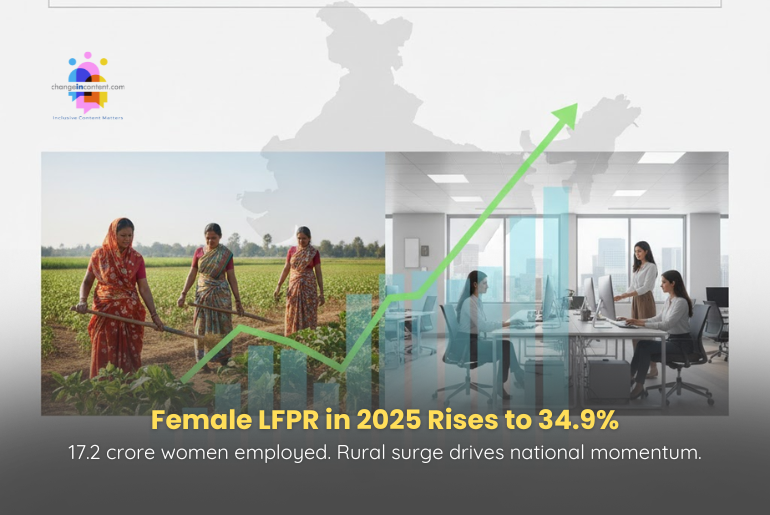
The latest data on Female LFPR in 2025, released by the Ministry of Statistics & Programme Implementation on February 10, confirms that women’s labour force participation has continued its upward movement in the October–December 2025 quarter. The overall Female Labour Force Participation Rate for persons aged 15 years and above rose to 34.9%, up from 33.7% in the previous quarter.
That 1.2 percentage point increase may appear modest. But in a country of India’s scale, even a single percentage point represents millions of women entering or remaining in the labour force. The question is not whether the number has improved. The real question is what is driving this increase and whether it signals structural transformation or cyclical shifts.
Understanding the framework: PLFS, NSO and CWS
The data comes from the Periodic Labour Force Survey (PLFS) conducted by the National Statistical Office (NSO) under the Ministry of Statistics & Programme Implementation (MoSPI). From January 2025 onwards, the survey methodology was revamped to provide monthly and quarterly estimates for both rural and urban India under the Current Weekly Status (CWS) framework.
The October–December 2025 Bulletin is the third quarterly release under this redesigned system, and for the first time in PLFS history, rural and urban labour indicators are being released together quarterly.
The all-India estimates are based on data collected from 5,61,108 persons. Out of these, 3,21,040 come from the rural areas, and 2,40,068 are from the urban areas. It is statistically significant coverage.
Female LFPR in 2025: The core numbers
The headline figure is clear.
Female LFPR for persons aged 15 years and above increased to 34.9% in October–December 2025, compared to 33.7% during July–September 2025.
The growth is not uniform. In rural India, the female LFPR increased from 37.5% to 39.4% over one quarter. That is a 1.9 percentage-point increase. In urban India, however, female LFPR remained largely stable.
This divergence is critical. The national increase is being driven almost entirely by rural women.
Female LFPR in 2025 in absolute terms
Percentages tell one story. Absolute numbers tell another.
Using projected population figures from the Ministry of Health and Family Welfare, the PLFS estimates that:
- During July–September 2025, 56.2 crore persons were employed in India. Of these, 16.6 crore were women.
- During October–December 2025, employment rose to 57.4 crore persons. Of these, 17.2 crore were women.
That means approximately 60 lakh additional women found employment in a single quarter. This is not a marginal movement. It is a measurable scale.
Worker Population Ratio: Women’s workforce presence strengthens
The Worker Population Ratio (WPR) for persons aged 15 years and above increased from 52.2% to 53.1% during the quarter.
For women, the WPR continued its upward trend compared to the last two quarters. The release explicitly notes that this reflects a positive shift in women’s engagement in the workforce.
Again, rural participation is the driver. The rural WPR shows consistent growth across quarters, whereas urban numbers remain relatively stable.
Unemployment rate declines across sectors
The Unemployment Rate (UR) under the Current Weekly Status framework also improved.
In rural areas, the unemployment rate declined from 4.4% to 4.0%.
In urban areas, UR fell from 6.9% to 6.7%. The primary driver of the same is a reduction in urban male unemployment from 6.2% to 5.9%.
The release indicates that both rural and urban unemployment rates declined for women, although the summary does not present gender-segregated UR figures.
Lower unemployment, combined with a rising female LFPR, indicates that women entering the labour force are not merely searching for work. They are finding work.
Sectoral distribution: Where are women working?
The sectoral data reveal structural patterns.
In rural India, 58.5% of employed persons aged 15 years and above are engaged in agriculture, up from 57.7% in the previous quarter.
In urban India, 61.9% of workers are in the tertiary sector, which includes services.
Self-employment increased in both rural and urban areas:
- The share of the rural self-employed rose to 63.2%, up from 62.8%.
- The share of urban self-employed rose to 39.7%, up from 39.3%.
The rise in self-employment deserves scrutiny. Self-employment in rural India is often associated with agriculture, informal work, family enterprises, or subsistence activities rather than high-growth entrepreneurship.
Therefore, while the female LFPR is rising in 2025, the quality and security of employment remain central concerns.
Female LFPR in 2025: Structural shift or economic compulsion?
The rise in female LFPR is undeniably positive. Yet analysis must go beyond celebration.
The rural surge suggests that women are increasingly participating in agriculture and self-employment. It could reflect:
- Increased economic necessity in rural households
- Agricultural seasonal cycles
- Greater reporting accuracy under CWS
- Improved rural labour market opportunities
However, urban stagnation indicates that structural barriers for educated, urban women persist. In fact, urban women’s participation remains historically lower than that of rural women in India.
The rise in absolute employment numbers for women is encouraging. However, the nature of that employment determines whether this constitutes empowerment or compulsion.
Female LFPR in 2025 compared to broader trends
India’s female labour force participation declined between 2005 and 2018, then gradually rose in recent years.
The PLFS data from 2024 and 2025 have shown steady upward movement, particularly in rural participation.
This quarter reinforces that trend. Yet India’s female LFPR at 34.9 per cent remains significantly lower than global averages and far below male participation rates.
The gap persists.
Changeincontent Perspective
At Changeincontent, we do not read data as merely a celebration. We read it as a responsibility.
The rise in Female LFPR in 2025 is real. Sixty lakh additional women employed in one quarter is significant. But rural concentration in agriculture and rising self-employment must be interpreted carefully.
Participation without quality, security, and wage parity cannot be the end goal.
Urban female stagnation also demands attention. Educated urban women continue to face structural barriers, including care burdens, wage gaps, and hiring biases. We explored this earlier in our analysis of the urban employment crisis for women, which readers can revisit here.
If participation is rising, policy must now focus on:
- Formalisation of rural employment
- Skill mobility for women beyond agriculture
- Childcare infrastructure
- Urban re-entry pathways for educated women
- Sectoral diversification
Data is progress. Policy must convert it into permanence.
The final thoughts on the Female LFPR in 2025
The October–December 2025 PLFS release confirms that the Female LFPR in 2025 is on an upward trajectory. At 34.9%, with 17.2 crore women employed and rural participation accelerating, the direction is positive.
Yet the composition of work, sectoral concentration, and urban stagnation complicate the story.
India is seeing more women enter the labour force. The next step is ensuring they enter secure, productive, and equitable employment.
The numbers have moved. Now the structure must follow.
Disclaimer: The views expressed in this article are based on the writer’s insights, supported by data and resources available both online and offline, as applicable. Changeincontent.com is committed to promoting inclusivity across all forms of content. We broadly define inclusivity as media, policies, law, and history. It encompasses all elements that influence the lives of women and marginalised individuals. Our goal is to promote understanding and advocate for comprehensive inclusivity.
