
A slight uptick hides a big problem. The July–September 2025 Periodic Labour Force Survey (PLFS) from MoSPI shows women’s participation inching up nationwide. However, the gains sit essentially in rural and informal work. In India’s cities, where stable, salaried roles should be the engine of upward mobility, the Job Crisis for Urban Women is getting worse, not better.
The snapshot: What moved, what didn’t
MoSPI’s PLFS (Jul–Sep 2025) records a modest rise in female LFPR to 33.7% (from 33.4%), driven by rural women (37.5% from 37.0%), on the back of Kharif-season activity. Overall LFPR for 15+ is 55.1%.
WPR nudged up too: overall to 52.2% (from 52.0%), and for women to 32.0% (from 31.6%).
Unemployment eased nationally to 5.2% (from 5.4%). However, the relief is in rural areas. Urban joblessness ticked up: men 6.2% (from 6.1%), women 9.0% (from 8.9%).
That is the headline: A stubborn, widening gap where India concentrates its formal jobs.
Where the work is:
- Rural: Self-employment dominates and grew—62.8% (from 60.7%). Agriculture’s share jumped to 57.7% (from 53.5%).
- Urban: Regular wage/salaried improved only marginally to 49.8% (from 49.4%). Tertiary share crept to 62.0% (from 61.7%).
Who’s working: An estimated 56.2 crore people 15+ were employed in Jul–Sep 2025—16.6 crore women, 39.6 crore men.
Reading the rise: Rural resilience vs Urban roadblocks
The rural increase is seasonal and self-employment-heavy. It means more participation, yes, but often low earnings, low protection, and high volatility. Cities should counterbalance that with steady, formal roles. They didn’t.
Urban women saw unemployment inch up to 9.0% even as the salaried share barely budged. It means that vacancies are not keeping pace with the number of women willing and qualified to work.
Why? A few frictions keep recycling:
- Entry barriers in hiring funnels (career breaks, “experience gaps,” bias against first-time city migrants).
- Rigid schedules and commute costs make urban jobs uneconomical for caregivers.
- Thin safety nets—childcare, safe late-evening mobility, and predictable shifts remain exceptions.
- Skills signalling gap—women pivoting from informal or home-based work struggle to convert capability into credentials that pass ATS filters.
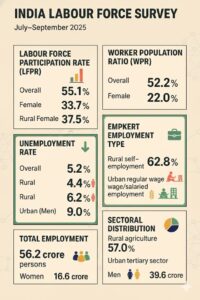
Job crisis for urban women: The data behind the headline
The PLFS gives three clear warnings for urban India:
- Demand isn’t inclusive enough. A 0.4-point rise in urban regular jobs (49.4 to 49.8%) is movement, not momentum.
- Participation without placement = frustration. With women’s LFPR inching up overall, a 9.0% urban female unemployment rate means more women are looking, not landing.
- Informality creeps where formality stalls. Rural self-employment rose to 62.8%; unless cities expand accessible salaried roles, households will default to patchwork income and exit the formal ladder.
Where policy should act (quick wins, not promises)
As employers, it is vital to reconsider the policies and make the workplace more favourable for urban women.
- Childcare as infrastructure: Co-funded creches near transit hubs and industrial/office clusters; tax credits for employers provisioning seats.
- Commute safety & cost: Extend last-mile women-only buses/vans on fixed corporate routes; pooled passes subsidised for low-income women hires.
- Flex as default: Mandate publish-and-prove flexibility (staggered hours, split-shifts, hybrid) in firms above a threshold; tie incentives to retention.
- Returnships at scale: Standardised 3–6 month paid pathways for career-break candidates, with conversion targets; disclose outcomes.
- Skills-to-salary bridges: Fast-track RPL (recognition of prior learning) for women moving from informal/home enterprise to retail, healthcare support, logistics ops, and digital services.
- Transparent hiring funnels: require quarterly gender metrics from applications through shortlisting to offers. It will ensure that bias shows up where it happens.
Sector watch: Where urban jobs for women can grow now
Let us look at some of the sectors that can offer more opportunities to urban women in India.
- Healthcare & elder-care services: Certified care coordinators, phlebotomy, clinic ops. They have steady shifts and proximate work sites.
- Logistics & dark-store ops: Picker-packer, hub desk, route planning. Women can find shift flexibility plus reliable pay.
- Retail & BFSI customer ops: Branch/desk roles with measurable conversions and safer hours.
- Ed-tech & micro-tutoring: Neighbourhood learning pods and hybrid models reduce commute friction.
- Hospitality & facilities with safeguards: Transparent rosters, safe transport clauses, and grievance redressal tied to vendor contracts.
Conclusion: Combatting the job crisis for urban women
India’s labour story cannot rely on seasonal spikes and self-employment forever. The PLFS tells us that women want to work; urban systems are making it hard for them to do so. Solve for childcare, commute, flexibility, and fair hiring. That is when the job crisis for urban women becomes the turnaround story of the following survey, not the footnote.
Changeincontent perspective
If we are serious about closing the gender jobs gap, cities must stop assuming growth trickles down to women. The PLFS shows intent, but without infrastructure, it does not move needles. Build childcare like roads, design commutes like safety nets, and treat flexibility as a right—not a perk.
Do this, and the mounting job crisis for urban women becomes a solvable design problem rather than a permanent statistic.
Disclaimer: The views expressed in this article are based on the writer’s insights, supported by data and resources available both online and offline, as applicable. Changeincontent.com is committed to promoting inclusivity across all forms of content. We broadly define inclusivity as media, policies, law, and history. It encompasses all elements that influence the lives of women and marginalised individuals. Our goal is to promote understanding and advocate for comprehensive inclusivity.