
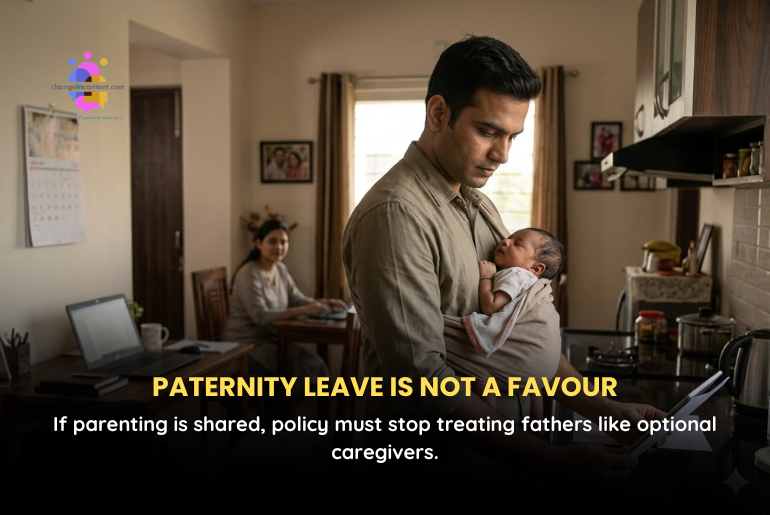
Paternity Leave in India is no longer a side conversation about workplace perks. It is now part of a larger constitutional and social question: who must care for a child, and why does the burden still fall so disproportionately on mothers?
UNICEF has noted that almost two-thirds of infants are born in countries where fathers are not legally entitled to even a single day of paid paternity leave, and India remains one of the countries without a universal national framework for it.
That gap matters. In India today, central government employees are entitled to 15 days of paid paternity leave. Still, the private sector has no mandatory law. That leaves most working fathers dependent on company policy rather than legal entitlement. Rajeev Satav introduced a private member’s Paternity Benefit Bill in the Lok Sabha in 2017. However, it did not become law.
Now, the Supreme Court has brought the issue back into national focus. While hearing a case on maternity leave for adoptive mothers, the Court urged the Union government to create a legal framework for paternity leave as a social security benefit. It made a deeper point that matters just as much. Parenting is shared work, and public policy should finally begin to treat it that way.
Why the Supreme Court wants a legal framework for paternity leave in India
The Supreme Court urged the Union Government to bring a law recognising paternity leave as a social security benefit. Moreover, the duration of such leave must be determined in a manner that is responsive to the needs of both the parent and the child.
The Court stressed that caregiving is a shared responsibility and should not fall only on mothers. It also suggested that India could adopt a structured framework, similar to existing government leave rules, to support families better.
A bench of Justices J. B. Pardiwala and R. Mahadevan stated that caregiving duties in society have been predominantly assigned to mothers, while fathers have not received equal recognition. The judges made this observation while hearing a case on maternity leave provisions for adoptive mothers. However, they extended the discussion to include the absence of paternity leave. They noted that not having such a policy continues traditional gender roles and restricts how much fathers can take part in early childcare. The bench said:
Society has historically attributed caregiving and nurturing responsibilities almost exclusively to mothers. While the role of a mother is undeniably central to a child’s emotional, physical, and psychological development, it would be incomplete and unjust to overlook the equally significant role of a father.
Equal Leave, Equal Parenting
The Court also pointed out that when fathers do get leave after the birth or adoption of a child, they can better support the mother. Moreover, they can share household responsibilities and stay emotionally involved during an important stage.
“A provision for paternity leave serves an important purpose by enabling fathers to participate meaningfully in the early stages of a child’s life and development. It helps in dismantling gendered roles, encourages fathers to take an active role in child care, fosters a balanced understanding of parenting, and promotes gender equality within family and workplace,” the Court said.
Right now, childcare is still seen as women’s work. Conversely, men stay tied to the idea of being only providers. If a father is present from day one, he is not helping the mother. He is doing his share. He learns the routine, takes responsibility, and builds a bond with the child early on. Over time, this makes caregiving look like a normal responsibility for both parents, not something that automatically falls on women.
Why normalising paternity leave in India could also reduce bias against women at work
Introducing and normalising paternity leave can also help lower the maternity penalty.
Women, particularly those of childbearing age, are frequently perceived as more likely to take extended leave or interrupt their careers. This perception contributes directly to the maternity penalty, where women face slower career progression, lower hiring preference, and reduced access to leadership roles. Men, in contrast, are typically viewed as uninterrupted participants in the workforce.
When men are equally likely to take time off following the birth or adoption of a child, the basis for treating women as higher-risk hires weakens. Employers can no longer justify biased decisions on the assumption that only women will require time away from work.
Over time, this can lead to more neutral hiring and evaluation practices. Organisations would need to assess candidates and employees based on performance and capability rather than gender-based expectations. If implemented, such a policy would require organisations to reassess long-standing biases in hiring, evaluation, and career progression, rather than continuing to rely on gendered expectations.
The changeincontent perspective
India does not only have a leave policy gap. It has an imagination gap. We still speak about mothers as natural caregivers and fathers as optional participants. And then, we act surprised when the workplace continues to punish women for caregiving and excuse men from it. That is why paternity leave matters far beyond HR policy. It changes what society expects from men, what employers assume about women, and what children grow up seeing as normal.
A meaningful law on paternity leave would not solve gender inequality on its own. But it would challenge one of its oldest foundations: the idea that care belongs to women by default. If fathers are legally enabled to be present from the beginning, caregiving stops looking like help and starts looking like responsibility. That shift can influence households, workplaces, and even hiring decisions over time.
The larger point is simple. We cannot build equal parenting on unequal policy. If India wants to talk seriously about gender equality, family well-being, and modern work, then paternity leave has to move from optional goodwill to legal recognition.
That is also where the conversation connects directly to what we have already explored in our article on the fatherhood premium and motherhood penalty at work, where the same system that rewards men for parenthood often penalises women for it.
Conclusion: Paternity leave in India is not about time off alone
As long as paternity leave remains optional or absent, the idea that parenting is mainly a mother’s responsibility will continue to be the default thought. A law on paternity leave would not just give fathers time off. It would reset expectations, where involvement from both parents becomes normal from the start. That shift is what can slowly move society away from fixed gender roles and toward a more balanced understanding of family and responsibility.
Disclaimer: The views expressed in this article are based on the writer’s insights, supported by data and resources available both online and offline, as applicable. Changeincontent.com is committed to promoting inclusivity across all forms of content. We broadly define inclusivity in terms of media, policies, law, and history. It encompasses all elements that influence the lives of women and marginalised individuals. Our goal is to promote understanding and advocate for comprehensive inclusivity.
