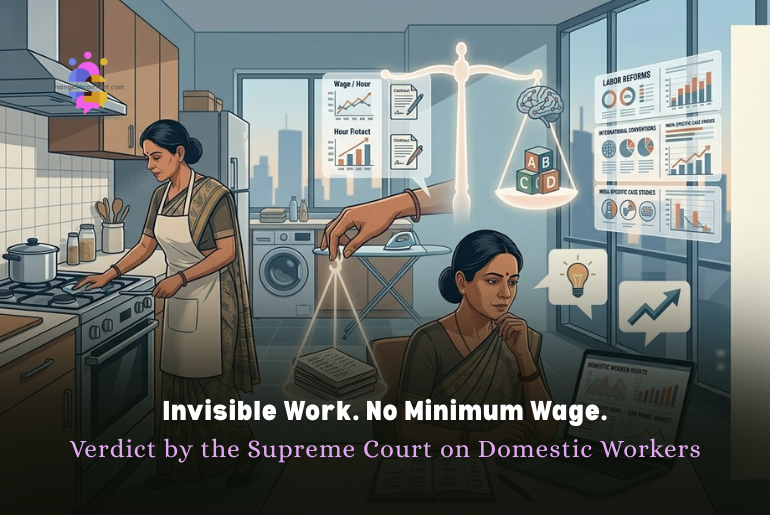
The recent position of the judiciary on the issue of domestic labour has once again brought the spotlight to an often-overlooked workforce. The verdict by the Supreme Court on Domestic Workers has sparked a debate. The SC has declined to intervene in a Public Interest Litigation seeking the inclusion of domestic workers in minimum wage notifications, citing structural and legal complexities.
At the heart of the petition was a simple demand. Domestic workers, who form a significant part of India’s informal workforce, should be guaranteed minimum wages under existing labour frameworks. The plea argued that the absence of such recognition leaves millions vulnerable to exploitation, wage instability, and a lack of dignity at work.
The Court, however, chose not to direct such inclusion through judicial mandate. Instead, it pointed to the layered nature of domestic work, the federal structure of labour laws, and the practical challenges of implementing wage regulation in private households.
This decision has triggered a deeper conversation. Not just about wages, but about how India recognises, regulates, and values domestic labour.
Supreme Court on Domestic Workers: What the petition sought
The Public Interest Litigation sought the inclusion of domestic workers under minimum wage notifications issued by states under the Minimum Wages Act.
Domestic workers in India include:
- House helps
- Caregivers
- Cooks
- Drivers
- Live-in workers
Despite the scale of this workforce, domestic work largely operates within the informal sector, often without formal contracts, fixed wages, or legal safeguards.
The petition argued that excluding domestic workers from minimum wage protections creates a structural imbalance where one of the most labour-intensive roles remains economically undervalued.
The reasoning of the Supreme Court
The Court’s refusal to intervene was not a dismissal of the issue, but rather a reflection of its complexity.
According to legal analysis and reporting, the Court highlighted several key concerns:
- Domestic work takes place within private households, making regulation difficult.
- Labour falls under the concurrent list, meaning both state and central governments share jurisdiction.
- Wage structures vary significantly depending on geography, role, and arrangement.
The Court indicated that such matters may be better addressed through policy frameworks rather than judicial directives.
In essence, the judiciary acknowledged the issue but stopped short of prescribing a uniform legal solution.
The legal and policy gap
India currently lacks a comprehensive national law governing domestic workers. While some states have attempted to include domestic workers under minimum wage schedules partially, enforcement remains inconsistent.
Globally, the International Labour Organisation (ILO) Convention 189 recognises domestic workers as workers entitled to labour rights, including fair wages and social protection. India, however, has not ratified this convention.
The absence of a unified framework leaves domestic workers dependent on informal agreements, often shaped by employer discretion rather than legal protection.
The argument for minimum wages
Advocates of including a minimum wage argue that domestic workers are among the most economically vulnerable segments of the workforce.
Many work long hours without:
- Written contracts
- Defined working conditions
- Social security benefits
Wages often depend on negotiation rather than standardisation. Supporters believe that formal wage recognition would:
- Provide income stability
- Reduce exploitation
- Acknowledge domestic work as legitimate labour
- Improve working conditions
For many, this is not just a policy issue. It is a matter of dignity.
The Counterargument: Regulation vs Reality
Critics of mandatory wage regulation raise practical concerns. Unlike factories or offices, domestic work happens in private homes, making enforcement challenging. Monitoring compliance could raise questions around privacy and administrative feasibility.
There is also concern that rigid wage structures could:
- Reduce employment opportunities
- Push arrangements further into informality
- Increase costs for middle-income households
These arguments suggest that policy solutions must carefully balance worker rights with implementation realities.
The invisible workforce behind Urban India
Domestic workers play a critical role in enabling urban economies. They enable households to function efficiently, support dual-income families, and indirectly contribute to productivity across sectors. Yet their work remains largely invisible in economic discourse.
According to estimates, India has over 50 million domestic workers. Many of them are women, migrants, and individuals from marginalised communities. This invisibility often translates into policy neglect.
Where India stands today
India’s approach to domestic labour remains fragmented. Some states have introduced welfare boards or minimum wage schedules, but implementation varies widely.
There is no unified national framework ensuring:
- Standard wages
- Social security
- Legal protection
At Changeincontent, we have previously examined the broader gaps in legal protection for domestic workers in India.
The absence of a consistent policy leaves domestic workers navigating a system that offers limited protection.
Supreme Court on Domestic Workers: The Changeincontent Perspective
The Supreme Court’s position reflects a broader truth. Some issues cannot be resolved through judicial intervention alone. Domestic labour sits at the intersection of Economics, Culture, Policy, and Household dynamics.
While the Court has chosen not to mandate minimum wages, the responsibility now shifts to policymakers, institutions, and society. The conversation must move beyond legality. It must address how we value labour that sustains everyday life.
Conclusion: The work that sustains us, the Rights we deny
Domestic workers remain one of the most essential yet least protected segments of the workforce. The ruling by the Supreme Court on Domestic Workers has chosen caution over intervention. But the absence of a legal directive does not erase the issue. It amplifies it.
If millions of workers continue to operate without wage security, social protection, or formal recognition, the question is no longer whether reform is needed. It is how long we can afford to delay it.
Disclaimer: The views expressed in this article are based on the writer’s insights, supported by data and resources available both online and offline, as applicable. Changeincontent.com is committed to promoting inclusivity across all forms of content. We broadly define inclusivity in terms of media, policies, law, and history. It encompasses all elements that influence the lives of women and marginalised individuals. Our goal is to promote understanding and advocate for comprehensive inclusivity.