
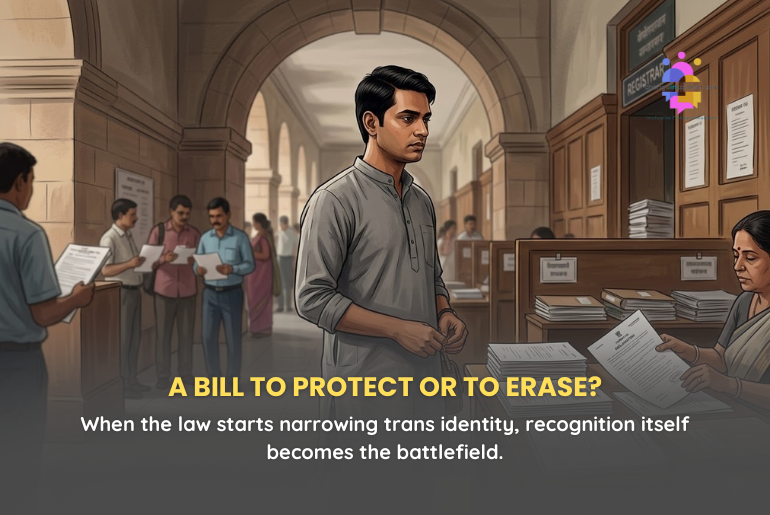
The Transgender Persons Amendment Bill (Right to Protection Bill) is being presented as a legal amendment. However, for many transgender Indians, it feels like something far more fundamental is at stake. At the centre of the backlash is a simple but urgent question: when the law starts narrowing definitions, deleting self-identification, and inserting medical scrutiny into identity recognition, is it still protecting rights, or is it beginning to take them away?
That concern is not abstract. The 2019 law recognised transgender persons broadly as those whose gender does not match the gender assigned at birth. Furthermore, the bill explicitly includes trans-men, trans-women, genderqueer persons, intersex persons, and socio-cultural identities such as hijra, kinner, aravani, and jogta.
The 2026 amendment bill proposes major changes to that framework. It drops trans-man, trans-woman, and genderqueer from the definition. At the same time, it omits the statutory right to self-perceived gender identity. It also ties the issuance of a certificate of identity to the recommendation of an authority led by medical officials.
That is why this debate has moved so quickly beyond technical lawmaking. Across cities, activists and community groups are arguing that the bill does not simply amend procedure. It redraws the boundaries of recognition itself and risks placing trans identity under bureaucratic and medical gatekeeping.
How the Transgender Persons Amendment Bill redefines who counts under the law
The Transgender Persons (Protection of Rights) Amendment Bill, 2026, was introduced in the Lok Sabha on March 13, 2026. The Bill seeks to amend the Transgender Persons (Protection of Rights) Act, 2019.
What disappears from the 2019 definition
The 2019 Bill defined a transgender person as one whose gender does not match the gender assigned at birth. It includes trans-men and trans-women, persons with intersex variations, gender-queers, and persons with socio-cultural identities, such as kinnar and hijra. However, the amendment removes this definition. Instead, it lists categories of people who can receive inclusion.
The Bill also states that it will not include or will never have included persons with different sexual orientations and self-perceived sexual identities.
Why deleting self-identification changes the entire framework
The Bill removes the following categories included in the Act:
- A trans-man or trans-woman, irrespective of whether such a person has undergone sex reassignment surgery, hormone therapy, laser therapy, or such other therapy
- Gender queer.
This directly impacts trans men and anyone assigned female at birth (AFAB) who is gender-diverse, as they no longer find clear recognition under the law. Furthermore, the Bill completely deletes Section 4(2), which guarantees the right to self-perceived gender identity.
Why the Transgender Persons Amendment Bill makes identity recognition more conditional
Under the Act, a transgender person may apply to the District Magistrate for issuing a certificate of identity as a transgender person.
From self-declaration to medical scrutiny
The Bill adds that the District Magistrate will issue the certificate after examining the recommendation of a designated medical board. A Chief Medical Officer or a Deputy Chief Medical Officer will head the board. The District Magistrate may also take the assistance of other medical experts. The Bill adds that transgender persons will be entitled to change the first name on their birth certificate and other official documents based on the certificate of identity.
Why certificate access can become a site of exclusion
Not all transgender persons seek medical intervention, yet the Bill requires evaluation by a board led by medical officials. This not only medicalises identity but also creates additional barriers, such as longer procedures, possible delays, and the risk of bias in decision-making. It places transgender individuals in a position where they must justify their identity to a panel, which can be very intrusive.
How the Bill narrows trans identity to approved categories and communities
The Transgender Persons (Protection of Rights) Amendment Bill, 2026 continues to recognise certain groups, including people with socio-cultural identities such as hijra, kinner, aravani, and jogta, as well as those born with variations in sex characteristics like chromosomes, hormones, or genitalia.
But the way it frames this recognition raises concerns. By focusing on these specific socio-cultural identities, the Bill hints that a person may need to belong to established communities or gharanas to be recognised as transgender. This narrows identity to tradition and group belonging, rather than acknowledging that it is something individuals can define for themselves.
Why the Transgender Persons Amendment Bill is facing national pushback
Groups like Mumbai Queer Pride have called the Bill a “regressive step” that weakens constitutional protections and rolls back progress on inclusion. At the same time, a newly formed coalition, Reject Trans Bill 2026, has brought together activists, lawyers, and professionals to condemn the proposed changes collectively.
In Bengaluru, members of the transgender community came together under the Karnataka State Gender and Sexuality Minorities Coalition to publicly oppose the Bill. They even wrote an open letter to PM Narendra Modi. In their letter, they warned that the amendment could put the rights of millions of currently recognised transgender persons at risk. They argue that instead of expanding rights, the Bill actively reduces them.
Protests, student gatherings, and public meetings have taken place in cities demanding that the government withdraw the Bill and protect the right to self-identification. Civil society groups have started campaigns, planned outreach efforts, and organised support meetings to build resistance. There is a public petition demanding the withdrawal of the Bill. It is already surpassing 13,000 signatures in just days.
Why is consultation after the introduction not enough
At a press conference held at the Indian Women’s Press Corps, activists, lawyers, and members of the transgender community called the amendments ‘discriminatory and unjust.’ They argue that the government is taking away rights that already have recognition. They also say that this is not how a democracy should function.
The Changeincontent Perspective
This bill deserves scrutiny, not because the law should never evolve, but because rights-based law cannot move backwards while claiming to offer clarity. The most troubling part of the proposed amendment is not only that it changes language. It appears to change the source of legitimacy itself. Earlier, the law at least recognised self-perceived gender identity as a legal principle. Now, the amendment seems to move toward a system in which identity becomes something to be examined, filtered, and validated through institutions. That is a profound shift.
The State can regulate procedures. It cannot ethically reduce a person’s identity to a category it finds administratively convenient. If a law excludes trans men, removes genderqueer recognition, weakens self-identification, and requires medical gatekeeping, then criticism that it risks identity erasure is not rhetorical excess. It is a serious democratic warning.
A better path is not difficult to imagine. Keep self-identification central. Expand legal clarity without shrinking who is recognised. Consult trans communities before drafting, not after backlash. And stop treating administrative neatness as more important than dignity, autonomy, and constitutional equality. Policies made for a community without that community’s substantive participation rarely protect them. They usually manage them.
Conclusion: When the state starts verifying identity, rights start shrinking
Who gets to decide identity? The individual, or the State? When a law begins to filter, verify, and restrict something as personal as gender, it also removes the right to dignity, autonomy, and the right to exist on one’s own terms. If identity today can be restricted, tomorrow it can be erased.
Maybe this is also what we need to start asking more seriously. When laws are made for a particular community, shouldn’t that community have a real say in shaping them? Not just token consultation, but actual input before you finalise the decisions. Because policies about people, without people, rarely protect them.
Disclaimer: The views expressed in this article are based on the writer’s insights, supported by data and resources available both online and offline, as applicable. Changeincontent.com is committed to promoting inclusivity across all forms of content. We broadly define inclusivity in terms of media, policies, law, and history. It encompasses all elements that influence the lives of women and marginalised individuals. Our goal is to promote understanding and advocate for comprehensive inclusivity.
