The Quick Read
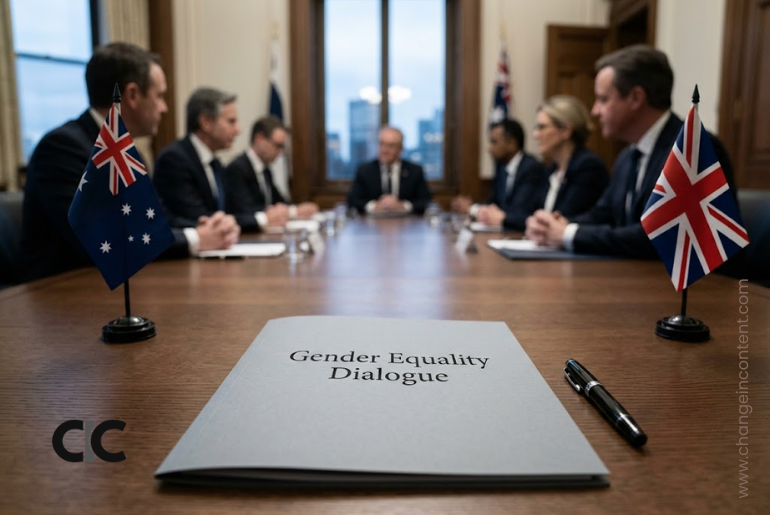
- Australia and the UK released a joint statement after the third Australia–UK Strategic Dialogue on Gender Equality, held on 4 May 2026.
- The two governments said gender equality needs practical and coordinated international action.
- The dialogue focused on UN gender mandates, sexual and reproductive health and rights, gender-based violence, Women, Peace and Security, women’s rights organisations, and climate finance.
- Both countries also linked gender equality with peace, stability, economic resilience and sustainable development.
Australia–UK Strategic Dialogue on Gender Equality
Australia and the United Kingdom have called for stronger international cooperation on gender equality, following the third Australia–UK Strategic Dialogue on Gender Equality.
In a joint statement released by Australia’s Department of Foreign Affairs and Trade on 8 July 2026, the two governments said they would continue to work together across regional and multilateral forums to protect gender equality, human rights and democratic values. The dialogue was held on 4 May 2026.
The statement comes at a time when gender equality is increasingly being discussed as a foreign policy, development and security issue. For Change in Content, that shift is important. Gender equality is no longer limited to domestic welfare or workplace inclusion. It is now part of how countries frame peace, economic resilience, climate action and democratic strength.
What Australia and the UK agreed on
Australia and the UK said they would safeguard and strengthen gender equality, including through the protection of United Nations mandates on gender equality, women’s empowerment, and sexual and reproductive health and rights. They also backed multilateral reform under the UN80 agenda, while stressing that reform should reinforce progress towards the Sustainable Development Goals.
The two countries also reaffirmed their commitment to sexual and reproductive health and rights. They said they would deepen coordination on advocacy and engagement across multilateral and regional forums.
A major part of the statement focused on gender-based violence. Australia and the UK said they remained committed to ending all forms of gender-based violence, including technology-facilitated gender-based violence. They also recognised that digital forms of abuse can affect social cohesion, stability and national security.
It is a useful signal for governments and workplaces. Online abuse is often treated as an individual safety issue. The Australia–UK statement puts it within a broader policy framework. Technology-facilitated harm can affect participation, leadership, public life and women’s ability to speak without fear.
Women, Peace and Security remains central
The two governments also reaffirmed support for the Women, Peace and Security agenda. They described it as a cornerstone of their foreign and defence policies and called for stronger implementation and accountability.
It is significant because Women, Peace and Security is often praised in principle but unevenly applied in practice. The agenda calls for women’s participation in peacebuilding, conflict prevention, security decisions and post-conflict recovery. Stronger accountability will be the real test.
The statement also recognised the role of women’s rights organisations and women’s funds. Australia and the UK said they would scale up and better coordinate support for these groups, including through more sustainable financing and innovative or blended finance approaches.
That point deserves attention. Women’s rights organisations often do the hardest ground-level work. They respond to violence, defend rights, support communities and help shape local solutions. Yet many operate with fragile funding. Longer-term financing can make a real difference.
Gender equality and climate finance
The dialogue also linked gender equality with climate resilience and inclusive growth.
Australia and the UK said they would deepen collaboration on gender-responsive climate finance and integrate gender equality across climate and development investments. They also said multilateral development banks should deliver quality gender equality outcomes.
It aligns with a broader global understanding that climate change affects women and girls in specific ways, especially in communities where women shoulder greater responsibility for care, food, water, health, and local livelihoods. A gender-responsive climate finance approach can help ensure that women are seen as decision-makers, workers, farmers, entrepreneurs and leaders in climate adaptation.
For business and policy audiences, this is where the dialogue becomes relevant beyond the realm of diplomacy. Gender equality is being tied to investment design, institutional accountability and long-term resilience. It is not only a social marker. It is becoming part of how development quality is judged.
The Change in Content View
The 2026 Australia–UK Strategic Dialogue on Gender Equality is a policy signal worth watching.
It shows that gender equality is being framed through a wider lens: rights, security, digital safety, climate finance, multilateral reform and economic resilience. That is the direction serious policy conversations are taking.
The real measure will be follow-through. Joint statements are useful when they lead to funding, accountability and stronger systems. For women and girls, progress will depend on whether these commitments reach the organisations, communities and institutions that carry the work on the ground.
Editorial Note and Source
This article is based on the official joint statement released by Australia’s Department of Foreign Affairs and Trade after the third Australia–United Kingdom Strategic Dialogue on Gender Equality. We have written it as a bureau-style policy update from the Change in Content desk. This article is for informational and editorial purposes only and should not be read as legal, diplomatic or policy advice.
Source used: Australian Government Department of Foreign Affairs and Trade: 2026 Australia–United Kingdom Strategic Dialogue on Gender Equality