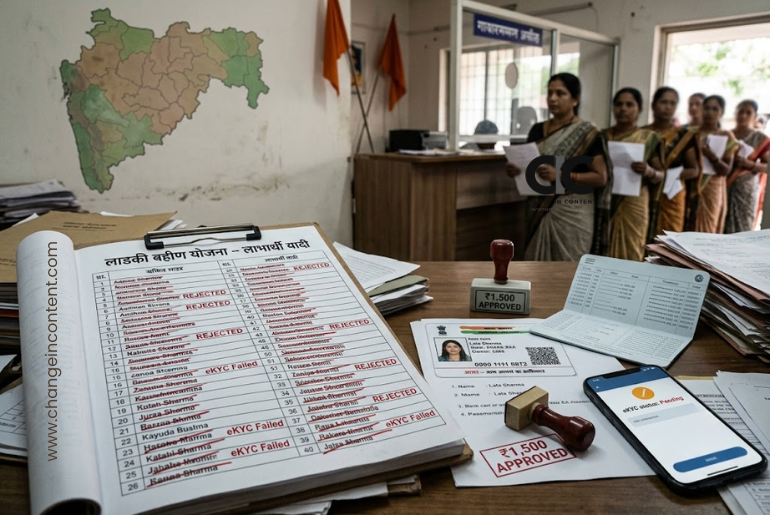
The Quick Read
- Maharashtra’s Ladki Bahin Scheme gives eligible women aged 21 to 65 a monthly benefit of ₹1,500 through Direct Benefit Transfer. The official scheme portal describes it as support for eligible women in the state.
- Recent reports say over 92 lakh names have been removed from the beneficiary list after verification, with failed eKYC reportedly accounting for nearly 62 lakh exclusions. At the time of writing, Change in Content could not find a public government release confirming the full figure of 92 lakh.
- The CAG’s State Finances Audit Report 2024-25 states that the scheme was approved on 28 June 2024 and had total available grants of ₹29,693.09 crore. Still, expenditure reached ₹33,237.24 crore, resulting in an excess of ₹3,541.16 crore, with no specific justification from the department.
- The same CAG chapter also says that ₹15,586 crore drawn between January and March 2025 was transferred to a Virtual Personal Deposit Account, indicating that the funds were drawn without immediate expenditure needs.
- The story now has two worrying possibilities: either public money went to many ineligible recipients, or genuine women were excluded because of digital and documentation barriers. Both demand answers.
Ladki Bahin Scheme now has a verification storm
The Ladki Bahin Scheme was intended to provide direct support to women. Cash in the bank. A little more control, a monthly cushion, and a signal that women’s economic needs deserve policy attention.
Now the same scheme is facing a serious credibility test.
Recent reports say more than 92 lakh names have been removed from the beneficiary list after verification. That is nearly 4 in every 10 names, if the earlier beneficiary base is taken as the reference point. The biggest reported reason is failed eKYC. Nearly 62 lakh recipients reportedly did not complete the mandatory electronic verification.
That number is too large to pass quietly. It raises an uncomfortable question.
Were lakhs of ineligible people receiving money meant for women who needed it? Or did lakhs of genuine women lose access due to digital barriers, weak verification design, poor communication, or documentation gaps?
The answer matters not only for Maharashtra. For every state, now building cash-transfer schemes around women.
The Ladki Bahin Scheme was built on a powerful promise
The official Ladki Bahin portal says eligible women in Maharashtra between the ages of 21 and 65 receive ₹1,500 per month through Direct Benefit Transfer.
The CAG’s State Finances Audit Report 2024-25 says the scheme was approved on 28 June 2024 to support women’s economic independence, improve health and nutrition, and strengthen their decisive role within the family. The Women and Child Development Department implemented it. And that objective is important.
Cash schemes for women can work as recognition. They can support household expenses. Furthermore, they can improve women’s bargaining power. And they can help women pay for mobility, nutrition, health care, education, or emergencies.
Change in Content has earlier written about cash schemes for women in India and why they are becoming central to state-level welfare politics. These schemes are no longer small policy experiments. They are large, expensive and politically powerful. And that is exactly why accuracy matters.
A scheme of this scale cannot afford casual estimates of beneficiaries. It cannot afford weak financial controls. And it cannot afford digital systems that quietly drop the women it claims to support.
The ₹14,000 crore question
Reports say officials estimate that beneficiaries later removed from the scheme had already received around ₹14,000 crore before payments were stopped.
This figure needs official clarity.
If ineligible recipients received that amount, then public money meant for eligible women was diluted. That would be a serious governance failure.
If the removed names include genuine women who failed eKYC, then the story becomes just as troubling. A woman may be eligible on paper and still fail in the digital system. She may not have a working phone. She may not understand the process. Her Aadhaar may not match. Her bank account may have issues. She may depend on a family member or local agent to complete verification. In that case, exclusion is not fraud control. It becomes digital gatekeeping.
It is not a theoretical concern. At Change in Content, we had raised similar questions earlier in our story on the Ladki Bahin Scheme and the digital divide. When welfare schemes move online, the women most in need of support can also be the ones most likely to struggle with access.
A cash-transfer scheme for women must be strict. It must also be humane.
CAG had already raised red flags
The verification controversy is unfolding against the backdrop of sharper audits.
The CAG report says the Women and Child Development Department incurred ₹33,237.24 crore against a total available grant of ₹29,693.09 crore. That resulted in excess expenditure of ₹3,541.16 crore. The report says the department did not provide any specific justification for this excess expenditure.
The same chapter says a test check of vouchers above ₹1,000 crore showed that ₹15,586 crore drawn between January and March 2025 was transferred to the Drawing and Disbursing Officer’s Virtual Personal Deposit Account. The CAG observed that this indicated funds were not required for immediate utilisation. Moreover, they were drawn without actual expenditure needs, contrary to budgetary discipline and financial propriety.
That is not a minor audit comment. It points to weak budget estimation, weak expenditure control and weak financial management around one of Maharashtra’s most visible welfare schemes.
The issue, then, is not only who was removed. The issue is how the scheme was planned, funded, verified and monitored.
What if the removals are correct?
Let us examine the first possibility.
Suppose the removals are correct, and many names were ineligible. Suppose some recipients crossed the income ceiling, while some were government employees. And suppose some were already receiving benefits from other schemes. Let us also suppose some were above the age limit. And consider that some were even men, as several reports have claimed.
Then the questions are more direct.
- How did they enter the beneficiary list?
- Who verified the applications at the first stage?
- What data was checked?
- Which department had responsibility?
- Were local-level processes rushed? Was enrolment expanded before the system was ready?
- Were political timelines more important than administrative checks?
If money was paid for months before verification caught the problem, then the damage had already been done.
Welfare leakage is not only a fiscal issue. It creates public anger against welfare itself. It allows critics to dismiss women’s cash transfers as wasteful, even when eligible women genuinely need them.
Bad implementation hurts good policy.
What if genuine women were removed?
Now consider the second possibility.
Suppose many removed names belong to women who were eligible but failed eKYC or documentation requirements. That would expose a different failure.
Digital verification often looks clean from a dashboard. On the ground, it can be messy. Rural women, older women, women with limited phone access, women with bank-Aadhaar mismatch, women dependent on others for paperwork, women in difficult households, widows, deserted women and women with low digital literacy may struggle to complete eKYC on time.
If they are cut off without enough assistance, grievance redressal and appeal, the scheme risks punishing the women it was built to support.
Change in Content also wrote about the Ladki Bahin Scheme blunder, in which implementation issues showed how women-centric schemes can become stressful when systems do not match women’s realities.
A scheme cannot call women “beneficiaries” and then make access so difficult that they need brokers, sons, husbands or cybercafes to remain eligible.
The accountability test
The authorities and representatives now need to answer basic questions in public.
- How many names were removed in total?
- How many failed eKYC?
- How many were found ineligible?
- How many were duplicates?
- How many were men?
- How many were government employees or income tax-linked cases?
- How many appeals have been filed?
- How many women have been restored after correction?
- How much money went to ineligible recipients?
- Will any recovery be attempted?
- What happens to women who missed eKYC but are otherwise eligible?
These questions are not partisan. They are administrative.
Women’s welfare cannot run on press claims, political counterclaims and confused beneficiary lists. The state must publish clear numbers, district-wise data, exclusion categories and a simple appeal process.
A woman who has been wrongly removed should not need influence to return to the list.
The political danger of women’s cash schemes
Women-focused cash schemes have become politically attractive across states.
They are easy to communicate. They reach households directly. More importantly, they create immediate visibility. They also speak to a real need: women have too little control over money. But these schemes carry risk when they are rushed, under-verified or poorly integrated with digital systems.
- If too many ineligible people enter, the scheme becomes fiscally weak.
- If too many eligible women are excluded, the scheme becomes unjust.
- If the beneficiary list changes sharply after elections, trust suffers.
- If audit concerns are not addressed, the promise of women’s empowerment gets pulled into a larger governance controversy.
That is why cash schemes for women need more than good intent. They need accurate data, simple access, strong grievance redressal, financial discipline and public transparency.
The Change in Content view on the Ladki Bahin Scheme controversy
The Ladki Bahin Yojana controversy is not only about 92 lakh reported deletions. It is about trust.
If ineligible people received money, women lost. And if genuine women were removed because of eKYC failure, women lost again. At the same time, if audit concerns are ignored, taxpayers lose. And if political noise replaces clear data, public policy loses.
Women’s welfare schemes must be generous in purpose and strict in execution. They must protect public money without shutting out the women who need support most.
Maharashtra now has to show that the Ladki Bahin Scheme is not only a powerful promise. It must also be a clean, transparent and accountable system.
FAQs
Q: What is the Ladki Bahin Scheme?
A: The Ladki Bahin Scheme is a Maharashtra government cash-transfer scheme for eligible women aged 21 to 65. The official scheme portal says eligible women receive ₹1,500 per month through Direct Benefit Transfer.
Q: Why were names reportedly removed from the Ladki Bahin Yojana?
A: Recent reports say names were removed after a verification exercise. Failed eKYC is reported as the most common reason, while other reasons include eligibility issues. At the time of writing, Change in Content could not find a public government release confirming the full deletion figure of 92 lakh.
Q: What did the CAG say about the Ladki Bahin Yojana?
The CAG’s State Finances Audit Report 2024-25 said the Women and Child Development Department spent ₹33,237.24 crore against available grants of ₹29,693.09 crore, causing excess expenditure of ₹3,541.16 crore without specific justification.
Q: Why is eKYC a concern in women’s welfare schemes?
A: eKYC can help remove ineligible names and improve transparency. But if digital access, documentation, Aadhaar-bank linkage or local support is weak, genuine women may be excluded from benefits.
Editorial Note and Sources
This article is based on official information from the Ladki Bahin scheme portal and the CAG State Finance Audit Report 2024-25. The reported figure of over 92 lakh deletions and the estimated ₹14,000 crore paid to later-removed beneficiaries are treated as reported developments because Change in Content could not find a public government release confirming the full figure at the time of writing. The article takes an editorial and accountability-focused view without alleging wrongdoing by any individual. It is intended for informational and editorial purposes only and should not be read as legal, political, audit or welfare-eligibility advice.
Sources used:
- Government of Maharashtra: Mukhyamantri Majhi Ladki Bahin Scheme Official Portal
- Comptroller and Auditor General of India: State Finances Audit Report 2024-25, Maharashtra, Chapter II: Budgetary Management