
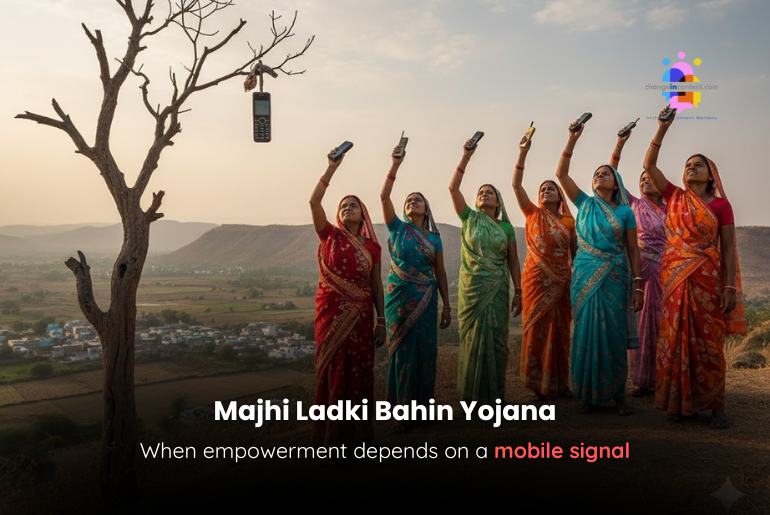
The Maharashtra government’s Mukhyamantri Majhi Ladki Bahin Yojana provides ₹1,500 per month to eligible women through direct benefit transfer (DBT). Implemented by the Women and Child Development Department, the scheme offers financial support to women aged 21 to 65. Beneficiaries must complete an e-KYC verification since the scheme operates through state-mandated digital processes.
We’re living in an undeniable digital world now. Everything is online, right there at the tip of your fingers, provided, naturally, that you have a decent smartphone and a data plan. But the problem is also right there. While we discuss digital progress, hundreds of women are still struggling with the e-KYC process just to receive their monthly Ladki Bahin Yojana payment.
Digital access still out of reach for rural women
In Kharde Khurd village of Dhadgaon taluka, obtaining an internet connection or a decent mobile signal is almost a daily challenge. It is not a click away but a 30-minute uphill walk. Every day, women make this journey just to catch a faint mobile signal. Once they reach the spot, a single phone is tied to a tree, becoming the village’s makeshift “tower.” Dozens wait nearby, watching for the signal to appear. Often, the network that finally connects comes from Gujarat or Madhya Pradesh.
Around 500 women from the Bhamane group gram panchayat and Kharde Khurd depend on this one spot. The chances of success stay below 5%. Websites take minutes to load, OTPs arrive late, and the Aadhaar-linked e-KYC process fails repeatedly. Out of a hundred women who attempt it, only 5 or 10 manage to complete the process.
Only verified beneficiaries are eligible to receive the ₹1,500 monthly payment. To complete the e-KYC, many women spend about ₹300 on travel to a nearby town with a better signal. For most, that means losing a day’s wages just to secure what is intended to be a welfare benefit.
It shows that, for many women in rural India, access to a government scheme depends on weather, terrain, and luck with the network. A system meant to empower ends up testing their patience, their time, and their wallets.
Mobile ownership gap among rural women
In May 2025, the National Statistical Office (NSO), under the Ministry of Statistics and Programme Implementation (MoSPI), released the Comprehensive Modular Survey: Telecom, 2025 (CMS-T). The survey, part of the 80th round of the National Sample Survey (NSS), was conducted between January and March 2025, covering 34,950 households in 4,382 villages and urban blocks, with data from 1,42,065 individuals.
The survey highlights a serious digital gap for women in rural areas. More than half of rural women aged 15 and above (51.6%) do not own a mobile phone, which limits their access to online services, information, and government schemes. Among young people aged 15–24, in rural areas, 74.8% of men own mobile phones, compared with only 51.7% of women. Even in urban areas, where overall access is higher, only 69.5% of women own a phone, compared with 82.7% of men.
Ensuring rural women don’t miss out on schemes like Majhi Ladki Bahin Yojana
The digital divide is still heavily gendered, particularly in rural India. Women face not only limited access to devices but also challenges in digital literacy, connectivity, and affordability. Without targeted policies to address these barriers, rural women risk being left behind in an increasingly digital world.
How many government schemes have rural women been unable to access simply because they did not own a mobile phone or lacked connectivity? From cash transfers to health and education programs, countless benefits may have never reached those who needed them most. Looking ahead, e-KYC is likely to become the standard for accessing services, which makes addressing the digital gap even more important.
Until there is improvement in rural network connectivity, there must be mandatory non-digital alternatives. For every digital step (like e-KYC), there should be a seamless and equally efficient non-digital alternative (e.g., dedicated camps, doorstep verification). We must ensure this until we achieve genuine, complete digital access. This ensures that essential benefits are not tied solely to technology.
Majhi Ladki Bahin Yojana: Bridging the digital divide before calling it empowerment
The government has announced an extension of the OTP verification deadline, acknowledging the technological issues that many users faced. Perhaps they’ll fix the glitches, add more server capacity, and even extend the 15-day deadline to 20 days or even a month. But what about fixing the actual connection problem? In 2025, some are still walking miles just to find a signal strong enough to upload a form. Extending deadlines won’t change that.
The fundamental issue is the serious digital divide that prevents many women, especially in rural areas, from accessing digital services in the first place. Therefore, the critical focus must shift from temporary deadline extensions to long-term solutions.
If we genuinely want digital schemes to be effective, we need to improve network coverage in rural areas, provide affordable smartphones, and implement digital literacy programs. Otherwise, each “technical glitch” will continue to remind us that technology is not reaching everyone equally.
Changeincontent perspective
At Changeincontent, we believe inclusion is not achieved when technology is available; it is achieved when access is equal.
The Majhi Ladki Bahin Yojana reflects a growing paradox in India’s welfare model: digital by design, unequal by default. For rural women, empowerment cannot begin with a smartphone they do not own.
More than half of India’s rural women still lack personal mobile phones. Connectivity, affordability, and literacy remain intertwined barriers. Until these are addressed, digital empowerment will stay a privilege, not a right.
Schemes meant to uplift women should not penalise them for living beyond the network range. Real progress lies in hybrid systems where digital innovation coexists with physical access. Every time a woman climbs a hill to find a signal, we are reminded that policy without infrastructure is just a good intention.
Also Read: 14,000 Men, Rs 21 Crore Lost: The blunder that haunts Ladki Bahin Yojana.
Disclaimer: The views expressed in this article are based on the writer’s insights, supported by data and resources available both online and offline, as applicable. Changeincontent.com is committed to promoting inclusivity across all forms of content. We broadly define inclusivity as media, policies, law, and history. It encompasses all elements that influence the lives of women and marginalised individuals. Our goal is to promote understanding and advocate for comprehensive inclusivity.
