
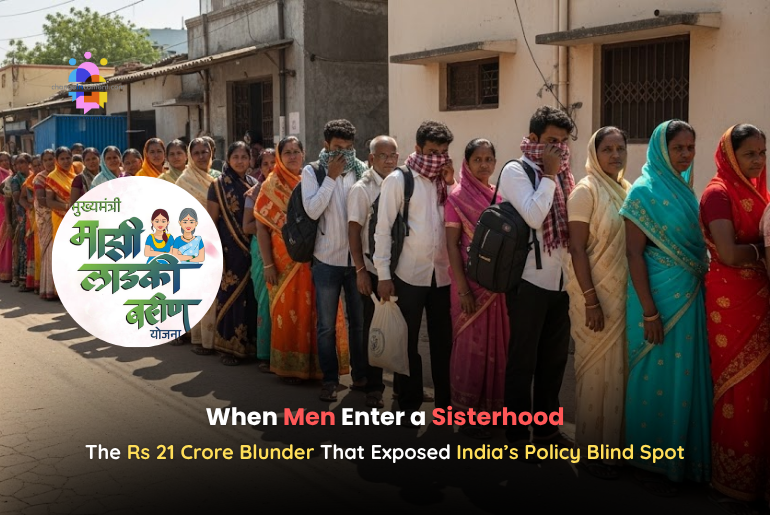
The Ladki Bahin Yojana was launched as a landmark welfare scheme for women in Maharashtra. The scheme promises a direct monthly cash support of Rs 1,500 to those in low-income households. Designed to improve health, nutrition, and financial security for women aged 21 to 65, it was not just a policy. Instead, it was a political triumph for the Mahayuti coalition that helped sweep them into power.
But within a year, that very promise is unravelling. A staggering 14,298 men managed to sneak into the program’s beneficiary list, claiming funds meant solely for women. That alone accounts for Rs 21.44 crore lost from the state’s coffers. The bigger shock? These men are only a sliver of the 2.634 million ineligible beneficiaries flagged under the scheme. That adds up to an astonishing Rs 1,640 crore in misallocated funds.
The numbers that should stop us in our tracks
Let us start with the bare facts. There was an allocation of Rs 3,700 crore for 24.1 million women. Each eligible woman would receive Rs 1,500 per month. The scheme was meant to be straightforward: online registration, Aadhaar-linked verification, and direct transfer to bank accounts. What could possibly go wrong?
Apparently, a lot. In the latest scrutiny by the Department of Women and Child Development, over 2.6 million beneficiaries have been found ineligible:
- 14,298 men enrolled, causing a loss of Rs 21.44 crore.
- 162,000 women from four-wheeler owning families.
- 287,000 women above the 65-year age limit.
797,000 cases where more than two women from one family signed up, violating the policy cap.
These instances collectively account for over Rs 1,640 crore in wasted resources. The Government has now stopped payments to these accounts, but only after almost a year of disbursals. The actual cost of this lapse is not just financial; it is also institutional.
How did 14,000 men enter a sisterhood?
The answer is painfully bureaucratic: identity misrepresentation during online registration. In the absence of physical verification, Aadhaar mismatches and digital manipulation allowed men to enrol. Most forms were filled out online, skipping a ground-level scrutiny step that could have prevented such fraud. It was a loophole waiting to be exploited, and it was.
The scheme relied heavily on digital systems, assuming that gender and income declarations online would be authentic. In theory, Aadhaar and PAN verification should have flagged these anomalies. In practice, the lack of integration across databases left gaping holes. Officials now admit this. They have initiated cross-verification with the Income Tax Department, and district collectors have been asked to conduct physical reviews.
From welfare to whiplash: When intent meets poor execution
No one is doubting the intent behind the Ladki Bahin Yojana. The idea of providing unconditional cash transfers to women is bold, progressive, and necessary. But when the system fails to differentiate between a man and a woman on paper, the entire credibility of welfare governance is compromised.
What makes this worse is that these were not isolated incidents. The systemic nature of the fraud, involving millions of ineligible beneficiaries, indicates deeper governance failures. It suggests a lack of data integration, minimal interdepartmental coordination, and an over-reliance on digital declarations without audit.
And then there is the human cost. Every rupee lost to an ineligible recipient is a rupee denied to a woman who may have genuinely needed it. The government has taken the first corrective step, identifying and blocking payments. That is not ignorance, but recognition. But that alone is not reform.
The larger conversation: Gender, governance, and the digital illusion
In a country where women’s participation in the formal economy remains dismally low, schemes like Ladki Bahin Yojana carry massive weight. They are not just welfare tools, but mechanisms to bridge centuries of exclusion. Yet, when over 2.6 million fake claims go through, it tells us that good policy is not enough. Execution is everything.
The digital push for governance is often touted as corruption-proof. But here, it became the blind spot. If men can digitally pose as sisters, it is not a tech failure; it is a design failure. Without community audits, local-level verification, or even basic cross-checks with existing beneficiary schemes, every online scheme remains vulnerable to manipulation.
It is not just about Maharashtra, but about every state that dreams of tech-led welfare. It is time we understand that we must build trust in systems through ground-level participation, not just software code.
The Ladki Bahin Yojana needs a reality check
Maharashtra’s government has said it will recover funds from the 14,000 men who fraudulently claimed benefits. Deputy Chief Minister Ajit Pawar has promised strict action. But what about accountability within the system? What about the officials and digital frameworks that allowed this to happen?
The Ladki Bahin Yojana deserves better. It is a scheme that has the potential to change lives. But it needs transparent data pipelines, third-party audits, income tax syncing, and the courage to pause disbursals when things do not add up. More importantly, it needs us to stop seeing policy as press releases and start seeing it as lives impacted.
Ladki Bahin Yojana: A wake-up call in the guise of welfare
This is not a satire. It is not just a data breach. It is a symptom of a larger rot in how we design, launch, and manage schemes that carry enormous public expectations. The fact that 14,298 men siphoned off funds meant for economically weak women is not just laughable; it is tragic.
It shows that a policy’s heart can be in the right place, but if its legs are broken, it cannot walk the talk. Maharashtra may be the first to find such a glaring fault, and that deserves credit. But the real test begins now. Will we clean up, or cover up?
Also read: India ranks 4th in income equality – But are we really sharing the wealth?
Disclaimer: The views expressed in this article are based on the writer’s insights, supported by data and resources available both online and offline, as applicable. At changeincontent.com, we endeavour to promote inclusivity across all forms of content. We broadly define inclusivity as media, policies, law, and history. It encompasses all elements that influence the lives of women and marginalised individuals. Our goal is to promote understanding and advocate for comprehensive inclusivity.
