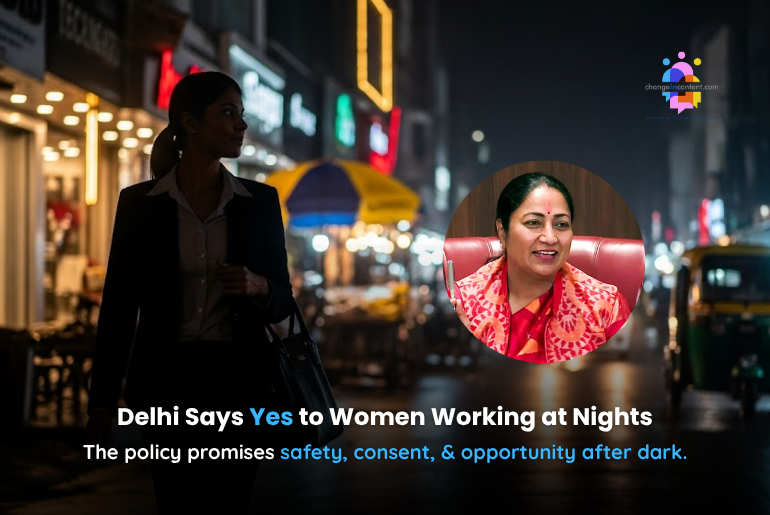
In a pivotal move for women’s workforce inclusion, the Delhi government has voted to amend the Shops and Establishments Act to allow women to work night shifts in shops and commercial establishments. The proposed Night Shift Policy for women in Delhi, now awaiting the lieutenant governor’s approval, aims to transform Delhi into a true 24×7 business hub while prioritising safety and women’s autonomy.
Sections of the 1954 Act currently prevent women from working late into the night. These prohibitions have long forced them out of round-the-clock roles. If approved, this policy could unlock new job opportunities, particularly in sectors such as retail, hospitality, healthcare, and logistics. Yet, as Delhi inches closer to becoming India’s capital of nighttime commerce, the real challenge lies in translating policy promises into everyday realities.
Ground reality: Why it matters
Allowing women to work during the night shift is not just about expanding working hours. Instead, it is about economic freedom. Many women, particularly those supporting families, need flexible schedules. Night work often pays better, especially with overtime. This move could raise incomes and support women whose daytime commitments make working conventional hours difficult.
But Delhi is no stranger to vaunted promises that fall flat in execution. Without the stringent enforcement of safety rules, flexible hours may remain aspirational. And without addressing broader societal norms around women working late, policy will meet resistance at home and at work.
Night Shift Policy for Women in Delhi: What it includes
The proposed changes will exempt women from existing restrictions in the Delhi Shops and Establishments Act. But the government has also laid out a robust safety framework:
- Prior written consent is mandatory before assigning a woman worker to night shifts.
- Employers must provide reliable transportation (preferably drop‑and-pick services) to and from her home.
- CCTV surveillance must cover all workplaces, ensuring visibility into each workspace.
- Female security guards should be stationed at entrances and exits. Workplaces must also form internal complaints committees under the POSH Act.
- Fundamental facilities such as restrooms, lockers, and break rooms must be available.
- Payment of wages must be through electronic modes. Employees must receive all statutory benefits: ESI, EPF, bonus, weekly offs, and overtime pay.
The policy explicitly cites similar frameworks in Haryana, Telangana, Madhya Pradesh, and Tamil Nadu. It shows that Delhi is catching up to established norms rather than charting untested territory.
What it could achieve, and what it may miss
A successful night-shift policy can reduce gender gaps in employment, fostering greater independence and redefining safety narratives. For businesses, it can mean expanded operating hours and more inclusive hiring.
Yet bureaucratic laxity could derail it. If police and municipal authorities do not coordinate or enforce compliance with transportation and surveillance norms, the safety framework remains paper-thin. Women may still avoid night duty for fear of harassment or logistics chaos. Supervisors, too, will need gender-sensitivity training to manage teams effectively after hours.
We must also acknowledge the cultural mindset barriers. Families may not support or understand women working nights. Leadership at the top must speak clearly and often so that policy becomes matter-of-fact, not exceptional.
Why Changeincontent supports this, but cautions implementation
As a platform committed to inclusive policy discourse, Changeincontent sees the Night Shift Policy for Women in Delhi as a potentially transformative reform. It is policy in service (not token instruction) with the power to redefine urban economic life. But real change demands more: affordable public transport, reliable infrastructure, community trust mechanisms, and enforcement.
Women deserve more than permission. In reality, they deserve protection, opportunity, and dignity. This policy works only if individuals feel it is safe, supported, and respected. That means ongoing dialogues with trade associations, civil society, guardians of night-time public spaces, and tech-driven transparency around compliance.
Night Shift Policy for Women in Delhi: A landmark policy, not a light switch
Delhi is stepping forward and telling women: you belong in every hour of the day. That is a powerful statement in a city known for gendered mobility constraints. But such a leap also demands rigorous follow-through, with transport audits, safety protocols, grievance mechanisms, and regular evaluation of impact.
Let us hope this is not just good policy on paper, but a transformational policy in practice. Where women’s night shifts are celebrated, not stigmatised; where safety is real, not conditional; where work is both inclusive and empowering.
Also read: The women’s safety tax: An unspoken economic inequality.
Disclaimer: The views expressed in this article are based on the writer’s insights, supported by data and resources available both online and offline, as applicable. Changeincontent.com is committed to promoting inclusivity across all forms of content. We broadly define inclusivity as media, policies, law, and history. It encompasses all elements that influence the lives of women and marginalised individuals. Our goal is to promote understanding and advocate for comprehensive inclusivity.