The Quick Read
- Karnataka is preparing a dedicated Women’s Health Policy, with menopause and perimenopause as its first major area of focus.
- A programme called Ruthu Thare will promote awareness, early identification of symptoms and access to care.
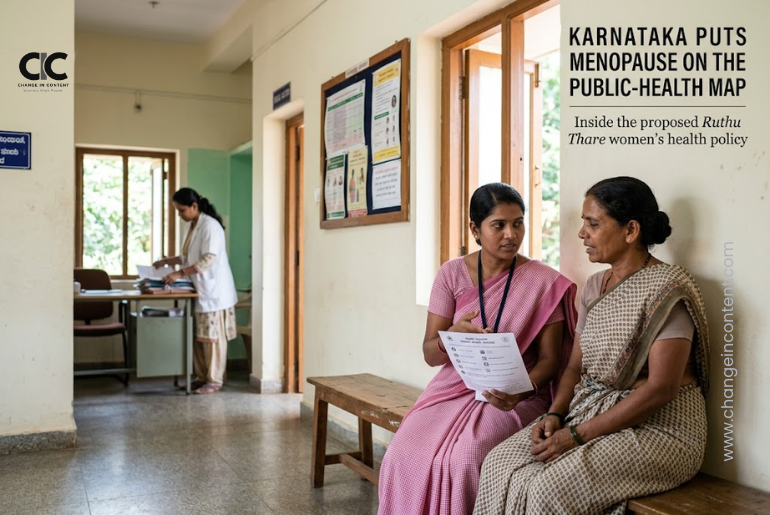
- ASHA workers are expected to conduct household outreach using a standardised menopause-screening checklist.
- The state plans to train healthcare workers and establish specialised midlife women’s health clinics.
- An expert committee headed by gynaecologist Dr Jyothsna Mirlay will develop clinical recommendations.
- Actor and former parliamentarian Ramya has been named the campaign’s brand ambassador.
- The policy has been announced but is still being developed. Its final scope, budget, timeline and implementation framework are awaited.
First-of-its-kind Menopause Health Policy in Karnataka
Menopause has remained one of the most predictable events in women’s lives and one of the least prepared-for stages in India’s healthcare system. Karnataka is now attempting to change that.
The state government has announced plans for a dedicated women’s health policy with menopause and perimenopause as an initial priority. The proposed Menopause Health Policy in Karnataka will bring awareness, symptom identification, preventive care and medical support into the public-health system rather than leaving women to work out the transition on their own.
The programme has been named Ruthu Thare. Its announcement followed a state-level discussion titled Healthy Menopause, Healthy Women, Healthy Family at Arogya Soudha in Bengaluru.
Karnataka’s Department of Health and Family Welfare has described the initiative as an effort to bring menopause formally into the state’s public-health framework. Health Minister U T Khader said the wider women’s health policy would have its own monitoring mechanism and an advisory committee drawn from medical and social sectors.
For millions of women who have been told to tolerate symptoms quietly, formal recognition by a government health system is a substantial step.
What will the menopause initiative include?
The state’s early outline combines public awareness with healthcare delivery.
Under Ruthu Thare, women are expected to receive information about perimenopause, menopause, nutrition, exercise, sleep, mental health, lifestyle changes and healthy ageing. Families will also be included in the awareness campaign because symptoms are frequently misunderstood at home as irritability, weakness or an unavoidable consequence of getting older. ASHA workers are expected to play a central role.
The government plans to train master trainers at the state level, followed by district and taluk-level personnel and eventually ASHA workers across Karnataka. These frontline workers will use a standardised checklist during household visits to identify women who may require further assessment or medical attention.
The initial programme is also expected to include:
- Door-to-door awareness and data collection
- Information about physical and emotional symptoms
- Early identification and referral
- Advice on nutrition, sleep, exercise and self-care
- Training for frontline health workers
- Dedicated midlife women’s health clinics
- Specialist guidance for complex symptoms
- Public communication in urban and rural communities
An expert committee led by Dr Jyothsna Mirlay, a consultant gynaecologist specialising in menopause and midlife women’s health, has been constituted to prepare scientific recommendations. The state has also announced plans for specialised clinics for women experiencing menopausal symptoms.
These details remain part of the government’s announced framework. The final policy document will need to clarify where services will begin, how women will be referred, what tests and treatments will be available and how the programme will be financed.
Why does menopause need a public-health response?
Menopause marks the end of menstruation after 12 consecutive months without a menstrual period, in the absence of another medical cause. Perimenopause refers to the transition leading up to it, when hormonal changes and symptoms may begin. The experience varies widely.
Some women have few symptoms. Others encounter hot flushes, night sweats, interrupted sleep, anxiety, low mood, joint pain, headaches, vaginal and urinary symptoms, memory lapses or difficulty concentrating. Menopause is also associated with longer-term changes in bone and cardiovascular health.
The World Health Organisation has argued that menopause care should include access to quality health services, accurate information and social support. Yet awareness among women and healthcare providers remains uneven, particularly in countries where health systems have historically concentrated on pregnancy and reproductive years. That gap is visible in India.
Women may consult different doctors for poor sleep, joint pain, anxiety, menstrual changes or urinary problems without anyone connecting the symptoms. Some assume treatment is unnecessary because menopause is “natural”. Others fear that speaking about it will invite comments about age, sexuality or declining usefulness.
A natural transition can still require medical attention.
Childbirth is natural. Ageing is natural. Neither description removes the need for qualified healthcare.
India has largely designed women’s health around reproduction
Public policy has often approached women’s health through menstruation, contraception, pregnancy, childbirth and maternal care. These are essential areas. They cover only part of a woman’s life.
Once women move beyond their reproductive years, their visibility within the health system often falls sharply. Symptoms are normalised, fragmented across specialities or addressed only after they develop into larger health problems.
India has an estimated 124 million women aged 40 to 49 who are in the menopausal transition, according to a 2026 policy brief from IWWAGE. The report argues that menstrual and menopausal health influences women’s physical wellbeing, mental health, economic participation and ability to remain in paid work.
The Indian Menopause Society’s clinical guidance has similarly called for systematic assessment, risk classification, individualised management, clear referral pathways and integration of menopausal care into non-communicable disease strategies. It also recommends structured menopause clinics across different levels of care.
Karnataka’s proposal moves in that direction by treating midlife health as a defined policy concern.
ASHA workers could make the policy reach women who never ask for help
The use of ASHA workers may become one of the policy’s most important features.
A specialist menopause clinic can help only women who know that the clinic exists, recognise that their symptoms deserve attention and are able to travel to it. Many women will not cross that first threshold without local outreach.
ASHA workers already have established relationships within communities. With appropriate training, privacy safeguards and referral support, they can help women recognise patterns they may have been living with for years.
Their role should not be to diagnose menopause or recommend treatment. It should be to:
- Share accurate information
- Identify possible warning signs
- Encourage medical consultation
- Explain available services
- Guide women through referrals
- Follow up where necessary
The quality of the checklist and training will matter.
Menopause cannot be reduced to hot flushes. Mental health, sleep, bone health, abnormal bleeding, urinary symptoms and cardiovascular risks may all require attention. Frontline workers must also know which symptoms need urgent investigation rather than being assumed to result from menopause.
Any household survey must protect confidentiality. Women should not be made to discuss intimate symptoms in front of relatives or neighbours merely because the programme is delivered door to door.
Including families could reduce a different kind of suffering
The Karnataka initiative plans to involve husbands and other family members in menopause awareness. That decision has practical value.
Women often continue managing employment, cooking, caregiving and household responsibilities while experiencing disrupted sleep, pain or emotional changes. When families do not understand the cause, symptoms may be interpreted as bad temper, disinterest or personal weakness. Accurate information can prevent some of that judgement.
Family awareness should not turn menopause into another occasion on which women are advised to remain calm, eat better and manage stress. The responsibility cannot sit entirely with the woman undergoing the transition.
Families can contribute through:
- Sharing domestic work
- Allowing time for medical appointments
- Taking persistent symptoms seriously
- Avoiding ridicule
- Supporting rest and treatment
- Recognising changes in mental health
- Discussing sexual and urinary health without shame
The strongest public-health campaigns will speak to women directly while asking the people around them to change their response.
The workplace must eventually enter the policy conversation
The announced framework is primarily a health initiative. Its eventual impact will also be felt at work.
Women may experience menopause during the years in which they hold considerable professional experience. Poor sleep, anxiety, fatigue, or concentration difficulties can affect the working day. Unsupportive conditions can make symptoms harder to manage. India’s workplace response remains fragmented.
The IWWAGE policy brief found that menopausal health at work receives limited attention despite its effects on attendance, productivity, career progression and premature workforce exit. It calls for a life-course approach that supports women’s entry, retention and dignity across different forms of employment.
Change in Content has earlier examined how menopause affects working women and senior careers. Women may reach the point at which their experience is most valuable while their workplaces remain least prepared for the health transition they are navigating.
Our analysis of menopause and corporate ESG commitments also found a gap between public promises about women’s advancement and practical support for women in midlife.
Karnataka’s final policy could encourage employers to participate through awareness programmes, manager education, health screenings and referral systems. This would be especially useful in a state with large technology, manufacturing, healthcare, education and service-sector workforces.
Public-health support and workplace support should reinforce one another.
A first-of-its-kind claim needs some context
Karnataka has described the proposed framework as India’s first dedicated women’s health policy with menopause at its centre. The distinction is important, but it should be stated carefully.
Maharashtra has already introduced dedicated menopause clinics in government hospitals. Those clinics provide medical assessment, counselling, lifestyle guidance and referrals. Karnataka’s claim appears to concern the development of a broader state women’s health policy and the integration of menopause into public-health outreach, screening, clinics and monitoring.
The final policy document will show how far the model extends beyond existing state initiatives.
For now, Karnataka has announced an ambitious framework rather than completed a national first whose implementation can already be evaluated. That does not reduce the value of the announcement. It keeps the reporting accurate.
What should the final Karnataka policy clarify?
The promise is strong. Several practical questions remain.
Which facilities will provide care?
Women need to know whether services will be available through primary health centres, community health centres, district hospitals, medical colleges or dedicated clinics.
What will happen after screening?
A checklist is useful only when a referral leads somewhere. The policy should define assessment, treatment and follow-up pathways.
What services will be free?
Consultations, tests, counselling and medicines can create high costs. The state should specify what the public system will cover.
How will healthcare providers be trained?
Women frequently encounter dismissal even after seeking help. Doctors, nurses, counsellors and frontline workers need consistent clinical guidance.
Will mental health receive equal attention?
Anxiety, low mood and sleep problems should not be separated from physical care or casually attributed to personality.
How will rural and low-income women access specialists?
Teleconsultations, referral transport and stronger district-level services may be necessary to prevent the programme from becoming Bengaluru-centred.
How will outcomes be measured?
Useful indicators could include women screened, referrals completed, conditions identified, treatment continuity, patient experience and differences between districts.
Will the policy address work?
A woman may receive a diagnosis and still return to an inflexible factory, school, hospital, farm or office. Health and labour departments should eventually work together.
The announcement has opened the door. The final document must show what stands behind it.
The Change in Content Perspective: Women’s Healthcare Cannot End with Motherhood
For decades, women have entered clinics carrying somebody else’s health card, accompanying a child, spouse or older relative. Their own midlife symptoms have often remained outside the consultation.
Karnataka’s proposed policy offers a welcome correction. It acknowledges that women need public healthcare after their reproductive years and that menopause deserves more than a whispered conversation or a list of home remedies.
The most promising part of Ruthu Thare is its potential reach. ASHA workers, local awareness, referrals and specialised clinics could connect women who would never independently seek menopause care with a functioning health pathway. Its success will depend on what comes next: trained workers, informed doctors, accessible clinics, affordable treatment, privacy and steady funding.
A campaign can help women name what they are experiencing. A policy must help them receive care for it.
Karnataka has begun a conversation that every Indian state needs to have. The final measure of progress will be whether a woman in Bengaluru, Bidar or a distant village can speak about her symptoms without embarrassment and receive competent care without being dismissed.
Editorial Note and Disclaimer
This article is based on announcements made by the Karnataka Department of Health and Family Welfare, publicly reported statements by state health officials and established medical and policy sources. The proposed women’s health policy and Ruthu Thare programme were under development at the time of publication; their provisions, timelines and implementation structure may change. Change in Content has not independently evaluated the programme. This article is intended for editorial and informational purposes and does not provide medical advice. Readers experiencing menopausal symptoms should consult a qualified healthcare professional.
Sources
- Karnataka Department of Health and Family Welfare: Official public announcement on menopause care
- World Health Organisation: Menopause
- Indian Menopause Society: Clinical Practice Guidelines
- IWWAGE: Menstrual and Menopausal Health at Work in India