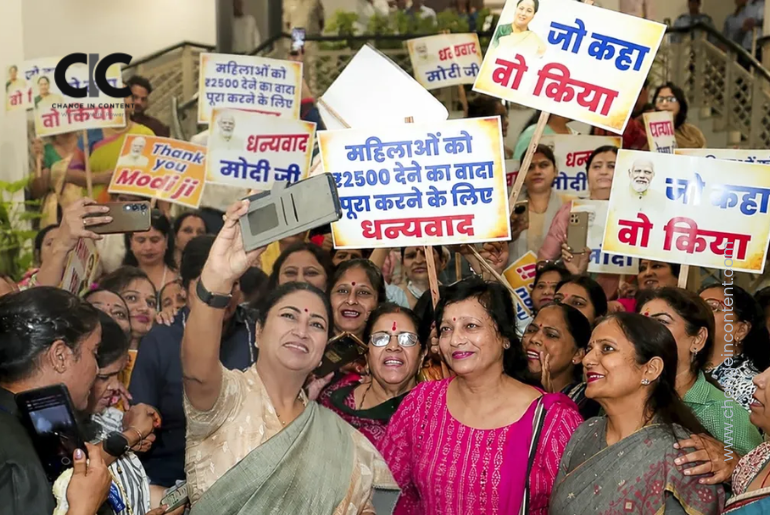
The Quick Read
- Delhi’s monthly payout scheme, officially named the Delhi Lakshmi Yojana, offers ₹2,500 a month to eligible women aged 21 to 60.
- The annual family-income limit is ₹2.5 lakh, and only the eldest eligible woman in a family can receive the benefit.
- The government has allocated ₹5,110 crore for 2026–27 and previously estimated that more than 17 lakh women could benefit.
- The payment will not function as an unrestricted monthly cash transfer. Women can choose between a restricted digital wallet plus savings deposit, or placing the full amount in a recurring or fixed deposit.
- Women with more than three living children are excluded. A Hindustan Times analysis estimates that this condition alone could affect around 15% of women in Delhi’s poorest households.
- Other exclusions cover high electricity use, four-wheeler ownership, government employment or pension within the family, existing government financial assistance and criminal records.
- Applicants must also show a ten-year connection with Delhi and upload a recommendation from their constituency’s MP or MLA.
Delhi’s Monthly Payout Scheme for Women: An introduction
A monthly payment of ₹2,500 can mean very different things in different homes. It can pay for medicines. Cover part of a school fee. Replace money borrowed from a neighbour. Give a woman something in her own name rather than requiring her to ask for every household expense.
That is the promise behind Delhi’s monthly payout scheme.
The Delhi government has opened registrations for the Delhi Lakshmi Yojana, a flagship welfare programme intended to provide financial assistance to eligible women from lower-income households. The scheme was approved by the Cabinet on 28 July 2026, with applications opening online from 1 August.
The programme recognises an important reality: access to even a modest independent sum can improve a woman’s financial room within a household. Its design, however, is more complicated than a simple monthly cash transfer.
The money comes with eligibility tests, savings conditions, spending controls and exclusions. Some may help concentrate public funds on families with fewer resources. Others risk removing women whose need has not disappeared merely because their household does not fit the chosen template. The most debated condition is the exclusion of women with more than three living children.
According to an analysis by Hindustan Times, that rule alone could leave out approximately 15% of women in the lowest-income sections of Delhi households. The figure is an external estimate, not an official government projection.
What does the Delhi Lakshmi Yojana offer?
The scheme provides eligible women with financial assistance of ₹2,500 per month. Applicants must:
- Be between 21 and 60 years old;
- Be the eldest eligible woman in the family;
- Belong to a family with annual income not exceeding ₹2.5 lakh;
- Be registered as a Delhi voter;
- Show that they, their husband or either parent have lived in Delhi for at least ten years.
The Delhi government has allocated ₹5,110 crore for the programme in the 2026–27 Budget. Before the final exclusion criteria were published, it estimated that more than 17 lakh women could receive support. It is not yet clear how much that number will change once all the conditions are applied.
The scheme has initially been approved for three years. The government may continue it afterwards with modifications based on its operation and results.
The ₹2,500 will not arrive as ordinary cash
The words “monthly payout” may suggest that a woman will receive ₹2,500 in a bank account and decide independently how to use it. That is not how the approved structure works. Beneficiaries have two options.
Option One
- ₹1,500 will be deposited into a recurring or fixed deposit.
- ₹1,000 will be transferred into a Central Bank Digital Currency (digital rupee) wallet.
- The digital amount can be spent on approved goods and services, subject to restrictions.
Option Two
- The entire ₹2,500 will be placed in a recurring or fixed deposit.
Under either option, beneficiaries will not be able to withdraw the amount as cash in the ordinary manner described in the current guidelines.
The government’s reasoning is understandable.
A savings-linked benefit can help women accumulate an asset rather than see the full amount absorbed by immediate household consumption. A controlled digital wallet may also improve transparency, reduce diversion and encourage participation in formal financial systems. But restrictions change the nature of the benefit.
A woman needing ₹1,800 for urgent medicine, rent or transport may not be able to use money locked into a deposit. A digital wallet may be helpful for approved purchases but less useful for informal expenses, local vendors or emergencies.
The design therefore tries to achieve two goals at once:
- immediate financial support;
- enforced long-term saving.
Those goals do not always align within a low-income household. A benefit intended to increase women’s agency should leave enough room for women to decide what their most urgent need is.
What the scheme gets right
The programme contains several promising elements.
It places money in a woman’s name
Direct financial support can give women greater control over daily expenditure and reduce complete dependence on another household member.
Research across cash-transfer programmes has repeatedly shown that money controlled by women can affect spending on food, children, health and household security. The outcome depends on programme design and family circumstances, but individual access matters.
Change in Content has previously argued that cash schemes for women recognise the importance of money reaching women directly. The shift is significant in homes where women perform extensive unpaid work but have little independent income.
The income threshold focuses the scheme
The annual family-income ceiling of ₹2.5 lakh aims to direct funds towards households with fewer financial resources rather than make the programme universal.
Targeting can help governments manage costs and direct larger support to those most likely to need it.
The quality of targeting depends on whether the chosen indicators identify poverty accurately.
The savings component can create a longer-term asset
Low-income women often have little money left to save after meeting household needs. A recurring deposit could create a protected sum that grows over time.
It may be especially useful when the woman genuinely controls the account and cannot be appropriated informally by someone else.
It connects financial support with other public services
The government intends to encourage beneficiaries to:
- Keep children enrolled in school;
- Create APAAR and ABHA IDs;
- Ensure timely immunisation;
- Register with the POSHAN Tracker;
- Participate in self-help groups and skilling programmes.
Used carefully, this connection could help women access services beyond the monthly amount. The encouragement should not turn into an expanding list of conditions that make the payment difficult to retain.
Why is the three-child cap controversial?
The official eligibility document excludes any woman with more than three living children.
Apparently, the policy logic is to connect welfare with smaller family norms and limit the financial size of the programme. The concern is that the exclusion applies after the children already exist.
Removing the mother’s benefit does not reduce the household’s present needs. A family with four children may face greater costs for food, health and education than one with two. Denying the woman support can therefore affect the same children whose number is being used to disqualify her.
There is also a question of agency.
Women do not always have equal control over:
- Whether contraception is used;
- The timing of pregnancies;
- Pressure to produce a son;
- Decisions made by husbands or extended families;
- Access to reproductive healthcare.
A rule based on the number of living children can assume a level of reproductive choice that not every woman possesses.
The Hindustan Times estimates that around 15% of women in Delhi’s lowest-income households may be affected, making the issue economically significant. Those excluded are unlikely to be concentrated among the city’s wealthiest families.
Family-planning objectives are legitimate public-policy goals. The question is whether withholding a woman’s financial benefit is the fairest or most effective way to pursue them.
The electricity rule could misread household need
A woman is ineligible when her family’s annual electricity consumption exceeds 2,400 units, equivalent to an average of more than 200 units a month.
Electricity use can serve as a rough indicator of household consumption. It is also an imperfect proxy for income.
Usage may be higher because:
- Several generations live in one home;
- A household includes infants, older people or someone with a medical condition;
- Home-based work relies on electrical equipment;
- Heat increases the use of fans, coolers or air conditioning;
- More than one family shares a connection;
- Appliances are old and inefficient.
A family can cross the threshold without being economically secure. The government will need an appeal or verification mechanism for households whose electricity use does not accurately represent their capacity to pay.
Four-wheeler ownership does not always indicate wealth
The official criteria exclude a woman if she or any family member owns a four-wheeler. It is a common welfare filter because car ownership often indicates higher household resources.
But the category includes a wide range of circumstances:
- An old or low-value vehicle;
- A vehicle used for self-employment;
- A taxi or commercial car supporting the household;
- A vehicle bought through debt;
- A car registered to a family member who does not support the applicant financially.
A bright-line rule is administratively simple. Simplicity can create inaccurate exclusions. A more sensitive test could distinguish between luxury consumption, basic mobility and livelihood assets.
Existing government assistance creates another exclusion
Women already receiving a government pension, financial assistance, or similar benefit are not eligible.
The exclusion also extends to families in which a member is employed by the Central or state government, a public-sector undertaking, a local body, or another government organisation, including regular and contractual workers. Retired government pensioners within the family can also trigger ineligibility.
Preventing duplication is a reasonable objective. Yet different schemes may address different needs.
A widow’s pension, disability support or maternity benefit is not necessarily equivalent to a general women’s income-support programme. Excluding a woman merely because another family member receives a benefit can also assume that household resources are shared equally. They may not be.
Change in Content’s analysis of women-centric welfare schemes in India has argued that programme design must look beyond headline coverage and examine whether eligibility rules reflect women’s actual access to money within families.
Why is only the eldest eligible woman covered?
The applicant must be the eldest woman in the family who meets the eligibility conditions. This limits the benefit to one woman in a household. It also raises questions about what the scheme considers a family unit and who controls the assistance after it arrives.
In a multigenerational home, the eldest eligible woman may be the mother-in-law, while a younger woman may be raising children, experiencing unemployment or carrying a different financial burden.
One payment per household helps contain expenditure. Calling it a benefit for women, however, can obscure the fact that several adult women may live within the same low-income family and only one can receive it.
The government should publish a clear definition of the family unit, particularly for:
- Separated women;
- Women living in shared homes;
- Daughters-in-law;
- Adult daughters;
- Households with separate kitchens but common addresses.
Administrative clarity will determine whether the eldest-woman condition creates order or household disputes.
A ten-year residency rule may exclude mobile women
The applicant, her husband or either parent must have maintained a Delhi connection for at least ten years. She must also be a registered Delhi voter.
The rule helps ensure that the programme benefits long-term Delhi residents. It may disadvantage women whose lives involve migration.
A woman may have moved to Delhi for marriage or work and lived in the city for several years without meeting the full period. She may lack old bills or records in her own name. Informal tenants frequently have limited documentary proof.
The provision allowing a husband’s or parent’s residence to count reduces some of this difficulty. It also reinforces dependence on family-linked documentation.
Women who are separated, estranged or unable to obtain documents from relatives may find the requirement harder to satisfy.
Why is an MP or MLA recommendation required?
The official document lists a recommendation from the applicant’s constituency MP or MLA among the mandatory uploads. This requirement is likely to attract close attention.
Eligibility is already determined through age, income, voter registration, residence, electricity use and other documentary conditions. It is unclear what additional fact an elected representative’s recommendation is expected to verify.
Requiring political certification can create practical risks:
- Applicants may need to visit constituency offices;
- Women with limited mobility or time may face greater difficulty;
- Access may depend on local staff and office processes;
- Applicants may believe political connections influence approval;
- Representatives could face an enormous volume of requests.
A rules-based welfare scheme should ideally be accessible through transparent documents and an independent verification process.
Where a recommendation is retained, the government should specify that elected representatives cannot refuse it arbitrarily and must follow a standard, time-bound process.
The entirely online process could leave some women behind
Applications are to be processed through the Delhi Lakshmi Yojana portal. Required uploads include Aadhaar, voter identification, photographs, signatures and residence and age documents.
Online systems can improve speed, reduce queues and create a traceable record. They can also exclude women who:
- Do not control a smartphone;
- Cannot upload documents;
- Have inconsistent names across records;
- Lack digital literacy;
- Have weak internet access;
- Depend on agents who charge fees;
- Cannot obtain the required political recommendation.
Delhi has stronger digital access than many parts of India, but access within a household is not always access for the woman.
The government will need assisted application facilities through recognised public centres, helplines and local offices. At Change in Content, we feel that the service should be free, and applicants should receive clear acknowledgement and appeal information.
The experience of Maharashtra’s women’s benefit programmes shows how digital verification can become a barrier when databases do not match lived reality. Change in Content’s report on the digital divide affecting women under the Majhi Ladki Bahin Yojana offers a relevant warning.
The criminal-record exclusion needs precision
The official criteria exclude a woman with “criminal antecedents/record”. That phrase requires clarification.
Does it cover:
- A conviction;
- A pending case;
- An arrest without conviction;
- Minor offences;
- Old cases;
- Cases in which the woman was acquitted?
A broad exclusion based on an allegation or unresolved case can deny welfare before guilt is established.
Women leaving prison or rebuilding life after a conviction may also be among those with the greatest need for basic economic support.
The detailed rules should distinguish serious, relevant convictions from mere accusations and establish an appeal process.
Cash support can help without solving the structural problem
The Delhi Lakshmi Yojana is part of a wider state-level trend.
Governments across India increasingly provide monthly payments to women. These schemes reflect political recognition that women’s unpaid work, lower employment and limited access to personal income have real economic consequences.
The support can be valuable. ₹2,500 a month equals ₹30,000 a year. In a low-income household, that is not trivial.
But cash support should not become a substitute for:
- Safe and suitable employment;
- Childcare;
- Affordable health services;
- Public transport;
- Skilling linked with jobs;
- Social security;
- Equal wages;
- Protection from violence;
- Women’s access to assets and credit.
Change in Content has previously argued that women-centric welfare must move from cash alone towards capability and economic mobility.
The best version of the Delhi scheme would function as a foundation. A woman receives money she can use with meaningful independence. She also gains access to banking, skills, self-help groups, public services and pathways towards income beyond the scheme.
The weaker version would provide a politically visible benefit while making many low-income women prove themselves through an unusually long list of filters.
What should the Delhi government monitor?
The first year of implementation should produce more than a registration total. The government should publish:
- Applications received;
- Applications approved and rejected;
- The reason for each rejection category;
- The number excluded by the three-child cap;
- Applicants unable to establish ten-year residency;
- Processing time for MP or MLA recommendations;
- Complaints about digital access;
- Use of the CBDC component;
- Premature need for locked savings;
- Geographic and income distribution of beneficiaries;
- Appeal outcomes;
- The number of women retaining independent control of the benefit.
The original estimate of more than 17 lakh beneficiaries should also be updated after eligibility verification. Transparency would allow Delhi to distinguish responsible targeting from accidental exclusion.
What could improve the design?
The scheme is new. That allows the government to correct problems before they become embedded. A few changes could strengthen it.
Review the three-child exclusion
The government could remove the rule, apply it only prospectively or create exemptions where the woman had limited reproductive agency or faces exceptional hardship.
A welfare benefit should not make existing children poorer to communicate a family-planning message.
Guarantee an accessible cash component
Long-term saving has value, but beneficiaries should retain enough immediately usable money for emergencies and ordinary household needs.
The balance between saving and liquidity should be reviewed using women’s actual experience.
Replace political recommendation with administrative verification
Eligibility should depend on published rules rather than an individual letter from an elected representative.
Create assisted and offline application routes
Women should be able to apply through public facilitation centres without paying an intermediary.
Establish a clear appeal process
Every rejection should state the precise reason and explain how the applicant can challenge incorrect records.
Review proxy indicators
Electricity use and vehicle ownership should allow exceptions where they reflect health needs, shared connections or livelihood assets rather than economic comfort.
The Change Ahead
Delhi’s monthly payout scheme begins from a sound proposition.
Women in low-income households should have money in their own name. A predictable monthly benefit can reduce financial stress and create a degree of personal security.
The savings element may also help some women build an asset that ordinary household pressures would otherwise make difficult. But a welfare scheme is defined as much by whom it excludes as by whom it pays.
- A woman with four children may need the money more, not less.
- A household consuming 205 electricity units a month may not be wealthy.
- A ten-year resident may lack paperwork in her own name.
- A contract worker in a government organisation may not make every woman in the extended family financially secure.
Good targeting removes those who do not need support. Poor targeting removes those who cannot satisfy the proxy.
Delhi now has the opportunity to demonstrate that the Lakshmi Yojana can learn from its first applications. The government should publish who is being rejected, why they are being rejected and whether those rules match the programme’s stated objective.
₹2,500 can make a difference. The scheme will be larger when its safeguards prevent misuse without turning women’s complicated lives into reasons for exclusion.
Editorial Note and Sources
This Bureau report is based on the eligibility and exclusion document published by the Delhi Department of Women and Child Development, public announcements surrounding the Cabinet’s approval of the Delhi Lakshmi Yojana and contemporary reporting on its payment structure and possible coverage. The estimate that the three-child rule could exclude approximately 15% of women in Delhi’s lowest-income households comes from a Hindustan Times analysis. It is not an official Delhi government estimate. Implementation details may be amended as applications are processed and further notifications are issued.
Principal sources
- Department of Women and Child Development, Government of NCT of Delhi: Delhi Lakshmi Yojana – Eligibility Criteria, Exclusion Criteria & Documents.
- Department of Women and Child Development, Government of NCT of Delhi: Official scheme notice and application information.
- Hindustan Times: Analysis of the three-child exclusion and the possible impact on women in lower-income households.
- News On AIR: Delhi Cabinet approval and ₹2,500 monthly assistance announcement.