
The Brief
- The Gender Index Australia 2026 is the first national, data-led study designed to map female business leadership across Australian sole traders and incorporated companies.
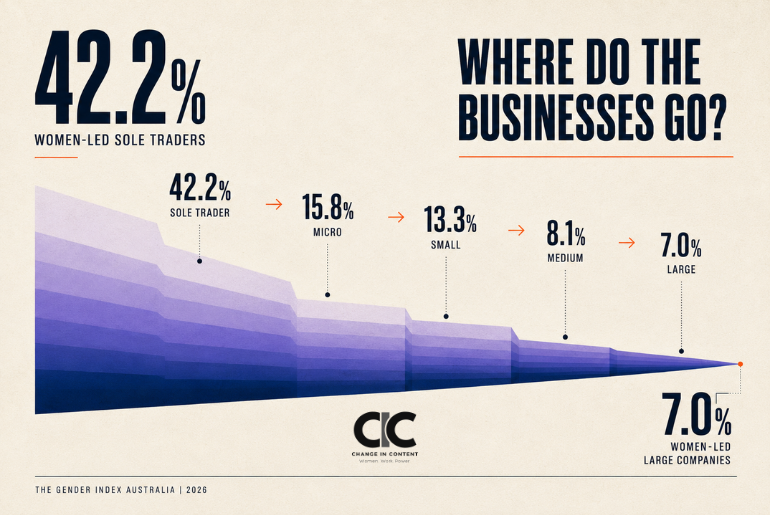
- Women lead 42.2% of sole traders, but only 15.8% of micro companies, 13.3% of small companies, 8.1% of medium companies and 7% of large companies.
- Male-led businesses progress from micro to larger stages at a rate of 13.68%, more than twice the rate for women-led businesses at 6.71%.
- The report estimates that closing the scaling gap could support around 29,000 additional women-led growth businesses, 745,000 jobs and more than A$100 billion in annual wages and government tax revenue.
- The largest opportunity is early in the growth journey: 86.3% of the modelled opportunity lies in helping women-led micro businesses become small businesses.
Gender Index Australia: The first-of-its-kind report
Australia has no shortage of women willing to start businesses. That may be the most important starting point in the Gender Index Australia report released in September 2026.
Women lead an average of 42.2% of Australian sole traders. In Queensland, the figure reaches 45.1%. Western Australia follows at 43.1%, while the Australian Capital Territory sits at 42.9%. Across much of the country, women are already a substantial part of the entrepreneurial base.
Then the numbers fall.
Women lead only 15.8% of micro companies. At the small-company stage, that falls to 13.3%. Medium companies: 8.1%. Large companies: 7%.
The report calls it a scaling cliff. That phrase captures the issue rather well.
Women are entering business. Far fewer are reaching the point where those businesses become larger employers, build management teams and acquire the commercial weight associated with scale.
The pipeline is healthy at the beginning
This matters because the usual conversation about entrepreneurship often starts by asking how to persuade more women to become founders.
The Gender Index suggests that, at least in Australia, the bigger question may begin later.
Women already represent more than two-fifths of sole traders. The gap appears when business activity moves from self-employment into incorporated entities and then through successive stages of growth.
Women lead only around 15.2% of ACN-registered companies overall, compared with their 42.2% share among ABN sole traders. That is a 27-percentage-point drop from entry-level entrepreneurship to incorporated company leadership.
Change in Content recently explored a similar shift in the wider entrepreneurship conversation: female entrepreneurship trends in 2026 are increasingly moving from “start” towards “survive and scale”. Australia’s new national data gives that shift unusually concrete numbers.
The biggest gap appears surprisingly early
The report’s most useful policy finding may not be the 7% figure at the top. It is what happens much earlier.
Male-led businesses progress through the critical growth stage at a rate of 13.68%, compared with 6.71% for women-led businesses.
That creates what the report calls a “missing middle” of women-led growth companies.
And the modelling suggests that 86.3% of the total opportunity lies in improving the transition from micro to small business. Another 13.4% sits between small and medium businesses. Only 0.3% comes from the final step from medium to large.
That changes where policy attention might be most useful.
The headline ambition might be more women running large Australian companies. The practical intervention may begin much earlier:
- when a sole founder needs to hire;
- when a micro business needs working capital;
- when a small supplier needs its first major contract;
- when systems need to replace founder dependency;
- when the business needs finance that is larger and more sophisticated than a startup grant.
The report argues that Australia already provides considerable support around education, mentoring, startup grants and early-stage assistance.
What becomes thinner is the support required to employ people and build scalable operating systems.
Performance does not appear to explain the drop
There is another important finding.
The report says women-led businesses that reach scale demonstrate commercial performance comparable with, and in some cases stronger than, their peers. Its conclusion is therefore not that women-owned businesses fail to grow because they are weaker businesses.
The problem appears to be progression. That distinction matters because many entrepreneurship programmes are implicitly built around fixing the founder.
- Improve her confidence.
- Improve her financial literacy.
- Give her a mentor.
- Teach her how to pitch.
Those interventions can help. But once viable businesses exist, the environment around the business also deserves examination.
Change in Content recently looked at research arguing that women entrepreneurship support needs to move beyond programmes that repeatedly prepare women for business without redesigning the ecosystem around them. The Gender Index Australia reaches a similar point through company data rather than academic theory.
Follow the scale gap and money appears
Capital is one part of the picture.
Female-only founding teams accounted for 8% of reported Australian startup deals in 2025 but received just 2% of total capital, according to figures cited in the report.
Venture capital covers only one part of Australia’s business economy. Hence, it cannot explain the entire scaling gap. But it illustrates how access can narrow as the funding requirement becomes larger.
The same pattern can occur with customers.
Recurring corporate or government contracts provide predictable revenue, which can help a business hire, invest and attract finance.
Women-led companies remain underrepresented in industries where established procurement and supply chain pathways often enable scale.
Networks matter as well.
Scaling businesses need introductions to investors, advisers, executives, board members and large customers. The report points to weaker professional networks and lower access to mentors and role models as barriers identified for female founders.
None of these barriers works independently.
- Capital becomes easier to raise with credible customers.
- Large customers can become easier to reach through networks.
- Hiring becomes easier when cash flow becomes predictable.
- Governance becomes more important as the company grows.
Scale is an ecosystem.
Industry changes the odds
Women-led businesses are also distributed unevenly across sectors.
Women lead more than one-quarter of classified companies in Health Care and Social Assistance and Education and Training. Their presence falls to around one in ten in Construction, Mining and Utilities.
That matters because sectors have different routes to scale.
A professional-services company may grow with relatively little physical capital. A mining, construction, or infrastructure company may require equipment, assets, insurance, large contracts, and much deeper financing.
The report therefore links women’s scaling prospects partly to the industries in which women-led companies are concentrated.
Western Australia illustrates the point sharply. Women lead 43.1% of sole traders there, above the national average, but only 13.3% of companies. In mining specifically, women lead only 7.2% of classified WA companies.
The distance from starting to scaling is not identical across industries. So, the policy cannot assume it is.
What would closing the gap be worth?
That is where the report moves from representation into macroeconomics.
The Gender Index estimates that closing the female business scaling gap could support approximately:
- 29,000 additional women-led growth businesses
- 745,000 additional jobs
- A$79.4 billion in annual wages
- and approximately A$24.4 billion in annual government tax revenue.
Combined, the report places the annual wages and tax opportunity at more than A$100 billion. It also estimates around A$9.5 billion in additional employer superannuation contributions.
These are modelled estimates rather than guaranteed outcomes. But their scale explains why female entrepreneurship can be treated as an economic development question rather than a niche business diversity programme.
The policy question is shifting from entry to progression
Australia already has numerous programmes aimed at women entrepreneurs.
The report documents state-level initiatives involving training, mentoring, grants, co-investment, procurement, and founder support.
New South Wales, for example, has expanded women-in-business training and targeted grants. Victoria uses social procurement and co-investment mechanisms. Queensland recognises female-owned suppliers within procurement policy. South Australia has also explored gender-responsive procurement.
The emerging question is whether those interventions connect into a coherent growth pathway.
A programme can produce thousands of registrations without telling us whether participants subsequently build sustainable businesses. A grant can help somebody start without helping her obtain the next round of finance. And a networking programme can create contacts without opening procurement.
The Gender Index suggests policy should increasingly track what happens after entry.
- Did the business incorporate?
- Did it hire?
- Did it win larger contracts?
- Did revenue grow?
- Did it access growth capital?
- Did it move from micro to small?
- And did the woman remain in leadership as it scaled?
Those measures would tell policymakers considerably more about whether entrepreneurship support is changing the shape of the economy.
Australia may have found the more useful question
Female entrepreneurship has often been discussed in terms of participation.
- How many women start companies?
- How many founders receive grants?
- How many join programmes?
Those numbers still matter. But the Gender Index Australia adds another layer: What happens to those businesses next?
Australia appears to have a substantial pipeline of women willing to build. The data suggests the economic loss begins when too few of those businesses move through the next stages.
For policymakers, financial institutions and corporate buyers, that makes the task more specific. Do not only create more founders. Help more viable founders become employers.
Change in Perspective: Watch the Middle
The easiest numbers to celebrate sit at either end.
A woman starts a business. A woman builds a major company. The Gender Index Australia’s most revealing numbers sit between them. That is where teams are first hired.
Where larger finance becomes necessary. Where procurement begins to matter. And where systems, governance, and networks begin to determine whether the company remains small or becomes something bigger.
Australia’s report suggests that this middle is where much of the economic opportunity is currently disappearing.
The country already has women willing to start. The next test is whether its business ecosystem can help more of them keep going.
Editorial Note & Sources
This Policy Pulse article is based primarily on The Gender Index Australia Report 2026. The report analyses active Australian sole traders and companies using large-scale business and corporate records and classifies leadership gender where it can be reliably identified. Its estimates of additional businesses, jobs, wages and tax revenue are modelled economic opportunities and should not be read as guaranteed outcomes or as observed annual losses. The report states that its methodology achieves approximately 99% coverage of the commercial entity universe, while some variables, including industry classification, require proprietary classification methods due to incomplete Australian registry data.
Sources
- The Gender Index Australia — Report 2026: Primary source for national data on women-led sole traders, company scale, industry representation, productivity and the modelled economic opportunity.
- The Gender Index Australia — National initiative: Background on the project’s purpose and national data-led approach.
- Kanze, Huang, Conley & Higgins — We Ask Men to Win and Women Not to Lose: The report cites this peer-reviewed research when discussing differences in investor questioning and funding outcomes.
