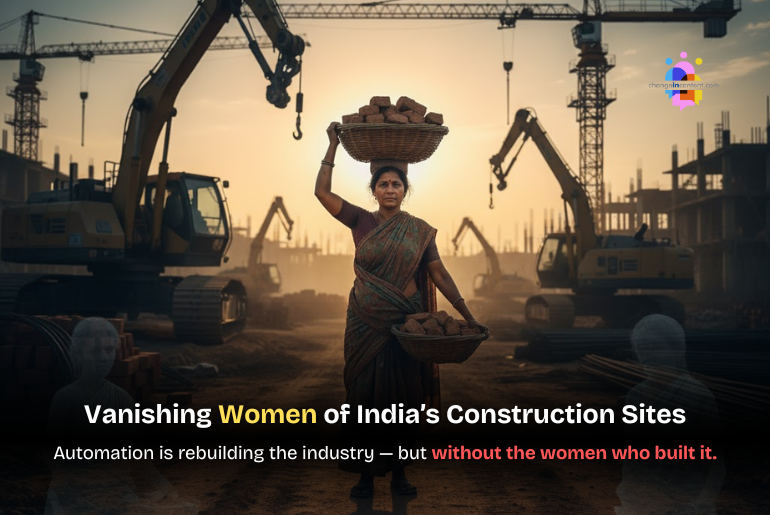
Automation was meant to make construction smarter, faster, and safer. But for millions of women who once powered India’s building sites, it has meant something else — disappearance. This article is the story of the vanishing women of India’s construction sites.
Introduction
The impact of GenAI on jobs is not the same for everyone. Gender plays a defining role, leaving women disproportionately affected across most sectors. Only 27% of women work in roles with low exposure to GenAI.
Automation threatens approximately 65 million women’s jobs worldwide, nearly twice the risk faced by men. This gap exists because many women hold roles that automation can easily replace, both in white-collar and blue-collar jobs. A recent study, led by researchers Geeta Thatra and Saloni Mundra, found that automation has eliminated 80% of women’s construction jobs in Gujarat.
Automation is rebuilding the construction workforce without women
The study “Building Futures: Women Workers at the Margins of Construction Automation,” by Aajeevika Bureau and Work Free and Fair, examines how automation is changing women’s work in the construction industry. Conducted between December 2023 and February 2025, the research gathered insights from migrant women workers, contractors, engineers, safety officers, and supervisors. Fieldwork covered three high-rise projects, one infrastructure site, two AAC block factories, a precast factory, and a precast yard, covering both on-site and off-site processes in Ahmedabad and Gandhinagar.
Before the pandemic, Ahmedabad had around 1,500 active construction sites. The number dropped during the COVID-19 pandemic, but has now grown to approximately 2,200. Despite this rise, women’s participation in construction continues to decline. The industry contributes nearly 9% to India’s GDP and employs about 68 million workers, including 7.6 million women, making it the second-largest employer of women after agriculture.
Yet, women’s roles have steadily reduced. Their share in tasks such as material handling and concrete work has decreased by nearly 80%.
Low-skilled labour at risk
Automation and new technologies are becoming standard at many construction sites. Concrete batching plants and automated machinery allow tasks that once required multiple workers to be completed faster and with greater precision. Similarly, Building Information Modelling (BIM), drones, and precast systems are streamlining planning, monitoring, and assembly processes. While these tools improve efficiency, they also cut the need for on-site labour, reducing opportunities for low-skilled workers, most of whom in India are marginalised women.
The materials and methods used in construction have also changed in ways that disproportionately affect women. The shift from traditional brick to autoclaved aerated concrete (AAC) blocks, combined with an increased reliance on formwork and precast technologies, has reduced demand for manual labour, particularly in material handling, concrete mixing, and plastering. These are tasks where women historically formed a substantial part of the workforce.
Tasks that once provided steady employment for women are now largely handled by machines. Women make up the majority of India’s low-skilled construction workforce, so these changes have eliminated close to four out of every five positions they once held on construction sites.
Gender and labour stratification
The report finds that contractors are increasingly hiring long-distance male migrants from northern and north-eastern states. This biased hiring has marginalised Bhil Adivasi women from Gujarat, Rajasthan, and Madhya Pradesh, who historically formed a core part of Ahmedabad’s construction workforce. As more men are brought in from outside, local women face reduced opportunities for daily wage employment.
In construction, “deskilling” happens when workers lose their skills because of new processes or machines. For migrant women, the problem is different. They are not losing skills they once had. Instead, they are never given the chance to learn or perform “skilled” trades in the first place. This means women are excluded from higher-paying, more secure work from the start.
Gender plays a deliberate role in determining who gets access to skilled work. Women are often kept out of higher-paying, skilled jobs, so they end up doing routine, low-paid work. This creates a system where the labour of women is undervalued, allowing contractors and employers to extract surplus value while limiting women’s job opportunities.
Jodi-based hiring and lost wages
Another major issue is workplace practices such as “jodi-based hiring,” where couples are recruited together. While this may seem practical for contractors, it limits women’s independence, forcing them to rely on a partner to secure a job. This practice can prevent women from accessing work opportunities on their own and reduce their ability to negotiate wages or responsibilities.
Despite years of experience, women make 10–20% less than male “helpers” and 40–50% less than skilled men. In some cases, women’s wages are paid to male family members, usually their husbands, making their labour invisible.
Inadequate facilities on construction sites also significantly constrain women’s participation. Many sites lack proper childcare, sanitation, and safety measures, making it difficult for women to work long hours or balance family responsibilities with their jobs. Without access to these basic amenities, women are more likely to leave the workforce or take lower-skilled, lower-paid positions that require fewer hours on-site.
Risk of declining participation
The report warns that women’s jobs in construction could drop sharply if the government does not take action. Automation, hiring practices that favour male workers, and poor facilities are already reducing women’s opportunities. Without specific measures, more women could be pushed out of the sector.
According to Dr Geeta Thatra, Associate Director of WFF, “Automation does not necessarily mean unemployment. The construction industry must now reimagine how women can participate equally. With proper training, recognition, and support, women can move into technical and higher-paying roles. Governments must set clear policy goals in this direction.“
Vanishing women of India’s construction sites: Building inclusion into the future of work
Policies addressing wage parity, workplace safety, childcare, and recruitment practices are necessary to prevent the further exclusion of women in the construction industry. Otherwise, decades of women’s contributions to construction may be erased, leaving the sector increasingly male-dominated.
The above report represents only a small part of the larger picture of women’s employment in India’s construction sector. Conditions, practices, and levels of automation can vary widely across different states. To understand the full impact on women, similar studies are needed in other major construction hubs, including Maharashtra, Karnataka, Tamil Nadu, Delhi, Uttar Pradesh, Rajasthan, and West Bengal. Gathering state-specific data will help policymakers design targeted interventions that reflect the local realities of women workers across the country.
Changeincontent perspective
At Changeincontent, we see automation as a double-edged sword. It is capable of efficiency, but often blind to equity.
The vanishing women of India’s construction sites represent a more profound crisis of invisibility. Women built India’s skylines brick by brick, yet the future of construction is being scripted without them.
Their exclusion is not about inability. It is about access to skill training, fair wages, safety, and recognition. It is about systemic design that normalises women as “helpers” but never as “technicians,” “engineers,” or “machine operators.”
If technology is rewriting India’s labour story, it must also rewrite inclusion into its code. Automation cannot be the reason women disappear from the workforce. It must be the reason they reappear as trained, skilled, and respected professionals.
Also Read: Patriarchy and Women’s Income: What changes when a paycheque arrives.
Disclaimer: The views expressed in this article are based on the writer’s insights, supported by data and resources available both online and offline, as applicable. Changeincontent.com is committed to promoting inclusivity across all forms of content. We broadly define inclusivity as media, policies, law, and history. It encompasses all elements that influence the lives of women and marginalised individuals. Our goal is to promote understanding and advocate for comprehensive inclusivity.