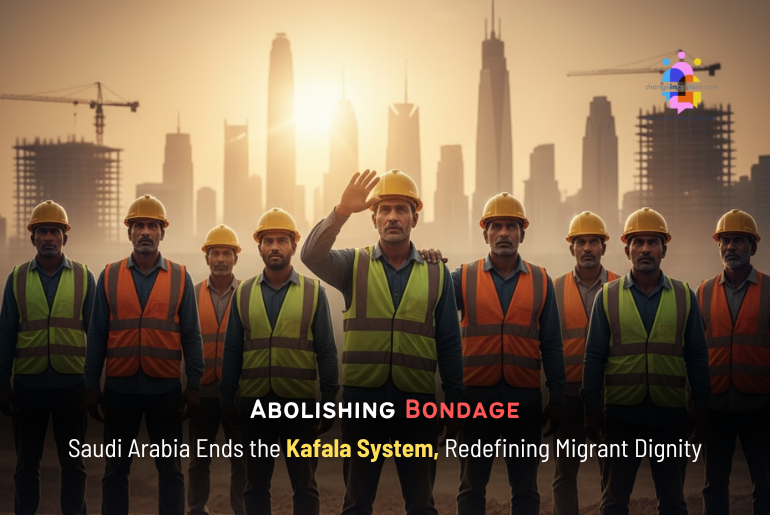
For decades, the Kafala System dictated the lives of millions of migrant workers across the Gulf. It was not a policy as much as a practice. A practice that quietly turned economic migration into a form of bondage.
Now, in a landmark reform, Saudi Arabia has officially abolished the Kafala System. They are now replacing it with a contractual model designed to improve worker rights, independence, and dignity.
The move aligns with the Kingdom’s Vision 2030, which is a national roadmap for social and economic transformation. The decision has the potential to impact over one million migrant workers, including hundreds of thousands from India.
However, to understand the weight of this decision, one must grasp what the Kafala System truly was and why its end signifies a profound moral shift.
What was the Kafala System?
The Arabic word Kafala means “sponsorship.” In practice, it meant control.
Under the Kafala System, every migrant worker entering Saudi Arabia required a local sponsor (usually their employer). This sponsor held legal authority over the visa, employment status, and mobility of the individual. The worker’s right to work, change jobs, travel abroad, or even exit the country depended on the sponsor’s consent.
Saudi Arabia first institutionalised the system in the 1950s. That is when Gulf nations began importing labour from South and Southeast Asia to meet their oil-driven economic boom. Over time, it expanded to include domestic workers, construction labourers, healthcare staff, and service professionals. These workers formed the invisible backbone of Gulf economies.
Yet beneath the façade of opportunity, the system normalised dependency and vulnerability.
The human cost: A system critics called ‘Modern-day slavery’
The Kafala model gave employers a level of control that blurred the line between employment and ownership. Many sponsors confiscated passports, withheld salaries, or restricted mobility. Workers who protested risked deportation, unpaid wages, or even imprisonment.
For countless migrant families from India, Bangladesh, Nepal, and the Philippines, this system turned dreams of prosperity into cycles of exploitation.
During the years leading up to the 2022 FIFA World Cup in Qatar, the world finally noticed. Global scrutiny intensified after reports revealed thousands of migrant workers (many of them South Asian) had died under extreme heat and unsafe working conditions during the construction of stadiums and infrastructure.
The Kafala System, critics argued, had made this possible by giving employers near-total power over workers’ fates.
Human rights organisations, including Amnesty International and the International Labour Organisation (ILO), repeatedly called it “a structure that facilitates forced labour.”
For the millions who endured it, the end of Kafala is not just administrative reform. It is a release.
Why Saudi Arabia ended the Kafala System
Saudi Arabia’s decision to dismantle Kafala did not arrive overnight. It is part of Crown Prince Mohammed bin Salman’s Vision 2030. They seek to modernise the Saudi economy, attract global investment, and improve its international reputation on human rights.
The old system was incompatible with the new narrative of a reforming, forward-looking Saudi Arabia. The global economy increasingly demands compliance with fair labour practices. Saudi leaders recognised that retaining Kafala risked alienating investors and international partners.
But this is also about internal transformation. The Kingdom is diversifying beyond oil, expanding into tech, services, and tourism. For that, it needs a workforce that is not just available but motivated and free.
What the new labour reform brings
The new contractual model, introduced under the Labour Reform Initiative (LRI), replaces sponsorship with a more equitable relationship between employers and workers.
Under the new system, migrant workers in Saudi Arabia can:
- Change jobs without employer approval after your contract ends, or after serving the required notice period.
- Exit and re-enter the country without requiring the sponsor’s authorisation.
- Travel abroad permanently with a digital notification, rather than an exit permit.
The reform also enhances access to digital documentation, wage protection systems, and complaint redressal platforms. Hence, it provides migrant workers with tools they have never had before.
Officials say the new model will boost worker independence. Moreover, it will help the Kingdom attract global talent by improving transparency and fairness in the labour market.
What this means for India
India is the largest single source of migrant workers in the Gulf Cooperation Council (GCC) region. Over 2.5 million Indians are residing in Saudi Arabia alone.
For decades, remittances from these workers have fueled local economies in states such as Kerala, Tamil Nadu, and Telangana. However, they have also come at a human cost. Stories of unpaid wages, confiscated passports, and inhumane working conditions have long haunted India’s migration narrative.
The abolition of the Kafala System could dramatically reduce such exploitation. It gives Indian workers legal agency and safer negotiation power. It is especially beneficial for those in low-wage sectors such as construction and domestic work.
However, experts caution that implementation will determine impact. Rules can change overnight, but attitudes, systems, and enforcement mechanisms take longer to implement.
The Gulf-wide ripple effect
Saudi Arabia’s decision could also influence neighbouring GCC nations. Bahrain abolished its Kafala system in 2009, and the UAE has partially reformed it since 2015. Qatar has introduced limited mobility reforms but continues to face scrutiny for poor implementation.
Saudi Arabia’s move (given its size and influence) sets a new precedent for the region. It signals that the era of total employer control is fading. Moreover, it signals that migrant dignity can co-exist with economic ambition.
Kafala system abolished: Between reform and reality
The abolition of the Kafala System is undoubtedly historic, but it is not yet a victory. The real test will be in its enforcement. The challenge would be whether workers can truly access justice when their rights are violated.
The challenge lies in bridging the gap between legal change and lived experience.
Workers may still depend on intermediaries, face contract substitution, or struggle with language barriers. All these can prevent them from understanding their new rights. Advocacy groups insist that training, awareness, and cross-border legal support must accompany reform if it is to be more than symbolic.
But one thing is clear: a door has opened.
For decades, workers under Kafala could not choose their own destinies. Now, at least on paper, they can.
Conclusion: The light beyond the labour camp
The end of the Kafala System is a beginning. It is a recognition that the dignity of work cannot depend on the mercy of an employer.
For millions who left their homes in India, Pakistan, Nepal, and the Philippines to build the skylines of the Gulf, this is more than a policy change. It is an overdue acknowledgement that progress without fairness is not development. Instead, it is exploitation in disguise.
Saudi Arabia’s step is both moral and pragmatic. It redefines labour not as servitude but as partnership. And for the global South, whose people fuel economies far from home, it offers a small but powerful truth: freedom, like labour, must always be earned — and protected.
Disclaimer: The views expressed in this article are based on the writer’s insights, supported by data and resources available both online and offline, as applicable. Changeincontent.com is committed to promoting inclusivity across all forms of content. We broadly define inclusivity as media, policies, law, and history. It encompasses all elements that influence the lives of women and marginalised individuals. Our goal is to promote understanding and advocate for comprehensive inclusivity.