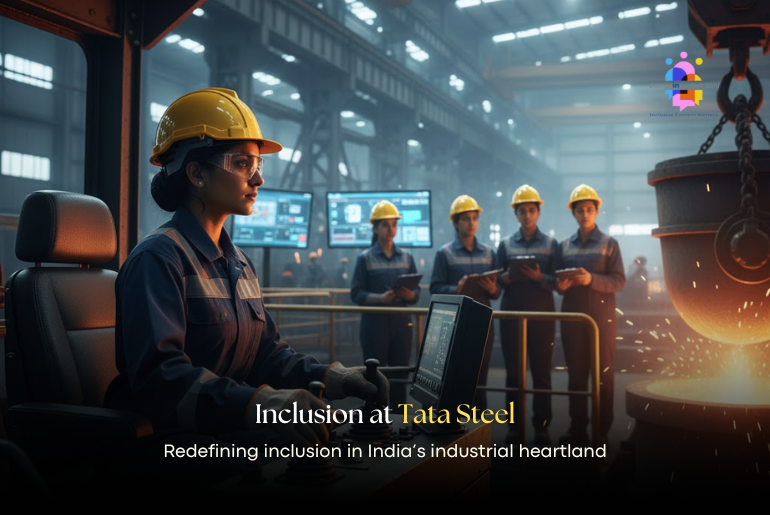
For decades, India’s industrial and mining sectors have been seen as male-only domains. These are places where women were “not meant” to work beyond office walls. But Tata Steel is challenging that narrative with data, determination, and an unshakable belief in equality.
In December 2024, Tata Steel made history by running India’s first all-women shift at the Noamundi iron mine. The shift included women employees in every mining task, including operating Heavy earth-moving machinery (HEMM), shovels, loaders, drills, and dozers, along with shift supervision.
In September 2025, the company deployed women employees across all three shifts in the outbound logistics department at its Kalinganagar plant in Odisha. These were all part of Tata Steel’s DEI strategy to achieve gender balance in industrial operations, a sector traditionally dominated by men.
Following these milestones, Tata Steel announced plans to include women in all three shifts at its Jamshedpur plant from February 2026. The plan aims to expand women’s roles in core operational work across its plants and promote equal access to industrial employment.
Tata Steel to deploy over 500 women employees in three-shift operations
Tata Steel will include women employees in all three shifts at its Jamshedpur plant starting February 1 next year. As part of the diversity and inclusion initiative, Udaan: Wings of Change, the company plans to deploy around 543 women across 21 departments in three-shift operations by that date. The decision marks a significant step in integrating women across core manufacturing roles and not limiting them to traditional day shifts within heavy industry.
Tata Steel has developed a detailed support system to ensure safety, security, well-being, and professional development for the women employees participating in the program. The company stated that this initiative follows recent regulatory approvals by the government. For decades, labour laws in India restricted women from working night shifts in factories due to safety concerns. Only in recent years have governments started granting exemptions to companies that ensure safety and welfare measures.
Manufacturing is often seen as “men’s work.” By including women in all shifts, Tata Steel challenges that stereotype and normalises their presence on the shop floor, in production lines, and in technical departments.
In a company statement, Atrayee Sanyal, Chief People Officer, said, “The ‘Udaan: Wings of Change’ initiative is a testament to Tata Steel’s deep-rooted commitment to empowering women and fostering a truly inclusive workplace.“
Women@Mines: Gender inclusion in mining operations
The initiative began in 2019 with the launch of Tata Steel’s flagship diversity programme, Women@Mines, making the company the first in India to deploy women in all shifts at its mines following the Government of India’s relaxation of the Mines Act, 1952. Building on this, Tata Steel introduced the Tejaswini programme to recruit and train women from local communities to operate Heavy Earth Moving Machinery (HEMM) and participate fully in mining operations.
The Tejaswini 2.0 programme, launched in 2021, trained women from nearby communities as HEMM operators. Participants received rigorous preparation in technical and operational skills, simulator sessions, safety protocols, and physical fitness. By April 2022, trained women joined the workforce in roles including dumper, shovel, dozer, grader, and drill operators.
Following this success, the Tejaswini 2.1 programme was launched in 2022. It received over 2,100 applications and resulted in the selection of 24 operators. It resulted in further expanding women’s participation in core mining operations.
In January 2025, Tata Steel Kalinganagar inducted 39 trade apprentices from the 2023 batch, including 26 women. Eighteen of them joined the outbound logistics department. These women completed comprehensive training in safety, quality, dispatch processes, inventory management, and digital tools.
Women’s empowerment in mining and heavy industry
Because of the way the industry is set up, with harsh working conditions, remote locations, safety risks, and traditional mindsets, the metals and mining sector has built-in challenges. These challenges make it hard for women to join or grow in the field. Even when women entered the workforce, their roles were often limited to administrative or support functions rather than production or technical fields.
With better technology, automation, and stronger workplace safety systems, the idea of who can work in mines or heavy industries is being redefined. Women are increasingly taking on roles once considered beyond their reach, from machinery operation and logistics to quality control and engineering. The progress may be slow and change takes time, but every move toward inclusion makes the industry better, fairer, and closer to representing everyone it serves.
The final thoughts
When women step into roles that were once out of reach, they do more than operate machines or manage production lines. They break stereotypes that have limited generations. They show that skill, focus, and determination are not defined by gender. This change does not just benefit one company. It sets an example for the entire industrial sector and sends a strong message to future employers and policymakers.
But inclusion cannot stop at hiring. We must support it with safety systems, training, and respect at the workplace. When you create equal opportunities and back them with real support, you empower women to grow and contribute fully. Progress becomes a shared responsibility and a shared achievement.
Changeincontent perspective
At Changeincontent, we often talk about policy-driven inclusion. But what Tata Steel demonstrates is infrastructure-driven inclusion. It embeds equality into systems, not just HR guidelines.
The company’s “Udaan: Wings of Change” and “Women@Mines” programmes are not token efforts. Instead, they are structural blueprints for the future of industrial India. When women operate dozers, shovels, and drills in the same mines that once excluded them, it signals a more profound cultural shift, from permission to participation.
Inclusion, when done right, is not symbolic. It is operational. It is when diversity becomes part of the production line, not an annual campaign.
By deploying women in mining, manufacturing, and logistics, Tata Steel is rewriting what an inclusive factory floor looks like. Moreover, they are proving that equality is not an HR goal, but a business competency.
Also Read: Equal opportunities at Tata Group: A commitment to inclusivity and fairness.
Disclaimer: The views expressed in this article are based on the writer’s insights, supported by data and resources available both online and offline, as applicable. Changeincontent.com is committed to promoting inclusivity across all forms of content. We broadly define inclusivity as media, policies, law, and history. It encompasses all elements that influence the lives of women and marginalised individuals. Our goal is to promote understanding and advocate for comprehensive inclusivity.