
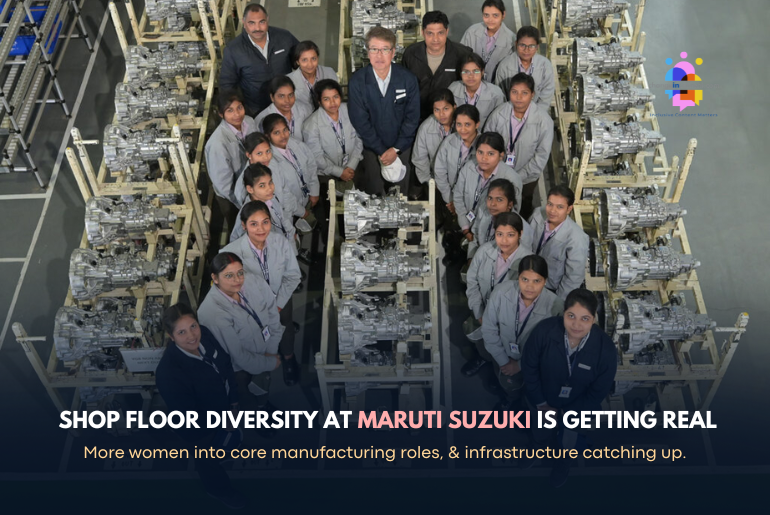
For years, everyone built the image of the Indian automobile shop floor around one assumption: this is men’s work. Heavy, technical, repetitive, industrial, and therefore male by default. That is what makes the latest shift at Maruti Suzuki worth paying attention to. The company is not only increasing women’s presence in manufacturing. It is doing so in the very spaces that have historically been treated as least open to them, including assembly, quality, and engine and transmission roles.
That matters because inclusion in manufacturing is often discussed in general terms, while the actual shop floor remains slower to change. Maruti Suzuki’s recent hiring (over 190 women) push suggests a more practical model: if companies want women in core roles, they need to design the conditions that make those roles workable. The shift is not only about representation. It is about whether manufacturing can finally stop treating women’s participation as exceptional.
Shop floor diversity at Maruti Suzuki is becoming more visible in core manufacturing roles
Over the last two years, Maruti Suzuki has increased the number of women working at its Gurugram and Manesar plants. The company has focused on hiring women for roles in vehicle manufacturing, as well as in engine and transmission work. These are areas that many had earlier seen as male-dominated.
Women employees now take part in key functions like assembly and quality checks. The company says women workers have become an important part of these processes, especially in tasks where accuracy matters every day.
This initiative has helped the company cross 1,300 women employees across its operations. Much of this growth comes from hiring on the shop floor at its Gurugram and Manesar facilities. The effort shows how the company is bringing more women into core manufacturing roles, not just office-based or desk jobs.
How Maruti Suzuki is backing shop floor diversity with support systems
Hisashi Takeuchi, Managing Director and CEO of Maruti Suzuki, said the company already has women working across teams like engineering, sales, finance, legal, logistics, and supply chain. He pointed out that real inclusion shows on the shop floor, where employees work together to build vehicles with care and accuracy.
To make this possible, the company has taken several steps following a review of its facilities. It has added dedicated restrooms and changing areas for women, as well as crèche services for working mothers. It has also improved safety by increasing the number of security staff and establishing regular patrols, especially during evening shifts.
Maruti Suzuki has also started sensitisation initiatives to build a more respectful workplace. These sessions focus on how employees interact with one another and how teams can work more effectively together on the shop floor. The company also makes it compulsory for employees to attend the POSH training.
More women hired, but Maruti Suzuki also focuses on what comes after
Maruti Suzuki said it has hired more than 190 women on its shop floor in the past year. With this, the total number of women employees across all roles in the company has crossed 1,300.
What stands out here is that the company did not stop at hiring. It looked at what women employees actually need to stay and work comfortably in these roles. After studying these needs, the company implemented infrastructure and safety changes to support this shift.
It matters because many companies bring in women but fail to create the right conditions for them to continue.
What companies often miss after recruitment
Lack of proper facilities, safety concerns, and weak support systems often lead to women leaving these jobs. In that sense, hiring numbers alone do not tell the full story. What happens after hiring determines whether women remain part of the workforce.
By focusing on both hiring and support, the company demonstrates a more practical approach that prioritises long-term participation over short-term numbers.
Read next: Women in the electronics industry are outpacing men in employability.
The Changeincontent perspective
The strongest part of this story is that it pushes inclusion beyond the office corridor and onto the production line. Many companies are comfortable celebrating women in strategy, HR, finance, or communication, while the shop floor remains one of the last stubbornly male spaces.
What Maruti Suzuki is doing matters because it shifts that visual and structural norm. It suggests that the question is no longer whether women can do this work, but whether companies are willing to redesign workspaces so women can enter, stay, and advance there on equal terms.
That said, this kind of progress should never be measured by entry alone. The more serious test will be whether women remain after one year, whether they grow into supervisory and technical leadership roles, and whether the systems built for them today remain strong enough when the hiring spotlight moves on. Inclusion becomes real only when retention, progression, and everyday safety become part of the same commitment as recruitment.
The closing thoughts
If companies want more women on the shop floor, they cannot stop at hiring. They have to look at safety, basic facilities, childcare, and behaviour at work. What Maruti Suzuki shows is that inclusion requires long-term planning. It needs companies to listen, adjust, and fix everyday problems that often go ignored. Without that, hiring stays temporary.
If more women join, do they stay after one year? Do they move into better roles? Do they feel safe enough to continue? These answers matter more than any hiring figure.
Disclaimer: The views expressed in this article are based on the writer’s insights, supported by data and resources available both online and offline, as applicable. Changeincontent.com is committed to promoting inclusivity across all forms of content. We broadly define inclusivity in terms of media, policies, law, and history. It encompasses all elements that influence the lives of women and marginalised individuals. Our goal is to promote understanding and advocate for comprehensive inclusivity.
