
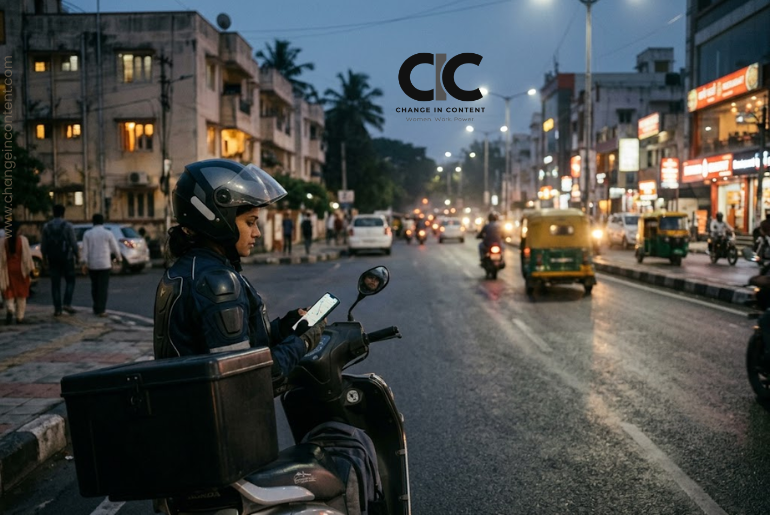
The Quick Read
- Women make up only 0.8% of drivers on the Indian platforms studied, compared with 1.5% in Indonesia.
- Women who enter platform-based driving and delivery work tend to work fewer hours and are more likely to log in during spare time rather than follow a regular full-time schedule.
- In India, women earned 6–8% less per hour than men. In Indonesia, the estimated gap ranged from 8% to 22%.
- The difference was linked partly to when, where and what women were willing or able to drive, with safety and domestic responsibilities shaping those choices.
- Women reported more harassment in both countries. Indonesian women also faced widespread customer discrimination and higher accident rates.
- Yet many women had been unemployed before joining a platform and were more likely than men to say they earned more than in their previous work.
- The lesson is not that platforms have failed women entirely. It is that flexibility can open a door without removing what stands behind it.
At 7 pm, the app may be offering higher incentives. Orders are increasing. Commuters are heading home. Drivers willing to remain online can earn more from the evening rush.
For a woman driver, 7 pm may mean something else. The road is becoming less safe. A child is waiting at home. The next passenger’s destination is unfamiliar. The return trip may take her through an area she would rather avoid after dark.
She switches off the app. The platform records fewer hours and lower earnings. It does not record the calculation that produced them.
This is the central tension facing women in the platform economy. Digital platforms promise workers the freedom to decide when and how much they work. For women, that freedom operates within limits created outside the app: personal safety, unpaid care, family approval, vehicle ownership and the behaviour of customers.
A new National Bureau of Economic Research working paper offers unusually detailed evidence from women working as two-wheeler drivers and delivery partners in India and Indonesia. Its findings do not support either of the convenient stories often told about gig work.
Platform work is not simply liberation. Nor is it merely exploitation. For some women, it creates an income opportunity they did not have before. But women enter in tiny numbers and receive unequal returns because the supposedly flexible worker is still expected to navigate a deeply gendered world.
Women in the platform economy: What did the study examine?
The researchers partnered with some major two-wheeler driving and delivery platforms in India and Indonesia.
They surveyed representative samples of platform workers, deliberately including more women than their actual workforce share so gender differences could be examined. The Indian sample covered 404 women and 2,153 men. The Indonesian sample included 892 women and 2,114 men. Interviews were conducted by telephone between February and July 2024.
For India, the researchers also examined several months of platform records covering working hours and compensation. This allowed them to compare what workers reported with how they actually logged in and earned through the platform. Indonesia’s analysis relied mainly on survey data.
The paper is descriptive. It identifies patterns and possible explanations but does not claim that gender alone caused every difference. It is also an NBER working paper circulated before peer review.
Even with those limitations, the data provides a close view of an occupation in which women are visible on advertising campaigns but almost absent from the workforce itself.
The first number is 0.8%
Women represented only 0.8% of the Indian platform drivers studied. In Indonesia, the proportion was 1.5%. That is not a modest gender gap. It is near-exclusion.
Platform driving is frequently presented as work with low formal barriers. A person needs a suitable vehicle, a smartphone, documentation and the ability to complete the work. There is no conventional office interview or long promotion ladder.
Yet “low barrier” depends on who is approaching it. A woman may be less likely to own or control a two-wheeler. She may never have been taught to ride one. Her family may object to her carrying unknown passengers or travelling alone. She may lack access to the money required for a vehicle, fuel, repairs and registration.
The work may be available on the app while remaining socially or materially unavailable to her. That distinction matters whenever platforms describe themselves as democratising work.
Technology can reduce one gatekeeper. It cannot automatically remove the family member who controls the vehicle, the lender who doubts the borrower, the unsafe road or the passenger who refuses a woman driver.
Change in Content’s earlier analysis of women and gig work in India found that women remain a minority across the platform workforce. Most women are often concentrated in domestic, care and beauty services rather than driving and delivery. The latest paper shows how much narrower participation becomes in occupations that require mobility through public space.
Flexibility is valuable because women’s lives are inflexible
Women in both countries placed greater value on flexibility and supplemental earnings than men did. They worked fewer hours and were more likely to log in during free time rather than treat the platform as a fixed, full-time occupation. A disproportionate share had been unemployed before joining. Women were also more likely than men to report earning more through the platform than in their previous work.
It is an important part of the evidence. A woman managing children, household work or another income activity may be unable to accept a conventional job with fixed hours. Platform work lets her enter for two hours, leave, and return when her time becomes available again.
That flexibility can be economically meaningful.
It can allow someone who was previously outside paid employment to begin earning. It can provide money without requiring an employer’s permission for every change in schedule. And it can accommodate care emergencies more easily than many formal jobs.
But there is a danger in praising flexibility without asking why women require so much of it.
- A woman may be working around a child’s school day because the platform is innovative.
- She may also be doing so because the household still assumes that childcare is hers.
- She may log in only during daylight because she can choose her hours.
- She may also be avoiding the more profitable evening period because the city has failed to make mobility safe.
The platform offers a flexible response to an inflexible social arrangement. That is useful. It is not the same as correcting the arrangement.
The earnings gap is produced one choice at a time
Women earned less per hour than men on the platforms studied. In India, the gap was approximately 6–8%. In Indonesia, it ranged from about 8% to 22%, depending on the measure used. It is particularly revealing because platforms often appear gender-blind.
The app does not necessarily display one rate for men and another for women. An algorithm may allocate work using the same formal rules. Prices may depend on distance, demand, timing and type of service rather than the driver’s gender.
Unequal outcomes can still emerge. Women may avoid:
- Late-night shifts;
- Isolated areas;
- Long-distance journeys;
- Passengers or deliveries that end far from home;
- High-risk routes;
- Services involving unknown male customers;
- Hours that conflict with household responsibilities.
Each decision may be sensible. Together, they can lower earnings.
Peak periods often pay more because they are inconvenient, congested or risky. A worker able to remain online late, travel widely and accept the next job without considering the return route has access to a larger earnings field.
A worker operating within a smaller safety and care radius does not. That is a gender tax that may never appear as a line on the payment statement.
The woman is not formally charged for being a woman. She earns less because protecting herself and meeting unpaid obligations alter how she can participate.
India’s wider gig workforce already faces unstable earnings and limited protections. Women encounter those uncertainties alongside additional restrictions on time, mobility and acceptable risk.
The algorithm sees availability. It does not see why she is unavailable
Suppose the platform rewards drivers who complete more trips, remain online during peak demand and accept jobs consistently.
On paper, these rules are equal. In practice, they can reward the worker whose life most closely resembles the model assumed by the platform. That model is often someone who:
- Controls the vehicle;
- Can remain available at short notice;
- Can work after dark;
- Has no urgent care duties;
- Can travel anywhere the app sends them;
- Is not routinely rejected by customers;
- Can absorb the risk of an unsafe journey.
Women may be less able to meet those conditions, not because they lack commitment but because the cost of doing so is higher.
Algorithmic management can convert existing inequality into performance data.
A woman declines a distant booking for safety. The system records a rejected job. She logs off to collect her child. The platform records lower availability.
A customer cancels after discovering the driver is a woman. The system may record an incomplete transaction. The social reason disappears, but the worker’s metric remains.
That is why apparently neutral platform rules need gender analysis. Equality in the code does not guarantee equality in the working day.
Harassment is part of the business model unless the platform prevents it
Women reported higher levels of harassment in both India and Indonesia. In Indonesia, women also faced widespread customer discrimination and higher accident rates.
Driving and delivery work puts workers in public space while repeatedly connecting them with strangers. The work may involve private addresses, isolated pick-up points, unfamiliar routes and late hours.
Women can face harassment from passengers, customers, other road users and people at collection points.
They may also face subtler forms of exclusion. A customer might cancel after seeing a woman’s name or photograph. A passenger may doubt her ability to drive. Someone may request personal information, make comments about her appearance or treat the journey as an invitation to conversation she did not choose.
In an office, an employer has at least a visible duty to create a safe workplace. Platform work makes the boundary less convenient.
Is the workplace the app, the road, the restaurant, the passenger’s home or the customer’s doorstep?
The platform cannot avoid responsibility by arguing that harassment occurred between two independent users. It created the match, designed the transaction and earns from its completion.
Safety must therefore be treated as part of the product, not as advice given to the woman before she goes online.
The growth of quick-service apps employing women in private homes raises the same question. Platforms cannot formalise access to labour while leaving the worker alone with risks created by the service model.
A woman-only service may help. It can also shrink the market
One response is to connect women drivers only with women passengers. It can improve comfort and reduce some forms of risk. It may encourage families to support women’s participation and attract female passengers who feel safer with women drivers.
But the model has limits.
If women drivers can accept only women customers, their pool of potential work becomes smaller. Demand may be uneven across hours and locations. A worker could spend longer waiting for the next eligible passenger, reducing utilisation and earnings.
Women-only systems can become a useful entry route while unintentionally creating a separate, lower-volume market.
The aim should not be to keep women permanently inside a protected corner of the platform economy. It should be to make the wider marketplace safe enough for them to participate on equal terms.
That may require women-only options for workers and passengers who prefer them, combined with stronger protections across the full platform.
Asset ownership is the hidden entry ticket
Driving work depends on more than willingness.
A worker needs access to a two-wheeler, licence, smartphone, fuel and working capital. Vehicle repairs can interrupt earnings immediately. A loan or rental arrangement can create a fixed cost even when demand falls.
Women generally have less control over household assets and formal finance. A vehicle registered in a male relative’s name may technically exist in the household without being available to her.
Even when the family agrees, she may get the vehicle only after someone else has finished using it. Her “flexible” working hours are then built around another person’s priority. Platforms interested in recruiting women cannot treat asset access as someone else’s problem.
Possible interventions include:
- Vehicle leasing designed around part-time work;
- Lower-deposit finance with responsible underwriting;
- Driving and road-safety training;
- Help obtaining licences and documentation;
- Affordable insurance;
- Maintenance support;
- Shared charging or parking infrastructure for electric vehicles;
- Safeguards ensuring that the woman retains control of the financed asset.
Recruitment campaigns will achieve little when the basic tool of work remains out of reach.
Platform work can improve a woman’s income without becoming a good job
One of the most valuable findings is that women were more likely to have been unemployed before entering platform work and more likely to say their current earnings exceeded those from previous jobs. That should not be minimised.
A job does not need to be perfect to improve someone’s life. A woman who begins earning may gain greater say in household spending, confidence in public spaces and access to future opportunities. But improvement relative to the previous option does not settle whether the present option is fair.
A woman can earn more than before and still earn less per hour than a man.
- She can value flexibility and still need social protection.
- She can prefer platform work to unemployment and still face harassment.
- She can choose the job freely from a set of choices narrowed by gender.
Public discussion often demands that platform work be classified as either empowerment or exploitation. The data suggests a more honest answer. It can be both opportunity and inequality in the same working day.
The household may gain an earner without losing a caregiver
Paid work does not automatically reduce unpaid work.
A woman may complete deliveries for three hours, return home, prepare meals, care for children and resume work if time remains. The platform expands her economic activity without redistributing her domestic responsibilities.
It can turn flexibility into fragmentation. She works whenever nobody else needs her.
The resulting schedule may include many transitions, short sessions and periods of unpaid waiting. She may spend a long day moving between paid and unpaid responsibilities while platform records show only a few hours online.
Employers in conventional workplaces have begun to recognise that care affects workforce participation. Platforms must do the same without converting flexibility into another mechanism for transferring every adjustment to the worker.
The future of women’s digital work in India depends on creating higher-value pathways and safer systems, rather than simply allowing women to fit income-generating tasks into whatever time remains after care.
What should platforms change?
The paper provides descriptive evidence rather than a formal policy programme. Its findings nevertheless point towards practical questions for platforms, governments and investors.
Design safety around the journey, not the emergency button
An emergency button is useful after danger has emerged. Better systems should reduce exposure before that moment. Platforms could allow workers to:
- Set preferred geographic zones without losing ranking;
- Avoid isolated drop-offs after specified hours;
- See sufficient destination information before accepting;
- Request jobs that end near home;
- Share real-time trips with trusted contacts;
- Reach a trained human safety team quickly;
- Block customers reported for harassment;
- Appeal penalties linked to safety-related cancellations;
- Access safe waiting points, toilets and charging areas.
A woman should not have to choose between protecting her safety and protecting her acceptance rate.
Examine gender differences in algorithmic outcomes
Platforms possess detailed information on working time, cancellations, destination patterns, earnings, customer ratings and incentive access. They should analyse:
- Hourly earnings by gender;
- Participation in peak periods;
- Customer cancellations after driver assignment;
- Complaint rates and outcomes;
- Safety-related trip refusals;
- Time spent waiting between jobs;
- Access to bonuses;
- Account suspensions and appeals;
- Retention after the first three and six months.
A gender-neutral algorithm should be tested for gendered effects. Without that analysis, platforms may repeatedly call unequal outcomes personal preferences.
Make flexibility compatible with incentives
Incentives commonly reward long or uninterrupted working periods. That design disadvantages people who can participate only in shorter windows. Platforms could test:
- Proportional bonuses rather than all-or-nothing thresholds;
- Incentives based on completed work across several sessions;
- Advance visibility of likely demand;
- Minimum earning guarantees during selected periods;
- Part-time pathways without reduced status;
- Benefits that do not require near-full-time availability.
Flexibility should not be advertised to women and penalised by the payment structure.
Treat customer discrimination as a platform failure
Customers who cancel because the driver is a woman should not be allowed to impose the financial cost on her.
Repeated discriminatory behaviour should have consequences. Platforms can monitor cancellation patterns, remove ratings associated with harassment and compensate workers for certain customer-initiated failures.
The customer is not always right. Sometimes the customer is the workplace risk.
Build women’s progression beyond one gig
Driving and delivery can be an entry point into logistics, fleet management, training, safety operations, customer support, vehicle maintenance and entrepreneurship. Platforms should create routes for experienced women to become:
- Driver trainers;
- Hub supervisors;
- Fleet managers;
- Safety specialists;
- Local recruiters;
- Quality auditors;
- Operations leads;
- Vehicle owners employing other drivers.
Otherwise, participation remains tied permanently to the next trip.
The 90-day eligibility rules governing Indian gig workers also show why fragmented work histories can affect access to social-security protections. Platform careers need benefits and recognition that can travel with the worker rather than disappearing whenever she changes apps.
What should public policy address?
India’s platform economy is expected to employ millions more workers over the coming years. Regulation cannot assume that every worker enters with equal assets, mobility and bargaining power.
Policy priorities should include:
- Portable social security across platforms;
- Accident, disability and health insurance;
- Clear standards for platform-funded worker welfare;
- Fast grievance systems;
- Protection against arbitrary account deactivation;
- Sex-disaggregated platform workforce data;
- Access to public toilets and safe rest points;
- Affordable vehicle finance;
- Training and licensing support;
- Recognition of harassment involving customers and third parties;
- Representation of women workers in policy design.
India’s rapid growth in blue-collar gig jobs makes this urgent. A sector expanding quickly can either reproduce old labour inequalities at scale or build protections before harmful practices become permanent.
The objective should not be to protect women out of mobility-based work. It should be to ensure that safety does not become another word for exclusion.
What would genuine success look like?
A platform may announce that it has doubled the number of women drivers. If the number rises from 100 to 200 in a workforce of tens of thousands, the campaign has produced visibility rather than transformation.
A meaningful scorecard would ask:
- What share of active workers are women?
- How many remain after six and twelve months?
- Is the hourly earnings gap narrowing?
- Are women accessing peak demand safely?
- How often do customers cancel after assignment?
- Are harassment reports resolved?
- Do women control the vehicles they use?
- How many move into supervisory or ownership roles?
- Has platform work increased their control over income?
- Has it reduced or merely reorganised their time poverty?
The paper’s 0.8% figure should become a baseline for action rather than a surprising statistic used for a few days.
Women in the platform economy: The Change Ahead
The platform economy did not create the conditions restricting women’s work. It inherited unsafe streets, unequal care, weaker asset ownership and social suspicion of women moving independently through public space. But platforms do not merely operate inside society. They redesign labour within it.
Their algorithms determine which behaviours earn more. At the same time, their incentives decide what availability is valuable. Their safety systems determine whose risk is absorbed. Their customer rules decide whether discrimination carries a cost. And their data can reveal inequality or keep it hidden.
The new research shows that women value platform work because it opens an economic door. Many were previously unemployed. Many earn more than they did before. The flexibility is real. So is the penalty attached to using it as a woman.
Women work fewer hours because their time is claimed elsewhere. They avoid certain routes because danger is not evenly distributed. They earn less per hour because the safest choice is not always the most profitable one.
The platform economy promises work on demand. For women, the unanswered question is whose demands come first: the app’s, the customer’s, the household’s or their own.
A fairer platform economy will not simply recruit more women riders. It will ensure that a woman can go online without safety, care and discrimination quietly deciding her earnings before the first job arrives.
Editorial Note and Sources
This article is based primarily on NBER Working Paper 35467, Women in the Platform Economy: Descriptive Evidence from Drivers in India and Indonesia, by Achyuta Adhvaryu and co-authors. The study uses survey and administrative data from selected partner platforms and focuses on two-wheeler driving and delivery work. Its findings should not be generalised automatically to every platform, city or category of gig work. The paper is descriptive, circulated before peer review, and does not establish a causal explanation for every gender difference reported. This article adds independent editorial interpretation and policy analysis.
Principal sources
- National Bureau of Economic Research: Women in the Platform Economy: Descriptive Evidence from Drivers in India and Indonesia.
- IDinsight: Research summary, methodology and key findings from India and Indonesia.
- International Labour Organisation: Research on gender inequality, occupational segregation and algorithmic management in the digital economy.
- NITI Aayog: India’s Booming Gig and Platform Economy: Perspectives and Recommendations on the Future of Work.
