The Quick Read
- Defence Minister Rajnath Singh has approved new Coast Guard reforms to boost gender equality in officer recruitment and service conditions.
- Women candidates can now enter both Permanent Appointments and Short Service Appointments on the same terms as men.
- Serving women officers on short-service appointments may apply to convert to permanent appointments, subject to eligibility conditions.
- Existing women officers holding permanent appointments will be considered for higher promotions when they meet the prescribed requirements.
- A separate reform will speed up compensation and terminal benefits for families of Coast Guard personnel missing at sea while on duty.
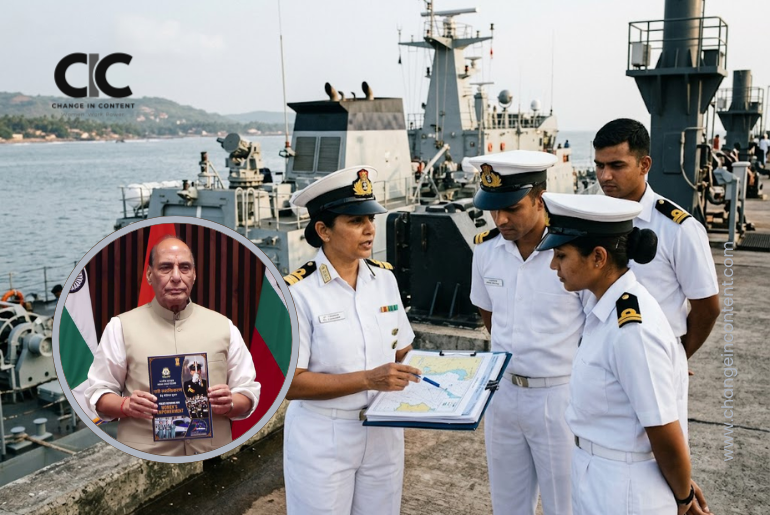
Defence Minister Rajnath Singh has unveiled two policy reforms for the Indian Coast Guard, including a gender-neutral framework for the recruitment and career progression of officers.
The Coast Guard reforms to boost gender equality will allow women to join through both Permanent Appointments and Short Service Appointments on the same basis as male candidates. The Ministry of Defence announced the changes on 28 July 2026.
The reforms were unveiled at Kartavya Bhavan-2 in New Delhi in the presence of Defence Secretary Rajesh Kumar Singh, Indian Coast Guard Director General Paramesh Sivamani and other senior officials.
What changes for women joining the Indian Coast Guard?
Under the new policy, officer recruitment will follow a gender-neutral framework from the initial training stage.
Women candidates will be eligible for:
- Permanent Appointments, or PA;
- Short Service Appointments, or SSA;
- comparable career-progression opportunities after joining.
Short Service Appointments have also been opened to male candidates. That brings both appointment routes under a common framework.
The policy also addresses women who are already serving in the Coast Guard.
Existing women officers holding permanent appointments will be considered for promotion to higher ranks. This will happen when they satisfy the applicable eligibility requirements. At the same time, women officers currently serving through short-service appointments will have the option of converting to permanent appointments. However, it will be subject to the prescribed conditions.
Permanent appointments can provide longer career continuity and a clearer route towards senior ranks. The conversion provision may therefore allow eligible serving women officers to build more sustained careers within the force.
Coast Guard reforms to boost gender equality: Why does the reform matter?
The Indian Coast Guard performs responsibilities involving coastal security, maritime surveillance, search and rescue, pollution response and the protection of India’s maritime interests.
Equal access at recruitment must therefore be supported by equal access to training, operational experience and promotion. The latest policy formally extends that career framework to women officers from the beginning of their service.
The development also comes as women’s participation across India’s wider maritime sector is increasing. Change in Content recently reported that women’s participation in India’s maritime sector has risen by 340% since 2020, alongside efforts to expand their presence in shipping, ports, logistics and maritime administration.
Women are also taking on greater responsibility across India’s security ecosystem. An earlier Change in Content report on women officers in CISF leadership roles examined how access to senior operational positions can move inclusion beyond entry-level representation.
What is the second Coast Guard reform?
The second policy announced by the Defence Minister concerns compensation for the families of Indian Coast Guard personnel who go missing at sea while on duty.
The revised process allows an officer or other personnel reported missing at sea to be declared “presumed dead” for the purpose of granting ex-gratia compensation and terminal benefits to the next of kin.
The change is intended to reduce administrative delays faced by families during such cases. The Ministry said the procedure would allow compensation and other benefits to be processed more quickly instead of leaving families waiting through an extended period of uncertainty.
Coast Guard approaches its Golden Jubilee
The Indian Coast Guard will complete 50 years in 2027.
Rajnath Singh said the reforms would strengthen personnel morale and operational effectiveness as the force approaches its Golden Jubilee. He also reiterated the Government’s intention to develop the Coast Guard as a modern and future-ready maritime force.
The Change Ahead
The new appointment rules create a more consistent career framework for women officers in the Indian Coast Guard.
Their impact will become clearer through future recruitment, conversions to permanent service and the number of women progressing into higher operational and command positions.
For now, the policy removes an important structural distinction. It formally places women and men on comparable appointment and career pathways within the force.
Editorial Note and Sources
This Bureau report is based on the official announcement issued by the Ministry of Defence through the Press Information Bureau on 28 July 2026. It summarises the policy changes presently announced; detailed eligibility conditions, implementation procedures and subsequent service rules should be read from official Coast Guard and Ministry of Defence notifications when issued.
Source
Press Information Bureau, Ministry of Defence: Raksha Mantri unveils landmark policy reforms for ICG personnel and their families.