
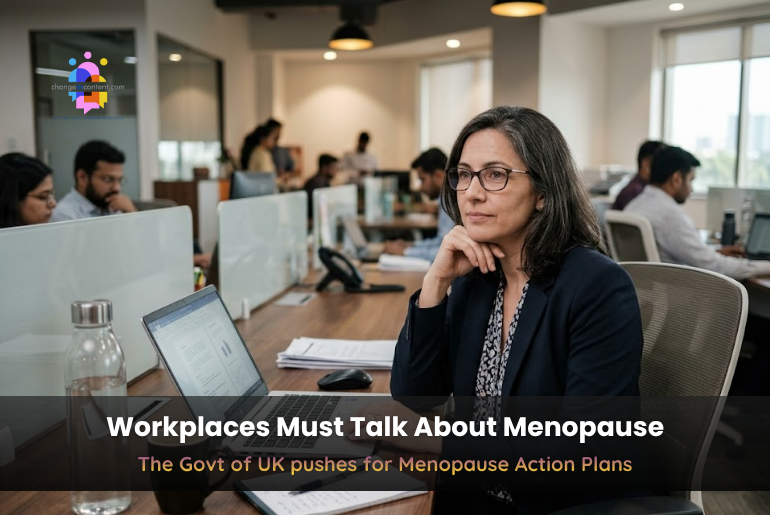
The UK Government’s push for Menopause Action Plans marks a significant shift in how workplaces must respond to women’s health. For decades, menopause has remained an unspoken factor affecting productivity, retention, and career progression. Now, it is being formally recognised within policy frameworks that demand employer accountability.
This move is not symbolic. It is structural. The policy signals a transition from voluntary awareness to measurable action. It is for the employers, HR leaders, policymakers, and organisations that claim to support inclusion, but have yet to address one of the most common and overlooked experiences in the workforce.
Menopause Action Plans: What the UK Govt is proposing
The UK Government has urged employers to publish Menopause Action Plans starting April 2026, positioning them alongside gender pay gap reporting as a formal mechanism for workplace accountability.
These plans must:
- Outline how organisations support employees experiencing menopause
- Define workplace adjustments and accommodations
- Provide clarity on policies, leadership accountability, and employee support systems
- Demonstrate measurable action, not just intent
This recommendation is part of a broader policy initiative aimed at helping women remain, progress, and thrive at work.
Source: The Govt of UK
Why Menopause is now a policy priority
The shift is rooted in hard data and workplace realities.
- Around 1 in 10 women leave their jobs due to menopause-related symptoms
- A significant proportion reduce working hours or step back from leadership roles
- Symptoms such as fatigue, anxiety, and cognitive disruption directly affect performance
Despite this:
- Most organisations lack formal menopause policies
- Many managers are untrained to handle related conversations
- Workplace environments are rarely designed with these needs in mind
Source: BritSafe
It is not a niche issue. It affects a large segment of the workforce, particularly women in their most experienced and leadership-ready years.
Menopause Action Plans and Gender Pay Gap Reporting: A strategic link
The UK Government has strategically aligned Menopause Action Plans with gender pay gap transparency. Why? Because the two are connected. Here is how:
- Women exiting or slowing down careers during menopause directly impacts leadership pipelines
- It contributes to long-term pay disparities
- It weakens organisational continuity and institutional knowledge
By linking menopause support to gender pay gap reporting, the government is making a clear point: Workplace equality cannot exist if critical life stages are ignored.
What must Menopause Action Plans include?
Here is what the policymakers expect Menopause Action Plans to consist of:
1. Workplace adjustments
Organisations are expected to implement practical changes such as:
- Flexible working arrangements
- Temperature-controlled environments
- Access to rest spaces
- Adjusted performance expectations during severe symptoms
2. Managerial training
Managers must be trained to:
- Recognise symptoms without bias
- Handle conversations sensitively
- Offer support without stigma
3. Policy integration
Menopause must be embedded into:
- HR policies
- Health and well-being frameworks
- Diversity, equity, and inclusion strategies
4. Open communication systems
Workplaces must create:
- Safe reporting environments
- Non-judgemental conversations
- Clear escalation and support mechanisms
The workplace reality that Menopause Action Plans are addressing
The absence of structured support has created a pattern:
- Women hesitate to disclose symptoms
- Performance is judged without context
- Career progression slows
- Attrition increases silently
It is not just a health issue. It is a systemic workplace design flaw. When organisations fail to address menopause:
- They lose experienced talent
- They weaken leadership diversity
- They reinforce structural inequality
Global implications: Why this policy matters beyond the UK
Although the policy originates in the UK, its implications are global. Most countries:
- Do not formally recognise menopause in workplace policy
- Treat it as a private matter
- Offer minimal structured support
The UK’s move sets a precedent. It reframes menopause as:
- A workforce participation issue
- A leadership retention issue
- A productivity and inclusion issue
For countries like India, where conversations around menopause remain limited, this becomes an important reference point.
What organisations must learn from Menopause Action Plans
That is where most organisations get it wrong. They treat menopause as:
- A health benefit
- A wellness initiative
- An optional policy
But the UK approach treats it as:
- A workforce strategy
- A retention mechanism
- A leadership continuity issue
Organisations that want to stay competitive must:
- Recognise menopause as a structural factor
- Build policies that go beyond awareness
- Measure impact through retention and progression data
The Changeincontent perspective
The introduction of Menopause Action Plans is not just a progressive policy. It is overdue recognition. But policy alone will not change workplaces.
The real shift will happen when organisations:
- Stop expecting women to adapt silently
- Start designing systems that reflect real life
- Treat health as a workplace responsibility, not a personal burden
If you connect this with our earlier analysis on menopause and mental health.
The gap becomes clearer. Menopause is not just physical. It affects confidence, cognition, emotional health, and identity at work. Ignoring it is not neutrality. It is exclusion.
Conclusion: Menopause Action Plans are redefining workplace accountability
The rise of Menopause Action Plans signals a new phase in workplace policy. We do not see this as a mere inclusion language. It is about operational change.
Because the question is no longer: “Should workplaces support women through menopause?”
The real question is: “Can organisations afford not to?”
Disclaimer: The views expressed in this article are based on the writer’s insights, supported by data and resources available both online and offline, as applicable. Changeincontent.com is committed to promoting inclusivity across all forms of content. We broadly define inclusivity in terms of media, policies, law, and history. It encompasses all elements that influence the lives of women and marginalised individuals. Our goal is to promote understanding and advocate for comprehensive inclusivity.
