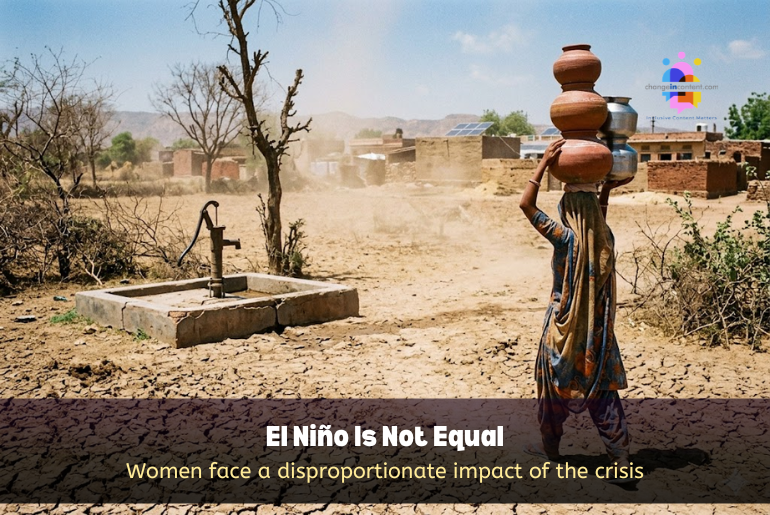
El Niño is once again making headlines in 2026, with global weather agencies warning of rising temperatures, erratic rainfall, and a potentially weak monsoon in India. While most conversations focus on agriculture, heatwaves, and economic disruption, there is a deeper layer that rarely gets the attention it deserves.
That layer is gender.
Because El Niño is not just a climate event, it is a multiplier of existing inequalities. And in countries like India, where women already operate with fewer resources, less mobility, and limited institutional support, the consequences are not just environmental. They are deeply social, economic, and structural.
What is El Niño and why does it matter?
El Niño is a climate pattern marked by the warming of sea surface temperatures in the central and eastern Pacific Ocean. It typically occurs every 2 to 7 years and lasts between 9 and 12 months, altering global weather systems.
According to the World Meteorological Organisation (WMO), the 2026 cycle will:
- Increase global temperatures
- Disrupt rainfall patterns
- Trigger droughts in some regions and floods in others
In India, forecasts from the India Meteorological Department (IMD) indicate:
- Extreme summer heat across the central and northwest regions
- Below-normal monsoon rainfall
- Possible excess rainfall in southern India later in the year
These shifts directly affect agriculture, water availability, food security, and livelihoods. But they do not affect everyone equally.
El Niño and the gender gap: Where inequality deepens
The impact of El Niño becomes disproportionately severe for women due to existing social and economic structures.
1. Agriculture and livelihood loss
India’s agricultural workforce includes a significant share of women. Estimates suggest that:
Around 80% of rural women are engaged in agriculture or allied activities. During El Niño-driven droughts:
- Crop yields decline
- Livestock suffers
- Access to fodder and water reduces
Women, who often manage small-scale farming and household resources, face immediate income loss. Their already limited asset base erodes faster.
2. The “Time Poverty” crisis: Water and unpaid labour
Water scarcity is one of the most visible consequences of El Niño. In drought-prone regions like Marathwada and Bundelkhand, women spend 4 to 6 hours daily fetching water. This has cascading effects:
- Reduced time for paid work
- Increased school dropouts among girls
- Physical strain and long-term health issues
We have already seen this dynamic play out in India’s water crisis. El Niño intensifies this burden.
3. Employment loss and economic exclusion
Data from the Indian Statistical Institute shows:
- Women are 80% more likely to seek work during droughts
- But 7.1% less likely to actually find employment compared to men
- Women’s workdays fall by 19%
- Their real farm wages drop by 38%
Meanwhile:
- Men are more likely to migrate to cities
- Women remain in rural areas due to caregiving and safety constraints
It creates a cycle where women face both increased responsibility and reduced income.
4. Informal sector vulnerability
In urban areas, women dominate informal sectors such as:
- Garment work
- Handicrafts
- Home-based production
- Waste recycling
Extreme heat caused by El Niño leads to:
- Damage to raw materials
- Loss of finished goods
- Reduced productivity
Unlike formal workers, these women have no insurance or safety nets.
Health risks amplified by El Niño.
The health implications of El Niño go far beyond heat discomfort.
1. Heat exposure and mortality
Recent studies show that heat-related mortality rises 9.5% for women compared to 7.5% for men once temperatures exceed 40°C. It is linked to:
- Indoor heat exposure
- Poor ventilation
- Long hours spent in kitchens or collecting water
2. Malnutrition and food insecurity
El Niño-driven crop failures lead to rising food prices and reduced availability of nutritious food. Women often respond by:
- Skipping meals
- Prioritising children and male family members
According to NFHS-5 (2019–21), 57% of Indian women of reproductive age are already anaemic. El Niño worsens this crisis.
3. Disease burden and care work
Climate fluctuations increase:
- Water-borne diseases like cholera
- Vector-borne diseases like dengue and malaria
Past El Niño cycles in South India saw about a 20–30% rise in dengue and malaria cases.
Women bear:
- Higher caregiving responsibilities
- Increased exposure to infection
4. Maternal and reproductive health risks
Extreme heat is linked to:
- Pre-term births
- Low birth weight
- Pregnancy complications such as preeclampsia
Older women face:
- Heatstroke risks
- Cardiovascular strain
These are not isolated outcomes. They reflect systemic vulnerability.
El Niño and structural disadvantages
Various structural disadvantages worsen the impact of the health crisis. Let us take a look:
1. Land ownership and financial access
Only 13.5% of landholdings in India are owned by women (Agricultural Census 2015–16). It means:
- Limited access to credit
- No collateral for loans
- Exclusion from relief schemes
2. Climate debt and exploitation
Without institutional support, women often:
- Turn to informal lenders
- Fall into debt cycles
- Face financial and social exploitation
It creates what experts call “climate debt traps”, where survival comes at the cost of dignity.
3. Information and technology gaps
Women have:
- Lower access to mobile phones
- Lower literacy rates in some regions
It restricts:
- Access to early warning systems
- Awareness about climate risks
- Participation in recovery programmes
What can be done: Practical and policy-level solutions
The impact of El Niño is not inevitable. It can be managed with targeted interventions.
1. Gender-responsive climate planning
- Map climate risks specifically for women
- Integrate gender into disaster planning
2. Direct financial support
- Anticipatory cash transfers
- Targeted subsidies for women-led households
3. Water and infrastructure solutions
- Community water systems
- Bulk water supply during droughts
- Public cooling centres
4. Health and nutrition support
- Nutritional programmes for women
- Accessible healthcare during climate events
5. Skill development and green jobs
- Training women in sustainable agriculture
- Expanding access to climate-resilient livelihoods
6. Strengthening women’s leadership
- Include women in local governance
- Involve women’s self-help groups in early warning systems
The Changeincontent perspective
The conversation around El Niño often stops at weather patterns. It should not be because the real story is not just about rising temperatures or failing monsoons. It is about who carries the cost of these disruptions.
And time and again, that burden falls on women.
If climate change is the defining challenge of our time, then gender inequality is its most overlooked dimension. Ignoring that connection is not just incomplete. It is irresponsible.
Conclusion: El Niño is a climate event, but its impact is social
El Niño will come and go. That is how climate cycles work. But the inequalities it exposes and amplifies will remain unless addressed deliberately.
The real question is not whether we can predict El Niño. We already can. The real question is whether we are willing to prepare for its unequal impact.
Because resilience is not just about surviving climate change, it is about ensuring that survival is not unfairly distributed.
Disclaimer: The views expressed in this article are based on the writer’s insights, supported by data and resources available both online and offline, as applicable. Changeincontent.com is committed to promoting inclusivity across all forms of content. We broadly define inclusivity in terms of media, policies, law, and history. It encompasses all elements that influence the lives of women and marginalised individuals. Our goal is to promote understanding and advocate for comprehensive inclusivity.