
The Quick Read
- Pink-collar skilling usually refers to training for occupations in care, education, health support, hospitality, beauty, administration, retail and customer service, where women form a large share of the workforce.
- Good training should combine occupational expertise with digital ability, financial knowledge, communication, worker rights, safety and pathways to higher-paying roles.
- Skilling women alone cannot fix low wages, unstable schedules, unsafe travel, poor sanitation, harassment or the lack of promotions.
- Employers also need pink-collar skilling: training in gender-responsive job design, fair pay, scheduling, care support, workplace health, grievance systems and career progression.
- The measure of success should not be how many women receive certificates. It should be how many enter decent jobs, remain employed, earn more and move into positions of authority.
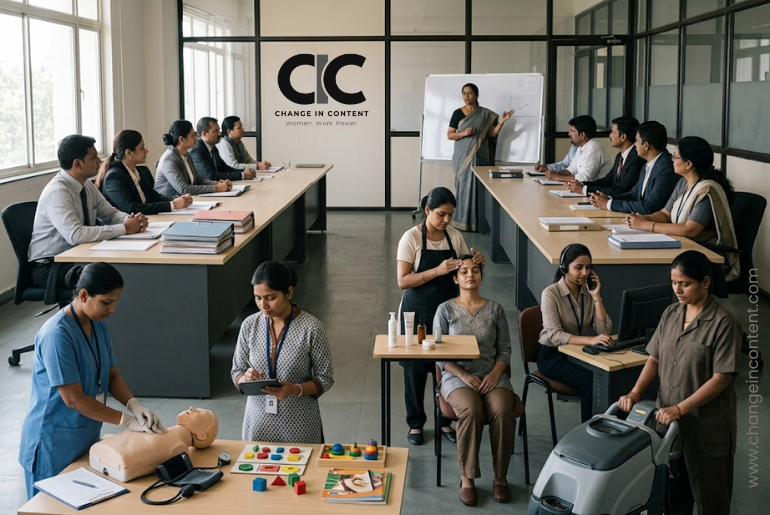
At a beauty training centre, a young woman learns how to prepare a workstation, speak to a customer, identify skin concerns, maintain hygiene and complete a service within a fixed time.
The course also teaches her to smile, remain polite and make the customer comfortable.
Nobody teaches the salon owner how to respond when the customer behaves inappropriately. Nobody asks who pays when the day has no appointments, whether the woman can refuse a late-night home visit. What happens when she becomes pregnant. Who bears the cost of products, transport and cancelled bookings. Or whether five years of experience will take her beyond doing more appointments in the same number of hours.
The worker has been trained. The workplace has not. And that is the missing half of pink-collar skilling.
India needs women with strong technical, digital and professional skills across healthcare, education, childcare, eldercare, domestic services, beauty, hospitality, retail, customer support and administration. These are growing and necessary areas of work.
But the conversation cannot end with making women more employable. It must also ask whether employers are ready to employ them well.
What is pink-collar skilling?
Pink-collar jobs are occupations in which women have historically formed a large share of the workforce. They commonly include nursing, teaching, childcare, caregiving, domestic work, secretarial and administrative support, beauty services, retail, hospitality and customer-facing roles.
The expression does not describe the colour of a uniform or the difficulty of the work. It describes a pattern of occupational segregation.
Many of these jobs involve care, coordination, communication, emotional labour and close contact with people. They can require considerable judgement and responsibility, yet are frequently treated as extensions of qualities women are presumed to possess naturally.
Change in Content has previously examined how pink-collar jobs shape women’s pay and power. The label helps identify a real labour-market pattern, but it can also preserve the stereotype it describes. Teaching, nursing and caregiving are not inherently women’s work. Men can and should enter them too.
Pink-collar skilling, in its conventional form, prepares people for these occupations. A training programme may cover:
- patient or elder support;
- early childhood care;
- classroom assistance;
- salon and wellness services;
- housekeeping and domestic services;
- front-office operations;
- retail sales;
- customer support;
- office administration;
- basic healthcare and community outreach.
India’s skilling ecosystem already includes training resources for sectors such as beauty and wellness and domestic work, alongside courses across healthcare, tourism, retail, technology and other industries.
That is the familiar part of the idea. The next stage must be more ambitious.
The pink-collar economy is not a small corner of work
Pink-collar occupations sit inside some of the largest economic and social transitions of the coming decades.
India will need more workers to support children, patients, older people, households, customers and expanding service industries. Technology may change how these jobs are performed, but it will not remove the human need for attention, judgement, trust and physical care.
The International Labour Organisation describes the care economy as paid and unpaid work connected with childcare, education, health, long-term care, domestic work and support across the life course. Women and girls perform more than three-quarters of unpaid care work globally. At the same time, women account for about two-thirds of paid care workers.
Care responsibilities also prevent an estimated 708 million women worldwide from participating in the labour market. This creates a double dependence on women.
Women provide much of the unpaid care that allows everyone else to work. When care becomes paid employment, women again form much of the workforce.
A childcare worker may care for another woman’s child so that the mother can return to her job. The childcare worker may then return home and perform her own unpaid care.
One woman’s workforce participation can rest on another woman accepting poorly paid, weakly protected work.
Pink-collar skilling should help break that cycle, not make it more efficient.
What skills do women in pink-collar jobs actually need?
The answer is broader than learning the immediate task.
A nurse needs clinical competence, while a childcare worker needs knowledge of early development and safeguarding. A salon professional needs technical ability and hygiene protocols, while a domestic worker may need skills in appliance use, food safety, elder support and household management.
Those are occupational foundations. They are not the entire career.
Technical competence that is formally recognised
We often teach pink-collar work informally.
A new worker watches someone more experienced, imitates the routine and gradually becomes competent. Her knowledge remains real but difficult to prove. This weakens her position when she changes employers or asks for more money.
Training should turn tacit ability into recognised skill. A caregiver, for example, may know how to help an older person move safely, observe changes in appetite, manage medication reminders and respond to confusion. A structured credential makes those abilities visible and portable.
Certification alone is not enough. It must be trusted by employers and connected with a wage premium. A certificate that changes neither the job nor the salary is an expensive piece of paper.
Digital skills designed around the work
Digital ability now affects almost every service occupation.
- A community health worker may update records on an application.
- A teacher may use learning platforms. A salon worker may manage digital bookings and payments.
- A domestic worker may find employment through an app.
- A customer-support professional may work alongside AI-enabled systems.
Training should cover the tools workers are expected to use, but it should also teach them what those tools do to their rights.
- Can an application track location after working hours?
- How is performance scored?
- Can a worker challenge an unfair rating?
- Who owns customer data?
- What happens when an algorithm reduces her access to assignments?
Technology training should not mean teaching women to obey a screen more efficiently. It should help them understand the system behind it.
The experience of women working through quick-service platforms shows why digital access and worker protection must develop together.
Financial and commercial knowledge
Many pink-collar workers are paid per task, customer, visit, shift or incentive. They need to understand more than the service they provide. Training should include:
- How wages and incentives are calculated;
- How to price independent work;
- How to record income and expenses;
- How commissions affect earnings;
- The cost of transport, equipment and unpaid waiting;
- Basic taxation and social-security provisions;
- Insurance and emergency savings;
- How to read a contract before accepting it.
A beauty professional generating ₹30,000 in monthly bookings is not necessarily earning ₹30,000. Product costs, platform commissions, travel, cancellations and unpaid time may leave her with considerably less.
“Earn up to” is not a salary. Workers should be trained to calculate what actually reaches them.
Communication without compulsory pleasantness
Communication matters in care and service roles. Workers must understand clients, explain procedures, manage conflict and maintain professional boundaries. But communication training often comes with an unspoken instruction: absorb disrespect gracefully.
Women in customer-facing roles are expected to remain agreeable even when customers are rude, intrusive or threatening. Their ratings, tips or future assignments may depend on it.
Pink-collar skilling should teach boundary-setting alongside courtesy. A worker should know how to say:
- This service is outside my assigned role;
- I cannot remain beyond the agreed time;
- This behaviour is inappropriate;
- I need another employee present;
- I am ending this appointment because I feel unsafe.
Professionalism does not require submission.
Knowledge of rights and routes to redress
A worker cannot use a right she has never been told about.
Training should explain wages, leave, working hours, safety, sexual-harassment protections, maternity provisions, social security, written contracts and complaint procedures in language the worker understands.
That matters particularly in informal and platform-mediated work, where the organisation may describe the person as a partner, volunteer, helper, service professional or independent contractor rather than an employee. The title can determine which protections become available.
India’s experience with home-based, domestic and community workers shows how easily women’s labour can sit inside commercial or public systems without receiving the recognition normally attached to employment. The continued precarity of women home-based workers in India is one example.
Rights training should not be treated as a rebellious addition to employability training. It is part of professional preparation.
Skills that create mobility, not permanent entry-level work
Many training programmes prepare women to enter a job but not to leave its lowest tier.
A childcare worker should be able to progress towards centre supervision, specialist early-learning support or entrepreneurship. A nurse should have routes into clinical specialisation, training, management or health administration. And a salon professional should be able to become a senior technician, trainer, product expert or business owner.
Skill architecture must show the next step. Without progression, upskilling can become a cycle in which women repeatedly receive short courses for different versions of low-paid work.
Why does women’s skilling fail when the workplace stays the same?
Think of a woman who completes a 6-week training course for eldercare.
She learns mobility assistance, nutrition, hygiene, basic first aid and communication with families. She passes an assessment and receives a certificate.
Her first job requires her to work 12-hour shifts. There is no written contract. The family expects housekeeping in addition to eldercare. She sleeps in the same room as the person receiving care. Her weekly day off changes whenever a relative visits. She has no safe process for reporting harassment.
Was the skilling programme successful?
The training provider may count her as placed. The employer has acquired a more capable worker. And the woman has acquired a job that may be impossible to sustain.
That is where skilling metrics become misleading. A placement made within 90 days says little about:
- Whether the woman remains after six months;
- Whether she earns more than before training;
- Whether her actual duties match the course;
- Whether she receives a contract;
- Whether the workplace is safe;
- Whether she has rest and leave;
- Whether the job leads to progression.
India has made substantial efforts to bring more women into training and apprenticeships. Yet education and skills do not automatically produce stable employment, pay parity or power, as Change in Content’s analysis of women’s workforce inclusion in India has shown.
The problem is not that women remain insufficiently prepared for work. Too much work remains insufficiently prepared for women.
It is time to teach pink-collar skilling to employers
An employer may know how to run a hospital, school, hotel, salon, call centre or platform. That does not mean the employer knows how gender shapes the experience of the people doing the work.
Business policies often appear neutral because they use the same words for everyone. Their consequences can be unequal.
- A late-closing policy affects the worker who has safe transport differently from the worker who does not.
- A short-notice roster affects a person with no care duties differently from a mother arranging childcare.
- A uniform designed around one body can be unsafe for another.
- An app-based complaint channel is useless to a worker who fears losing assignments after using it.
The OECD’s work on gender-responsive due diligence makes this point clearly: business risks and impacts are not gender-neutral. Organisations can miss or reinforce harm when their systems do not examine how women experience work differently.
Employer skilling should therefore become a formal part of pink-collar workforce development.
What should organisations learn?
At Channge in Content, we believe it is high time we stopped limiting these skilling programs to women. Organisations must also learn.
How to design the real job, not the brochure version
The advertised role and the lived job often differ.
A childcare assistant becomes a cleaner. A receptionist is expected to serve refreshments. Sometimes, a caregiver becomes a live-in domestic worker. A salon professional is sent alone to unfamiliar homes. And a community worker receives an expanding list of digital and administrative tasks without additional time.
Employers should be trained to map:
- The core duties;
- Related but optional duties;
- Tasks that require additional training;
- Work that should attract additional pay;
- Hours spent waiting, travelling or completing records;
- Emotional and physical demands;
- The risks attached to each setting.
Job descriptions should state what the worker is not expected to do as clearly as what she must do. Role clarity protects the employee and improves service quality.
How to calculate fair pay
Pink-collar jobs often contain work that is difficult to quantify.
How much is it worth to calm a frightened patient? Notice a child’s developmental delay? Prevent an older person from falling? Resolve an angry customer’s problem without losing the account?
Because the output is not always a unit that can be sold immediately, employers may undervalue it. They need training in gender-neutral job evaluation. That means assessing work through its actual requirements:
- knowledge and qualifications;
- responsibility for people;
- consequences of error;
- physical and emotional demands;
- problem-solving;
- communication;
- working conditions;
- supervision and decision-making.
The recent Change in Content analysis on why female-dominated jobs receive lower pay examines how skills associated with women can disappear behind words such as care, patience and dedication. Employer skilling must put those skills back into the job grade.
How to schedule around human lives
Poor scheduling can make an otherwise suitable job inaccessible.
Workers may receive rosters too late to arrange childcare. Shifts may end after public transport becomes unsafe. Split shifts can consume an entire day while paying for only a few hours. Platform workers may remain logged in for long periods without knowing whether work will arrive.
Organisations should learn to distinguish operational flexibility from transferring all uncertainty to the worker. Better systems include:
- Rosters issued sufficiently in advance;
- Clear limits on last-minute changes;
- Minimum guaranteed hours where appropriate;
- Paid waiting and travel policies;
- Safe transport for late shifts;
- Predictable weekly rest;
- Shift-swapping procedures;
- Protection from penalties when lawful leave is taken.
Women are often told to become more flexible. A well-run organisation should be capable of some flexibility too.
How women’s health enters the workplace
A generic wellness webinar is not gender-responsive job design.
Pink-collar jobs can involve standing for long periods, lifting people, repetitive movement, exposure to cleaning chemicals, emotional strain, irregular meals and limited access to toilets.
Employers need practical awareness of menstruation, pregnancy, reproductive health, menopause, occupational injury and mental exhaustion without turning women’s bodies into performance concerns.
The purpose is not to assume that every woman needs special treatment. It is to ensure that ordinary health needs do not become career penalties.
Suitable uniforms, rest breaks, sanitation, safe lifting equipment, access to water, medical support and confidential conversations can determine whether a trained worker remains in the occupation.
Change in Content’s reporting on women’s unresolved health concerns at work shows how care and health gaps can contribute directly to exits.
How to create a complaint system workers trust
A policy is not the same as permission to use it.
Women in low-paid service roles may fear losing shifts, customers, ratings, accommodation or references if they report harassment. A formal email address offers little reassurance when the supervisor controls their roster.
Employer training should cover:
- Receiving complaints without retaliation;
- Handling misconduct by customers, patients and family members, not only colleagues;
- Confidential reporting options;
- Support for workers with limited literacy or digital access;
- Escalation beyond the immediate supervisor;
- Action when a platform customer behaves inappropriately;
- Protection of wages and assignments during an investigation;
- Communication of outcomes.
A worker should not have to choose between personal safety and next week’s income.
How to manage supervisors
The everyday workplace is often defined by the frontline supervisor, not the employee handbook.
A hospital may publish a progressive inclusion policy while a ward manager denies breaks. A retail chain may promise flexibility while a store manager punishes every request. And a platform may announce worker protections while local coordinators informally discourage complaints.
Managers need scenario-based training grounded in real work:
- A worker says she cannot accept an unplanned night shift;
- A customer requests only a “young female” service provider;
- A pregnant employee needs task modification;
- A worker reports inappropriate behaviour in a private home;
- Two employees with care responsibilities request the same shift;
- A high-performing worker lacks formal qualifications for promotion.
Training should not teach managers to remember polished answers. It should give them authority, budgets and standards for acting fairly.
How to build careers inside pink-collar work
Organisations often train workers to improve service but retain the same flat hierarchy.
The experienced caregiver remains a caregiver. The senior beauty professional remains paid per appointment. The call-centre worker handles more difficult complaints without moving into quality, training or operations. The teacher takes on administration without a meaningful pay rise.
Employer skilling should include workforce planning:
- What does progression look like?
- Which skills justify the next pay band?
- Can prior learning be formally recognised?
- Are supervisory vacancies filled from the frontline?
- Can workers train while remaining employed?
- Are women being prepared for technology-led changes?
- Do leadership roles require credentials that the organisation never helped workers obtain?
A profession becomes more attractive when experience has somewhere to go.
Pink-collar skilling should not trap women in pink-collar jobs
There is a tension at the heart of the idea.
Women need access to skills in sectors that offer real employment. Yet training programmes can reinforce occupational segregation when they steer women towards beauty, tailoring, care or hospitality simply because those choices appear socially acceptable.
A rural woman may be offered a sewing course while a man is offered electrical repair, solar installation or machine operation.
Both forms of work require skill. Their income potential and market demand may differ significantly.
Training should therefore begin with the worker’s ambitions and the local economy, not assumptions about what women will be allowed to do.
Pink-collar skilling must sit alongside pathways into technology, manufacturing, logistics, construction, finance, green jobs and other historically male-dominated fields.
The goal is not to make gendered occupational boundaries more efficient. It is to give women genuine choice while improving the jobs in which women are already concentrated.
OECD recommendations on occupational segregation include both encouraging girls and women into STEM and encouraging boys and men to enter education, health and welfare. That second part deserves more attention.
A healthy care economy should not remain dependent on women. Bringing more men into care, teaching and service occupations can challenge the belief that care is a female instinct rather than professional work.
Who should provide employer skilling?
Training employers cannot be left to a single diversity workshop. A workable model would involve several actors.
Sector Skill Councils
Sector bodies already define occupational standards and curricula. They can add modules on decent work, gender-responsive supervision, pay structures and career pathways to employer accreditation.
Training providers
Training organisations should assess the workplace before counting a placement. They can require participating employers to meet minimum standards on contracts, wages, safety and grievance mechanisms.
Large companies and platforms
Businesses that depend on outsourced or gig-based pink-collar work should train not only direct employees but franchisees, vendors, customers and local partners.
A company cannot claim responsible skilling while its business model depends on the worker entering settings the company does not meaningfully monitor.
Government departments
Public programmes employing community health, nutrition and care workers must examine whether expanding duties are matched by status, pay, training and social protection.
Public employment should set a decent-work benchmark, not normalise the idea that women’s contribution is too socially valuable to be treated as an ordinary job.
Industry associations
Associations can publish sector-wide standards, share wage benchmarks and support smaller employers that lack specialist HR teams.
Workers themselves
Women performing the work must help design the training.
An expert can describe a policy. A worker can explain why it fails at 8.30 pm when the last bus has left, a customer refuses to let her leave, and the helpline does not answer.
Lived experience is not anecdotal decoration. It is operational information.
What should a pink-collar skilling scorecard measure?
The current language of skilling tends to celebrate enrolments, certifications and placements. Those numbers matter. They are not enough. A serious pink-collar skilling programme should track:
Access
- Who enrols?
- Who completes the course?
- Are childcare, transport and digital-access barriers addressed?
- Are women with disabilities, migrants and workers with limited literacy included?
Job quality
- Is there a written contract?
- What are the actual wages after expenses?
- Are working hours predictable?
- Is social protection available?
- Are sanitation and safety standards met?
Retention
- How many women remain after three, six and twelve months?
- Why do workers leave?
- Are exits concentrated under particular managers, customers or locations?
Earnings
- Did income rise after training?
- Does certification attract higher pay?
- Are incentives attainable during ordinary working conditions?
- Are women being paid for waiting, travel and administrative work?
Progression
- How many workers move into higher grades?
- What is the average time to promotion?
- Do women gain supervisory and decision-making responsibilities?
- Can workers move between employers without losing recognition of their skills?
Voice
- Do workers know the complaint process?
- Do they trust it?
- Are complaints resolved without lost wages or retaliation?
- Are workers represented when policies are reviewed?
These measures would produce a more honest definition of success.
A woman who completes training and exits an unsafe job after two months has not failed the programme. The programme failed to examine the job.
What would pink-collar skilling look like in practice?
Consider a home-care company recruiting women to support older people.
A traditional programme trains the women in hygiene, mobility, communication and basic health observation. They are assessed and placed with families.
A redesigned programme would do more.
The workers would also learn contracts, boundaries, digital records, financial planning, emergency escalation and their right to refuse unsafe tasks.
The company would train families on the caregiver’s defined role, rest time, privacy, respectful conduct and the distinction between care work and general domestic labour.
Supervisors would learn to respond to harassment, match workers with appropriate cases and support task modifications when health needs arise.
The pay system would recognise qualifications, experience, night work and complex-care assignments.
Experienced workers could progress into assessment, scheduling, training or supervision.
The platform would record cancellations, unsafe customers and unpaid extensions rather than allowing every dispute to become the worker’s word against the family’s.
That is pink-collar skilling as workforce development. It prepares the worker, the manager, the customer and the system.
The business argument is stronger than employers may realise
Better pink-collar work is not a charitable expense. Service quality depends heavily on continuity and trust.
Children benefit from consistent caregivers. Patients rely on experienced nurses and attendants. Customers value professionals who understand their needs. Older people can find repeated changes in caregivers distressing. Businesses lose money when trained workers leave and must be replaced.
Poor job design creates turnover. Turnover weakens service. Weak service damages the brand.
Investment in care systems also has wider economic value. ILO research suggests that closing gaps in care services could generate almost 300 million jobs globally by 2035, while broader investment in care can support women’s employment, social development and economic resilience.
The argument is not that every pink-collar employer must immediately become a large formal corporation. It is that organisations cannot build scalable services on an endlessly replaceable female workforce.
Women notice which companies pay on time, protect workers, offer predictable schedules, and create opportunities for advancement. Workers share that information. The better employers will attract and retain greater skill.
The Change Ahead
For years, skilling programmes have asked women to become ready for the labour market.
Learn the task. Improve your English. Use the app. Dress professionally. Speak confidently. Manage your time. Adjust to the customer. Become employable.
There is value in much of that training. But pink-collar work raises another question: When will the labour market become ready for the women it keeps training?
A capable worker cannot personally solve low pay, unsafe travel, weak contracts, unpaid waiting, arbitrary ratings or a manager who treats flexibility as disobedience. Those are organisational skills gaps.
The next generation of pink-collar skilling should train women for work without training them to tolerate poor work. It should also train employers to understand that care, service and support are not soft additions to the economy. They are skilled functions that require sound management.
The future of pink-collar work will not be decided by how many certificates are issued. It will be decided by what kind of job waits at the end of the course.
Editorial Note and Sources
This article uses “pink-collar work” as a labour-market description for occupations in which women are heavily represented, not as a claim that particular jobs naturally belong to women. It draws on International Labour Organisation research on care work and decent employment, OECD work on occupational segregation and gender-responsive business conduct, Indian skilling resources and Change in Content’s previous reporting. Pink-collar occupations differ widely in qualifications, employment status, wages and working conditions; the examples in this article should not be read as applying uniformly to every employer or worker.
Principal sources
- International Labour Organisation: Care Work and Care Jobs for the Future of Decent Work.
- International Labour Organisation: Care economy research, policy resources and training.
- International Labour Organisation: Unpaid care work prevents 708 million women from participating in the labour market.
- OECD: Gender Equality in a Changing World.
- OECD: Due diligence essentials for gender in global supply chains.
- National Skill Development Corporation: Curriculum and learning resources across beauty and wellness, domestic work and other sectors.
- International Labour Organisation: Greater investment in care could create almost 300 million jobs.
