
The Quick Read
- India’s female labour-force participation rate reached 40% in 2025, but women accounted for only 18.2% of workers in regular salaried employment.
- Women made up about 28% of India’s organised professional workforce in 2025, yet held only 18% of its top leadership roles, according to LinkedIn’s Economic Graph.
- Women occupied roughly 21% of board seats at NSE-listed companies by March 2025, but only around 5% of chief executive positions at listed companies in 2026.
- The leadership gap is particularly severe in manufacturing, infrastructure, construction, energy, transport and real estate.
- India will not create women leaders simply by hiring more women. They need factory, project, technology, finance, sales and profit-and-loss responsibility early enough to become credible candidates for the top.
- Viksit Bharat requires industry to move from women’s representation to women’s authority.
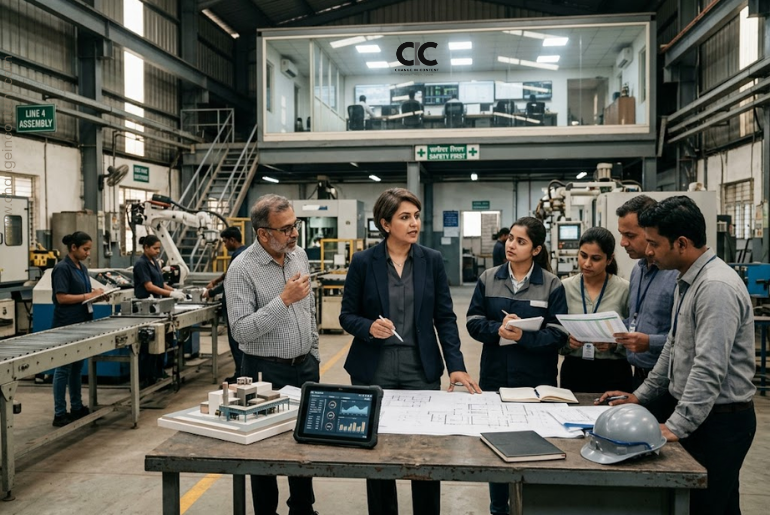
A new factory begins operations outside an Indian city.
Women are visible on the shop floor. They operate machines, inspect quality, manage documentation and appear prominently in the company’s photographs. The plant is described as modern, inclusive and proof that manufacturing is changing.
Then the senior review begins. The plant head is a man. Operations reports to a man. Men lead engineering, procurement, finance and supply chain. The people deciding capital expenditure, production targets and the next expansion are mostly men.
The contradiction that matters
Women have entered the industry. They have not yet entered its centre of power. That is the contradiction facing women in industry leadership as India works towards Viksit Bharat by 2047. Female workforce participation has risen substantially. Women are entering higher education in large numbers, joining technical institutions, building businesses and moving into sectors once considered unsuitable for them.
India’s ambition is not merely to employ more women. The national language has moved from women’s development to women-led development. That promise becomes meaningful only when women help decide which factories are built, where capital is invested, what technology is adopted, which people are promoted and how industrial growth is distributed.
We cannot imagine creating a developed India by treating half the population as participants in production but exceptions in leadership.
What does women in industry leadership actually mean?
Industry leadership is often reduced to the number of women on corporate boards or in the C-suite. Those figures matter. They do not tell the whole story.
A woman may hold a senior title without controlling a business, budget or workforce. She may sit on a board because regulation requires representation while remaining distant from daily operating decisions. She may lead human resources, communications or legal affairs but rarely be considered for chief executive succession.
Leadership becomes more consequential when it includes authority over:
- Factories and production;
- Capital allocation;
- Engineering and technology;
- Procurement and supply chains;
- Major projects;
- Revenue and sales;
- Investment and risk;
- Profit-and-loss accounts;
- Workforce design;
- Mergers and expansion;
- Industry policy and associations.
That distinction matters because the route to the chief executive’s office usually runs through operational and commercial roles.
Women can be highly visible in a company and still remain outside those routes. India’s leadership question, therefore, is not only how many women have senior designations. It is how many control decisions capable of changing an industry.
India is bringing more women into work
There has been real progress. The Periodic Labour Force Survey for 2025 placed women’s labour-force participation rate at 40%, compared with 79.1% for men. The female worker-population ratio reached 38.8%. An estimated 20 crore women aged 15 and above were employed during the year.
Women’s participation has increased markedly over the longer term. The World Bank notes that female labour-force participation rose from 22.9% in 2018 to 35.3% in 2025 under its internationally comparable measure. It estimates that raising participation to 50% could add one percentage point to India’s annual GDP growth and help move the country towards the growth required for high-income status by 2047.
These numbers should not be dismissed. They reflect millions of women entering or returning to economic activity. The composition of their work, however, demands closer attention.
In 2025, 64.2% of employed women were self-employed. Only 18.2% were in regular wage or salaried work, compared with 26.5% of employed men. Female labour-force participation was 45.9% in rural India but only 27.7% in urban areas.
An increase in participation does not automatically create an increase in industrial leadership. A woman working without pay in a family enterprise counts as employed. So does a woman running a small survival business with little access to capital. Neither is necessarily entering the organisational pipeline from which chief executives, plant heads and industry leaders emerge.
India needs more women in work. It also needs more women in work that provides income, formal experience, progression and decision-making power.
The leadership numbers are moving, but power remains narrow
Different reports use different samples and definitions, so their figures should not be treated as directly interchangeable. Taken together, however, they show a consistent pattern.
LinkedIn’s Economic Graph estimated that women represented 28% of India’s professional workforce in 2025 but held only 18% of top leadership positions. The country’s female workforce share was among the lowest in the global sample, while its leadership representation remained below the global median of 31%.
Women held approximately 21% of board seats at NSE-listed companies by March 2025. Nearly 97% of those companies had at least one woman director, showing the effect of mandatory board requirements. The figure looks less encouraging when executive authority is examined.
A 2026 Primeinfobase analysis found that women accounted for only about 5% of chief executives at India’s listed companies. Separate research on BSE 200 companies found that only 11% of women directors held executive positions, compared with 65% of male directors.
This creates a peculiar version of progress. The boardroom has become more diverse because regulation opened the door. The chief executive pipeline, which depends on years of operational assignments, sponsorship and succession decisions, remains much more resistant.
One woman on the board may satisfy a rule. It does not necessarily change who runs the company.
The gap grows wider in industries that will build 2047
India’s next two decades of growth are expected to rely heavily on manufacturing, infrastructure, logistics, energy, transport, construction, digital systems, green technology and advanced services. These are also sectors in which women’s leadership remains particularly thin.
A recent JLL–NAREDCO MAHI report found that women held only 1–2% of senior leadership roles in Indian real estate. Women’s representation was estimated at 40–45% near entry level, followed by sharp attrition towards middle and senior management. The pattern is explored in Change in Content’s analysis of women in real estate leadership.
Transport offers another example. A World Bank report found that women remain significantly under-represented in transport employment and leadership, even though their participation can improve innovation, service design and the sector’s understanding of diverse users.
Manufacturing has begun making visible progress. Companies are recruiting women to assembly lines, automotive plants, electronics units and technical roles. CEAT, for example, has set targets of 25% gender diversity on the shop floor and 20% in leadership roles at general manager level and above by 2027. Its overall representation had reached 17%, with women holding around 9% of senior roles when the target was reported. The company’s gender-diversity programme shows how industrial employers can set measurable goals.
Kirloskar Brothers has also reported 35% women’s representation at its Sanand plant and 30% on its board. It has placed women in front-end sales roles, widening the range of assignments available beyond administrative functions. Its approach offers another example of women entering core industrial work.
These examples show that change is possible. They also expose the scale of the distance ahead. A few prominent plants with women workers do not transform industry leadership unless women progress from operating the process to owning its outcomes.
Women in industry leadership: Why does the pipeline narrow?
The easy explanation is that fewer women entered industry in previous generations, so fewer are ready for senior leadership now. That is partly true. It is no longer sufficient.
Women are entering education and employment in larger numbers. The leadership pipeline still loses them through a series of ordinary organisational decisions.
Women do not always receive the first consequential assignment
Leadership careers are built through work that carries risk.
A future chief executive may be asked to turn around a weak business, open a factory, launch a product, handle a major client, lead a technology transition or take responsibility for a difficult region.
Women are often considered after they have already demonstrated readiness. Men are more readily given the assignment through which readiness is established.
The difference appears small at the time. Ten years later, one candidate has run three businesses and managed a profit-and-loss account. The other has an excellent record in a function that the succession committee does not view as chief-executive preparation. The leadership gap begins before the leadership title.
Change in Content’s report on women’s hiring remaining at 33% noted that the gap grows when women miss early opportunities, stretch roles and sponsorship.
Women remain concentrated in support functions
Human resources, marketing, communications, legal affairs and sustainability can lead to influential careers.
The problem is not that women work in these functions. It is that organisations often direct them there while reserving operations, engineering, sales, finance and business leadership for men.
A company can have several women vice-presidents and still have no woman in the chief executive pipeline. That is why the number of women in senior management can look healthier than the number controlling core businesses.
Leadership representation is not the same as a distribution of power.
Industrial workplaces were designed around a male default
Factories, construction sites, mines, warehouses and field operations were frequently built around an employee who could travel at short notice, work late shifts, relocate easily and rely on someone else to handle the household. Women are then judged against this design.
A site may lack suitable toilets, safe transport, properly fitted protective equipment or accommodation. Rather than correcting the infrastructure, the organisation may decide that women are not suitable for the role.
The company creates the barrier and calls the resulting absence a lack of interest.
These decisions matter because site and field experience often become informal qualifications for leadership.
Care still interrupts women’s careers more severely
In the 2025 PLFS, 44.4% of women outside the labour force cited childcare or personal commitments in homemaking as their main reason. The corresponding pattern for men was markedly different. It is not merely a family issue occurring outside industry.
Employers decide whether motherhood becomes a temporary transition or a permanent career penalty. They determine whether a returning woman receives a significant assignment, whether flexibility is compatible with promotion and whether leadership potential is judged by results or uninterrupted physical availability.
India cannot produce more women industrial leaders while leaving care arrangements almost entirely to individual families.
Sponsorship remains uneven
Mentors advise. Sponsors spend political capital.
A mentor may tell a woman how to prepare for a plant-leadership role. A sponsor tells the chief operating officer that she should receive it.
Informal sponsorship grows through familiarity, trust and repeated access to senior leaders. In male-dominated industries, these relationships often form through travel, late meetings, social gatherings and old professional networks.
Women may receive formal mentoring while men receive influential advocacy. The first helps them understand the organisation. The second helps them rise within it.
“Leadership potential” still resembles existing leaders
Companies frequently say they promote on merit. Merit, however, is interpreted by people with memories, preferences and assumptions.
Confidence may be read as leadership in a man and aggression in a woman. A man who takes credit can appear decisive; a woman doing the same may be judged insufficiently collaborative. A woman who requests flexibility may be seen as less committed even when her performance remains strong.
When most current leaders are men, the next leader can appear naturally credible when he resembles them.
A supposedly neutral system then reproduces a familiar result.
The board mandate worked. It also showed the limits of mandates
India’s Companies Act and SEBI rules pushed listed and prescribed companies to appoint women directors. The intervention had a visible impact. Nearly every NSE-listed company now has at least one woman director, and women’s overall share of board seats has grown.
The lesson is not that regulation failed. It is that regulation achieved what it measured.
Companies added women to boards because the requirement was clear and non-compliance carried consequences. Change in Content has reported on the penalty imposed on a company for failing to appoint a woman director.
The next problem lies in depth.
- Is the woman director independent?
- Does she chair an important committee?
- Does she possess executive experience?
- Is she heard on capital, risk and strategy?
- Are several women present, or is one expected to represent half the population?
- Does board diversity influence executive succession?
A seat creates access. Authority determines impact.
India now needs to examine whether board regulation has produced a broader female executive pipeline or merely diversified oversight while day-to-day power remains male.
Why women’s leadership matters to Viksit Bharat
The economic argument is often reduced to a line about diverse teams performing better. The opportunity is larger.
India needs the full available talent pool
India intends to expand manufacturing, strengthen exports, build infrastructure, lead in digital technology and create new industries around clean energy, electronics, semiconductors, mobility and artificial intelligence.
These ambitions require capable leaders at scale. Excluding women from operational and commercial leadership reduces the pool before competition begins.
The World Bank estimates that raising women’s labour-force participation to 50% could increase India’s annual GDP growth by one percentage point. Moving more women into productive and leadership roles would strengthen the quality as well as the quantity of that participation.
Women leaders can widen what industry notices
Women do not possess one universal viewpoint. A female executive does not automatically understand every woman worker or customer. A leadership group drawn from varied experiences is nevertheless more likely to identify risks and opportunities that a narrow group misses.
Transport leaders may ask whether women can use a service safely after dark. Manufacturing leaders may recognise that protective equipment was designed around male bodies. Property leaders may pay closer attention to care infrastructure, lighting and mobility. Financial leaders may question why women-owned enterprises receive less credit.
These are not soft observations. They affect adoption, workforce retention, product quality and market size.
Leadership changes aspiration inside the organisation
A woman engineer entering a company looks upwards.
- Who runs the plant?
- Who leads technology?
- Who controls the business?
- Who returned after maternity and continued progressing?
- Who is trusted with a crisis?
Visible women in consequential roles make a career path believable. This matters particularly in industries where girls and young women already face questions about whether they belong.
Representation at the top does not solve every barrier. Its absence confirms one.
Women’s authority can improve the quality of employment
The case for women leaders should not depend on the assumption that women are naturally kinder managers.
Women leaders can be demanding, commercial and ambitious. That is leadership, not a flaw. Their presence can still bring workplace experiences into decisions that previously ignored them. Policies on shifts, travel, care, health, harassment and progression are more likely to be tested against women’s actual lives when women have authority in the room.
The result can make industrial work more sustainable for a wider range of employees, including men with care responsibilities.
What should Indian industry change?
Another leadership programme will not be enough. Companies need to redesign the machinery that produces leaders.
Measure power, not only headcount
Most companies track the percentage of women employed. They should also track:
- Women in plant and site leadership;
- Women with profit-and-loss responsibility;
- Women managing capital budgets;
- Women in engineering, production, technology and sales;
- Women on succession lists;
- Promotion rates by career level;
- Access to international and high-risk assignments;
- Attrition after maternity and other career breaks;
- Pay and incentive outcomes;
- Women returning to substantial roles.
A company can improve overall gender representation while leadership remains unchanged. The dashboard must make that visible.
Repair the first broken rung
Senior leadership gaps begin with early promotions.
Companies should examine who receives the first team-lead role, first client account, first field posting and first project with genuine risk. Managers should be required to produce diverse candidate lists for consequential assignments, not merely for vacancies.
The aim is not to promote unprepared women. It is to stop preparation opportunities from being distributed informally and unevenly.
Put women on the routes that lead to chief executive roles
Women need exposure to operations, finance, sales, technology, procurement, strategy and capital allocation.
A leadership-development programme should not consist mainly of classroom sessions. It should identify the experiences required for top roles and ensure women receive them early enough to build credible records.
The question for every high-potential woman should be: Which experience is missing from her path, and who is responsible for giving it to her?
Make industrial infrastructure usable
Safe transport, suitable sanitation, housing near industrial clusters, childcare, well-fitting safety equipment and effective anti-harassment systems are business infrastructure. They influence whether women can accept site roles, work across shifts and remain in industrial careers.
The World Bank identifies safety, housing, transport, skills and finance as structural barriers that India must address to unlock women’s economic potential.
A company capable of planning a complex supply chain can plan a safe commute.
Treat care as an economic input
The government’s Viksit Bharat discussions have set an ambition of bringing 70% of women into economic activity and have connected that objective with childcare, social protection and care support. The Union Budget 2026–27 also emphasised the care economy and women’s workforce participation.
Industry must play its part. Childcare near industrial clusters, predictable shifts, care leave for all genders and support for employees returning from career breaks can reduce attrition at the stage when leadership pipelines usually thin.
Care should not be framed as a women’s benefit. It is part of labour-market infrastructure.
Replace mentoring theatre with accountable sponsorship
Every senior leader responsible for talent should be expected to sponsor capable women into difficult roles.
Progress can be measured through assignments, promotions and succession readiness rather than the number of mentorship meetings held.
A sponsor’s performance should answer a practical question: Whose career gained authority because this leader intervened?
Make managers responsible for retention
Women frequently leave organisations, not industries, because of local managers.
Companies should examine attrition by manager, location, function and life stage. A department repeatedly losing women should not be permitted to explain every departure as a personal choice.
Patterns are evidence. Managers who build strong, diverse teams should be rewarded. Those who consistently block progression or create hostile conditions should face consequences.
Develop women leaders beyond large corporations
The leadership discussion cannot stop at the Nifty 500.
India’s industrial economy includes MSMEs, family businesses, suppliers, contractors, start-ups, cooperatives and industry associations. Many have no formal succession process, limited HR capability and deeply gendered ownership structures.
Women entrepreneurs need credit, procurement access, technology, networks and a place in industry bodies where policy priorities are shaped.
The World Bank estimates that removing barriers to women’s entrepreneurship in India could create 25 million jobs. Industry leadership includes the woman who runs a company, not only the woman promoted inside one.
Link public support with workforce outcomes
Companies benefit from incentives, industrial land, production-linked schemes, public procurement and infrastructure.
Where appropriate, policy can encourage disclosure of women’s participation, leadership, pay, safety and retention without turning the process into a box-ticking exercise.
Public money already shapes industrial growth. It can also encourage wider participation in that growth.
What should women be enabled to do differently?
The burden cannot be placed entirely on women. Still, access to information, networks and commercial experience can increase their agency.
Women professionals should be supported to:
- Ask early which roles lead to business leadership;
- Seek operational exposure rather than waiting to be selected;
- Understand finance and profit-and-loss responsibility;
- Build networks beyond their immediate function;
- Identify sponsors as well as mentors;
- Document measurable business outcomes;
- Negotiate for authority, not only title;
- Participate in industry associations;
- Develop board readiness and governance expertise;
- Support other women without being expected to carry the entire diversity agenda.
It is not an instruction to behave more like men. It is an argument for making the hidden rules of advancement visible.
A woman should not need to discover after fifteen years that the work she was encouraged to do was never considered preparation for the role she hoped to reach.
Companies should stop asking whether women are ready
Women’s representation in education and the workforce has improved. They are leading businesses, running plants, managing technology, building financial institutions and entering industrial occupations once closed to them.
The question of readiness can become a delaying tactic. The better questions are:
- Did the company give women the assignments that create readiness?
- Did it make worksites usable?
- Did it protect careers through care transitions?
- Did senior leaders sponsor women when authority was allocated?
- Did the succession process look beyond familiar candidates?
- Did the organisation value performance more than uninterrupted visibility?
When the answers remain no, the shortage of women leaders is not a mystery. It is an outcome.
India’s best companies for women reported women holding around 20% of leadership positions in 2025, up from 13% in 2016. That progress proves organisational action can shift representation. It also shows how far even leading employers remain from parity.
The Change Ahead
Viksit Bharat is often described through highways, factories, exports, digital systems and a larger economy. It must also be visible in who holds industrial power.
India has made progress in bringing more women into economic activity. Women are entering education, professional work, entrepreneurship, factories and boards. The next step is harder because it reaches beyond access. It requires organisations to share authority.
We must encourage women to run plants, control budgets, lead technology, manage capital, negotiate major deals and enter succession plans. The judgements must happen on performance without being forced through workplace structures designed around someone else’s life.
This is not a request to decorate industry with more women. It is a growth strategy.
India cannot aim to become a developed economy while leaving most industrial decisions to one half of its talent. Nor can women-led development mean women executing plans that men continue to make.
By 2047, the defining statistic should not be how many women entered industry. It should be how much of Indian industry women were trusted to lead.
Editorial Note and Sources
This article is an opinion-led analysis based on the latest available government labour data, international economic research, corporate leadership studies, and sector-specific reports available through July 2026. Leadership estimates vary because sources use different definitions, samples and occupational categories. Figures covering boards, senior management, chief executives and the wider workforce should therefore be read as complementary indicators rather than directly comparable measures. The article uses “industry” broadly to include manufacturing, infrastructure, energy, construction, transport, real estate, technology, financial services and other organised business sectors.
Principal sources
- Ministry of Statistics and Programme Implementation: Periodic Labour Force Survey Annual Report 2025.
- World Bank: International Women’s Day 2026: Women Who Lead from the Front.
- LinkedIn Economic Graph: State of Women in Leadership 2026.
- World Economic Forum: Global Gender Gap Report 2025 and 2026 research on senior leadership.
- International Labour Organisation: Women in business and management data.
- World Bank: Research on women’s employment and leadership in the transport sector.
- Primeinfobase: 2026 findings on women chief executives in Indian listed companies, reported in contemporary business coverage.
- Ministry of Labour and Employment: Policy discussions on women-led economic growth, social security and care support.
- Government of India: Union Budget 2026–27 measures related to women’s workforce participation and the care economy.
