The Quick Read
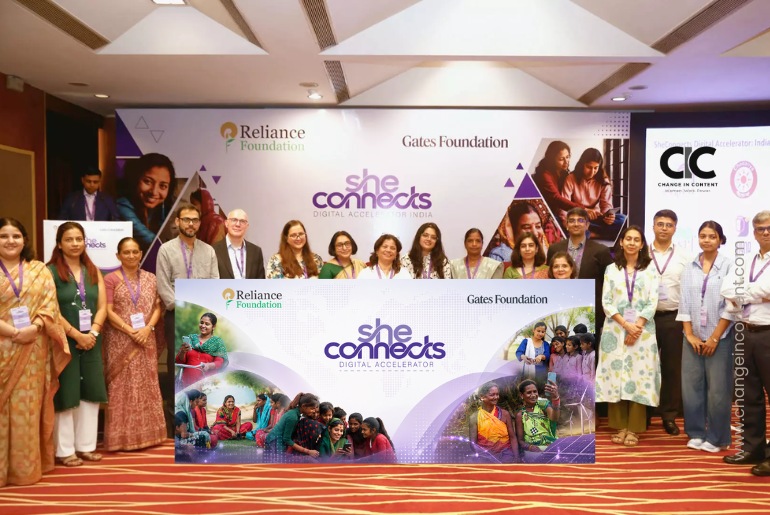
- The SheConnects Digital Accelerator is a ₹200-crore, three-year initiative founded by Reliance Foundation and the Gates Foundation to advance women’s digital inclusion in India and Sub-Saharan Africa.
- Six Indian non-profit organisations have received a combined commitment of ₹25.84 crore in the first funding round.
- Their projects are expected to reach nearly one million women over 15 to 18 months.
- The selected solutions cover rural enterprise, healthcare access, fisheries, self-help groups, digital service centres and community-based training.
- Applications for Round Two are open to eligible Indian non-profits, with grants ranging from ₹85 lakh to ₹4.2 crore per project. The deadline is 4 September 2026.
A smartphone in a woman’s hand does not automatically make her digitally included.
She may still need someone else to enter a password, complete an online payment, interpret an English-language screen or decide whether an unfamiliar message is genuine. She may own the device but have little privacy while using it. And she may know how to watch videos but not how to access healthcare, grow a business or challenge a fraudulent transaction.
The SheConnects Digital Accelerator has been designed around this gap between access and meaningful use.
Founded by Reliance Foundation and the Gates Foundation, the initiative aims to identify digital solutions that have already demonstrated results and help them reach substantially more women. The ₹200-crore programme will operate over three years across India and Sub-Saharan Africa, combining grants, technical assistance, evidence-building and knowledge exchange.
Its first Indian grants have now been announced. Six organisations will share ₹25.84 crore and are expected to reach nearly one million women.
The number is important. The variety of the chosen projects is more revealing.
What is the SheConnects Digital Accelerator?
SheConnects is not presented as a basic computer-training programme or a new consumer application.
It is an accelerator for non-profit organisations that already operate evidence-backed digital interventions for women and are ready to expand them. Its purpose is to help successful local models move beyond limited pilots and reach more communities without losing the context that made them work.
The programme follows 3 broad routes:
- funding proven solutions at scale;
- connecting organisations across India and Sub-Saharan Africa so they can exchange lessons;
- sharing evidence with the wider development and technology ecosystem.
Reliance Foundation supports the Indian grants. Gates Foundation supports the wider initiative and its work in Sub-Saharan Africa. GSMA Foundation manages the Indian programme and will provide selected organisations with bootcamps, peer learning and technical assistance. CARE and GSMA Foundation manage the African programme with Gates Foundation support.
This structure matters because the digital barriers facing women are not identical across regions.
A fisherwoman on the Odisha coast, a self-help-group member in rural Maharashtra and a woman seeking confidential health advice may all need digital access. They do not need the same intervention.
Which organisations were selected in Round One?
The first Indian cohort brings together six non-profits working across different parts of women’s lives.
Project Concern International India
PCI India will scale its government-supported EmpowerHer platform in Odisha. The project is intended to strengthen digital agency and economic resilience among rural women.
The idea moves digital inclusion closer to livelihood decisions. A woman needs more than the ability to operate a phone. She needs to use it confidently for information, services and economic participation.
M. S. Swaminathan Research Foundation
The foundation will work with coastal fisherwomen across five states, combining digital skills with post-harvest facilities.
Women perform substantial work in sorting, processing, preserving and selling fish, but their contribution can remain less visible than fishing itself. Digital tools can improve access to market information, coordination and business opportunities, provided the physical infrastructure needed to act on that information is also available.
Myna Mahila Foundation
Myna Mahila Foundation will use its Myna Bolo chatbot to expand last-mile healthcare access.
Chatbots and regional-language tools can help women seek information privately and at convenient times. Their usefulness will depend on whether the advice is understandable, trustworthy and linked to services women can actually reach.
Digital Empowerment Foundation
The organisation will support rural women entrepreneurs through Soochnapreneur Business Mitras and one-stop centres across four states.
Community intermediaries remain important where women are unfamiliar with digital systems or lack reliable access to devices, connectivity and formal support. A trusted woman nearby can often make a technology useful in ways that a distant application cannot.
ASPIRE
A Society for Promotion of Inclusive and Relevant Education will combine shared digital infrastructure with community-based training for women across four states.
Shared access can help women who do not own a device or cannot use one freely at home. The community setting may also reduce the hesitation that comes with learning alone.
Chaitanya
Chaitanya will help women in self-help groups build digital skills, navigate restrictive social practices and access greater economic opportunities.
That framing recognises that the digital gender divide is not only a technology problem. A woman may face resistance over phone ownership, online participation, financial independence or communication beyond the household. Training has to engage with those realities rather than pretend the device exists outside them.
The programme is funding use, not merely access
The selected projects cover healthcare, agriculture, livelihoods, education, digital finance, entrepreneurship, behaviour change and cyber safety.
It is a more useful definition of digital inclusion than simply counting phone ownership.
Meaningful inclusion asks whether women can:
- find reliable information;
- make and receive payments;
- access public services;
- protect themselves from fraud;
- communicate without surveillance;
- run or expand enterprises;
- use digital records and platforms;
- make decisions without depending constantly on another person.
Change in Content’s coverage of the Tata AI Sakhi Immersion Programme showed why women cannot be approached as one uniform digital category. Participants with artisanal backgrounds, basic digital literacy and more advanced experience required different routes into AI-enabled tools.
The SheConnects portfolio follows a similar logic. It does not offer one technology to every woman. It backs organisations that have already worked within particular communities and understand what prevents adoption there.
Why does scaling proven solutions matter?
India has no shortage of small digital-inclusion pilots.
A workshop may train a few hundred women. A chatbot may work well in one district. And a community centre may help local entrepreneurs complete online processes. The problem often begins after the pilot.
Expansion requires money, staff, technology, partnerships, monitoring and the ability to adapt without weakening the original model.
The accelerator is therefore looking specifically for solutions that have moved beyond the experimental stage. Round Two applicants must propose projects capable of operating for 15 to 18 months and expanding across target locations through their own presence or local partnerships. Grants may range from ₹85 lakh to ₹4.2 crore.
Funding alone will not guarantee successful scale. A solution that works through close personal relationships in one community may struggle when reproduced rapidly elsewhere.
That is why the accompanying support matters. Selected organisations will receive technical assistance for monitoring, evaluation and learning, along with bootcamps and opportunities to exchange knowledge with peers.
The programme is trying to answer two questions together: What works for women’s digital inclusion? And what continues to work when the number of women grows?
The larger test is whether digital access changes women’s agency
Digital programmes often report reach through registrations, downloads, accounts opened or training completions. Those are useful early measures. They do not establish whether a woman gained greater control over her life.
A stronger evaluation would ask:
- Is she using the tool independently six months later?
- Has it improved her income or access to work?
- Can she make financial decisions more privately?
- Does she know how to respond to online fraud or harassment?
- Has the digital service reduced the time or cost of reaching healthcare?
- Can she access the device when she needs it?
- Has another household member taken control of the account?
- Is the intervention available in a language and format she understands?
Reliance Foundation says its digital-empowerment work has reached more than 600,000 women in India over the past three years. SheConnects is intended to build on that experience while generating evidence that can inform programmes elsewhere in the Global South.
That evidence could become one of the initiative’s most valuable outputs.
Organisations already know that women face a digital divide. They need better answers on which combinations of technology, community support, training and social change actually narrow it.
Who can apply for the second round?
Round Two is open to not-for-profit organisations registered and operating in India.
Applicants must propose an initiative focused on women’s digital adoption and use. They must be capable of delivering the project directly across the target locations or working through credible local partners. They must also demonstrate a commitment to gender equality and the inclusion of underserved communities.
Proposals may work across areas including:
- digital financial inclusion;
- healthcare;
- agriculture;
- education;
- livelihoods;
- behaviour-change communication;
- cyber safety;
- artificial intelligence;
- chatbots;
- regional-language technology.
The application process begins with a short online pitch. Shortlisted applicants move through proposal development, a funding-panel stage, contracting and project launch. Applications are currently due by 11.59 pm IST on 4 September 2026.
The accelerator is looking for solutions ready to scale, not ideas at an early conceptual stage.
The Change Ahead
The SheConnects Digital Accelerator arrives at a useful point in India’s digital journey.
Access has widened. Public services, financial transactions, healthcare information and livelihood opportunities increasingly move through screens. But women do not gain equally simply because the technology exists.
The stronger feature of SheConnects is its decision to begin with working local solutions rather than designing one universal answer from the top.
A fisherwoman may need market access. A patient may need confidential health information. An entrepreneur may need a trusted digital intermediary. A self-help-group member may need the confidence and household support to use a phone independently.
All of them are part of the digital gender divide. Their routes across it will differ.
The accelerator’s success should therefore be judged by more than the promised reach of one million women.
The real measure will be whether those women gain greater control over information, income, health and opportunity after the grant period ends.
Editorial Note and Sources
This report is based on official announcements and programme information published by Reliance Foundation, along with information from CARE on the Sub-Saharan African arm of the initiative. The expected reach of nearly one million women is a programme projection for the six Round One grantees and is not yet a measured outcome. Funding, timelines and application details were current as of 23 July 2026.
Principal sources
- Reliance Foundation: Reliance Foundation and Gates Foundation advance scalable solutions for one million women; announce first-round winners of SheConnects Digital Accelerator: India.
- Reliance Foundation: SheConnects Digital Accelerator to Advance Women’s Digital Inclusion in India and Sub-Saharan Africa.
- Reliance Foundation: SheConnects Digital Accelerator: India — Round Two information and eligibility.
- CARE: SheConnects Digital Accelerator: Africa.