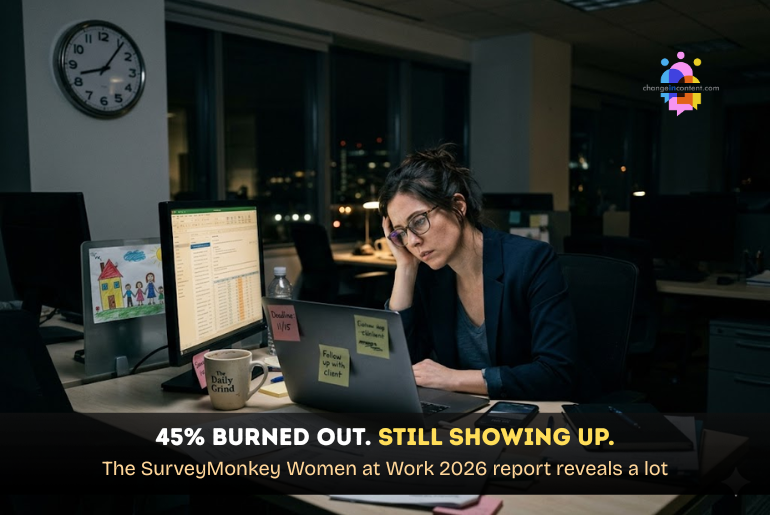
The SurveyMonkey Women at Work 2026 study, conducted in partnership with CNBC, does more than present workplace data. It exposes the emotional and structural realities shaping women’s careers today. From burnout and attrition to AI anxiety and identity struggles at work, the findings point to a workplace model that is still catching up with the lives women actually live.
What makes this report stand out is not just the scale of data, but the clarity of its message. Women are not stepping back from work. They are being stretched by it. And unless organisations start interpreting these signals correctly, the cost will not be just talent loss. It will be trust.
SurveyMonkey Women at Work 2026: The numbers that define reality
Here is what the Women at Work 2026 report by SurveyMonkey reveals.
45% Burnout: The most alarming signal
Nearly 45% of women workers say they feel burned out. But this is not surface-level fatigue. The data shows clear behavioural and career-level consequences:
- 80% of burned-out women feel less satisfied with their job (vs. 96% among those not burned out)
- 68% feel limited career growth opportunities (vs. 89%)
- 32% are working more hours than last year
- 25% are working longer hours regularly
- 21% delay taking paid time off due to job insecurity fears
- 17% delay in asking for a raise
- 21% report career setbacks in the past year (vs. 8%)
- 38% have considered quitting their job (vs just 7%)
What this means:
Burnout is no longer a personal issue. It is directly affecting retention, performance, and progression.
The work-life balance crisis: Only getting worse
One in six women (17%) reports that their work-life balance has worsened. The reasons are precise and layered:
- 50% cite increased workload
- 26% say they have taken on more demanding roles
- 33% report less flexible schedules
- 27% point to increased personal and family responsibilities
- 15% say fewer remote work options are hurting balance
- 29% of mothers struggle more with childcare access
On the flip side, for those who reported improvement:
- 57% credit flexibility
- Only 19% cite reduced workload
What this means:
Flexibility is not a perk. It is the backbone of balance.
Attrition is not random. It is predictable.
The report makes this very clear. 27% of women have considered quitting (21%) or already quit (6%) in the past year
Why?
- 42% considered quitting for a better work-life balance
- 38% actually quit for the same reason
- 25% considered quitting for flexibility
- 27% who quit cited flexibility
At the same time:
- 36% say work-life balance is the main reason they stay
- A similar percentage stay because of flexible work arrangements
What this means:
Retention is no longer about compensation alone. It is about how work fits into life.
Identity at work: The quiet struggle
22% of women feel it is harder to be themselves at work. That is not a small number. That is one in five women.
Even more revealing:
- Only 14% say their workplace is less diverse
- Yet perception of belonging is dropping
Where diversity initiatives decline:
- Women are 5x more likely to feel the workplace is less diverse (50% vs 10%)
- 51% say it becomes harder to be themselves (vs 14%)
Generational insight:
30% of Gen Z women say diversity initiatives helped their careers, compared with 23% of millennials, 14% of Gen X, and 10% of Boomers.
What this means:
Inclusion is not measured by policies. It is felt in daily experiences.
AI at work: Adoption without confidence
AI usage is growing, but unevenly
- 40% of workers have used AI at work this year
- 27% use it weekly or daily
- 60% still do not use AI at all
Among users:
- 55% rely on general AI tools (ChatGPT, Gemini)
- 27% use AI integrated into tools
- Only 12% use internal AI systems
The fear beneath the adoption
Even among users:
- 69% believe AI will cause job losses
- 67% say they need more training
- 53% fear falling behind without AI
- 30% say AI creates more work
Interestingly:
- 37% say using AI feels like cheating
Gender divide in AI usage
- 25% of women use AI multiple times a day (vs 32% men)
- Women are more likely to feel guilty using AI (41% vs 34%)
- Men are more likely to feel left behind
What this means:
AI adoption is not just technical. It is psychological.
What the SurveyMonkey Women at Work 2026 report is really saying
This is not just a workplace report. It is a mirror that tells us:
- Women are working more, not less
- They are staying, but questioning
- They are adopting technology, but not comfortably
- They are part of the system, but not fully supported by it
And if you read this alongside our analysis on healthy workplaces for women, one thing becomes clear: Workplaces are evolving. But not fast enough.
The Changeincontent perspective
The biggest mistake organisations make is treating these numbers as isolated problems.
- Burnout is not separate from flexibility.
- Flexibility is not separate from retention.
- Retention is not separate from inclusion.
- Inclusion is not separate from leadership.
This is one system. And right now, that system is asking women to adapt more than it is willing to adapt itself.
If organisations want to fix this, they need to:
- Redesign roles around realistic time expectations
- Make flexibility structural, not optional
- Invest in AI training with emotional context, not just tools
- Build cultures where identity does not feel like a risk
- Track burnout like they track performance
Conclusion: SurveyMonkey Women at Work 2026 is not a warning. It’s a blueprint.
The SurveyMonkey Women at Work 2026 report is not just telling us what is wrong. It is showing us where to look.
Because the question is no longer: “Are women struggling at work?”
The real question is: “Are workplaces ready to evolve fast enough to keep them?”
Sources: CNBC, SurveyMonkey
Disclaimer: The views expressed in this article are based on the writer’s insights, supported by data and resources available both online and offline, as applicable. Changeincontent.com is committed to promoting inclusivity across all forms of content. We broadly define inclusivity in terms of media, policies, law, and history. It encompasses all elements that influence the lives of women and marginalised individuals. Our goal is to promote understanding and advocate for comprehensive inclusivity.