
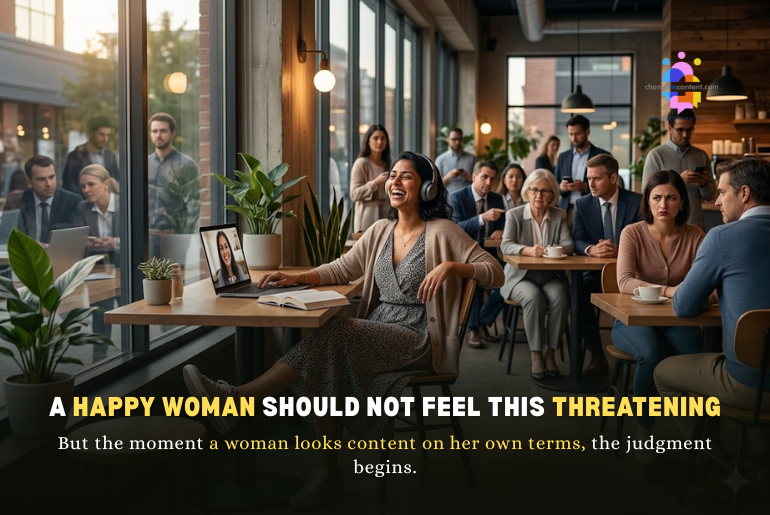
A woman smiling in a photo should not feel political. A woman enjoying her work, her body, her friends, her freedom, or her own company should not feel like a threat. And yet, for so many women, happiness still invites suspicion much faster than sympathy. That is what makes a happy woman such a strangely controversial figure.
She does not even have to say much. She only has to look content in her own skin, and suddenly, people want to know who gave her permission.
The problem with a happy woman
“People just hate happy women.” Hania Aamir, a prominent Pakistani TV and film actor, said on Instagram in response to the online trolls and bullying.
There is a rom-com called The Idea of You, where a 40-year-old woman, played by Anne Hathaway, gets into a relationship with the lead singer (and very much younger man!) of a boy band. And of course, the age gap became the headline. People had opinions, and most of them weren’t kind to the woman.
At one point in the film, Anne’s character says to her best friend, “I didn’t know my being happy would piss so many people off.”
And her friend replies, “Did I not warn you? People hate happy women.”
Whether it’s Hania Aamir, Anne Hathaway, or literally you reading this, deep down we all know it. A woman who’s happy on her own terms is instantly seen as someone not conforming to the standards set by patriarchy.
Why a happy woman bothers people
It doesn’t even take much. A vacation photo. A graduation post. A new job update. Just a woman sharing something good from her life, and somehow, that’s enough to invite sexist and hateful misogynistic comments.
- A photo of a well-dressed woman. “Who is she trying to impress?“
- A graduation post. “All this just to end up in the kitchen anyway.“
- A night-out post. “This is not how good girls behave.“
A visibly happy woman, achieving things, and putting herself out there isn’t staying within the usual boundaries people are comfortable with. Because the version of a woman society is used to is quieter. More contained and meek. Focused on others and not herself.
How public happiness becomes public permission for judgment
Success doesn’t protect women from hate. If anything, it brings more of it. Female celebrities get judged for everything at once. It’s the same with sports.
Women athletes train just as hard, win the same medals, break records, and still face comments that have nothing to do with their performance. And if they’re openly happy about their success, that somehow makes it worse. Almost as if they’re not supposed to enjoy it that much.
Happy women, and the friendships they’re told to outgrow
A majority of women’s friendships do not survive marriage and motherhood. Not always because she wants that, but because that is an expectation.
For men, nothing really changes in the same way. They still meet their friends, go out, and take that time without it being questioned. For women, even a simple plan with friends can come with a lot of judgment. If she steps out, people start asking who’s taking care of things at home, why she needs to go out so often, or whether this is the right time to go out.
We have to talk about it because we already know how important these friendships are. There’s research suggesting that women actually benefit from meeting their close friends regularly. Something like a girls’ night every few weeks can help reduce stress, improve mood, and make everyday life feel more manageable.
How friendship gets framed as selfishness
But when a woman actually does that, when she takes that time, laughs, posts a picture with her friends, looks genuinely happy, it gets questioned and judged.
If she’s middle-aged or older? Somehow it’s even worse. By then, there’s this assumption that her life should revolve entirely around family, that friendships are something she should have outgrown. So, a group of women enjoying themselves, without guilt, starts to look unusual.
It also mirrors something we discussed in Unhappy Leaves: Employee Wellbeing, where emotional exhaustion is often normalised instead of recognised, especially when women are expected to keep functioning without visible rest or joy.
Where are the happy women?
Maybe a happy woman feels “too much” simply because we barely see her. Most of the women we grew up watching are always dealing with something. There’s always a problem, always some struggle attached to them. Yes, real life has issues. But how are the women shown in films and series? It’s like they’re never allowed to exist and be okay.
A lot of the stories people consume keep showing women as sad, stressed, or stuck. Always adjusting, always sacrificing, always handling something.
Take Yeh Rishta Kya Kehlata Hai, just one of the many examples. At this point, no one even knows which generation the story is in anymore. But it always starts with a girl who’s fun, full of energy, has dreams, and has a personality. And then she gets married. She’s no longer the happy person we were introduced to.
Suddenly, it’s problem after problem. Issues with in-laws, issues in the kitchen, family drama every other day. The same girl who had ambitions and a spark slowly turns into someone constantly stressed about what to cook for a festival or how to fix yet another family issue.
And somehow, for the society she’s in, she’s exactly where she’s supposed to be. Perfect, even. Because who really cares if she’s happy, as long as she’s doing her duties as a wife or daughter-in-law?
Conclusion: A happy woman looks controversial only in a culture that still wants her contained
Society hates a happy woman because she is not performing the version of womanhood people are comfortable with. It’s not that society hates happiness. It just doesn’t know what to do when a woman has it.
There is also this weird expectation that women should always be in the process of becoming something better, something more acceptable. Fixing themselves, improving, adjusting. So when she shows up already okay with who she is, already enjoying her life, it interrupts that narrative. Like, wait, she’s not trying to change? She’s just… good? And maybe that’s what makes it feel controversial. Not because it actually is, but because it doesn’t fit into a system that’s used to women constantly negotiating their place in it.
Disclaimer: The views expressed in this article are based on the writer’s insights, supported by data and resources available both online and offline, as applicable. Changeincontent.com is committed to promoting inclusivity across all forms of content. We broadly define inclusivity in terms of media, policies, law, and history. It encompasses all elements that influence the lives of women and marginalised individuals. Our goal is to promote understanding and advocate for comprehensive inclusivity.
