
The Quick Read
- Female-dominated jobs often pay less than occupations requiring comparable education, skill or responsibility.
- This is different from women receiving lower salaries than men in the same job. The occupation itself may be assigned a lower economic value because it is associated with women.
- India offers visible examples in teaching, nursing, childcare, community health, social work, domestic work and administrative support.
- Anganwadi workers and helpers perform essential public functions but are officially classified as honorary workers and receive honorariums rather than regular salaries.
- Better pay will require job evaluation based on skills and responsibilities, stronger wage floors, formal employment and transparent comparison between occupations of comparable value.
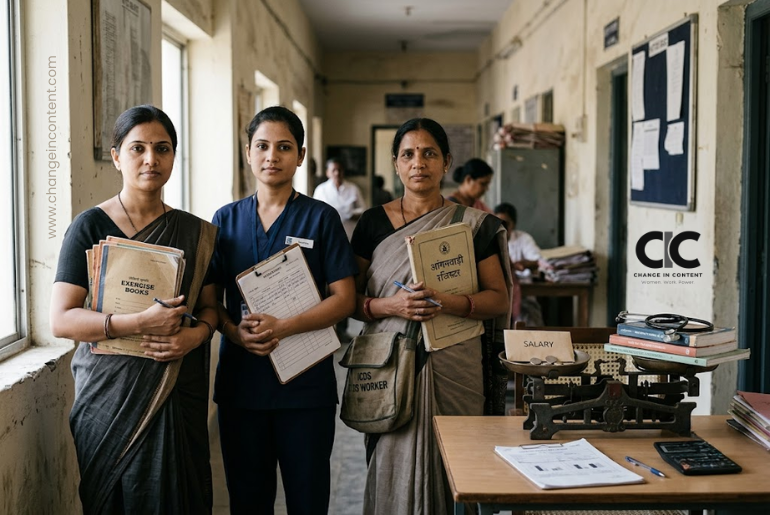
At 8 in the morning, a woman opens an Anganwadi centre in a village.
Before lunch, she may weigh children, record their growth, counsel a pregnant woman, speak to a family about nutrition, update government data and help distribute food. During an emergency, she may become the most accessible representative of the public health and welfare system.
Her work touches childhood development, maternal health and food security. The official description, however, may still call her an honorary worker.
That word performs an extraordinary piece of accounting. It acknowledges the service while avoiding the full cost of employing the person who provides it.
It is the larger story behind why female-dominated jobs pay less. The question is not only whether a woman earns less than a man sitting beside her. Sometimes, an entire occupation is priced poorly because the work has long been associated with women.
The employee is not merely underpaid within the job. The job itself has been undervalued.
The pay gap begins before the salary negotiation
Most conversations about the gender pay gap follow a familiar comparison.
A man and a woman perform the same role. The man earns more. The organisation is asked to explain the difference. That remains an important problem. It is not the only one.
A second form of inequality appears when society assigns lower pay to occupations in which women are concentrated. The comparison is no longer between two employees with the same title. It is between different jobs that may demand comparable education, responsibility, judgement or strain but carry very different economic rewards.
Consider the people trusted with children.
A preschool teacher must understand early learning, manage behaviour, notice developmental concerns, communicate with parents and remain responsible for the safety of several young children at once. Yet early-childhood education is often treated as pleasant, natural work for women rather than as specialised professional labour.
Now compare the language used around technical occupations.
Technical work is described through expertise, complexity and output. Care-related work is described through patience, affection and dedication. One vocabulary supports a salary. The other too easily invites applause.
International labour research has long identified this pattern. A major study using five decades of United States census data found that occupations with larger proportions of women paid less even after accounting for differences in education and skill. The researchers also found evidence that pay declined as occupations became more female-dominated, rather than low pay alone causing women to enter them.
The data came from another country, and India’s labour market has its own structure. The underlying question, however, travels well: When women become closely associated with a kind of work, do we begin to regard the work as less skilled, less demanding and therefore less deserving of money?
India already knows what women’s essential work looks like
India’s public systems rely heavily on women whose roles sit between employment, service and sacrifice.
Anganwadi workers support early childhood care, nutrition and maternal welfare. ASHA workers connect communities with public healthcare. Auxiliary nurse midwives, nurses, schoolteachers, childcare workers and domestic workers carry responsibilities that affect health, education and the continuity of family life.
These jobs are not identical. Their qualifications, employment arrangements and pay structures vary greatly.
What connects many of them is the assumption that women are naturally suited to care, patience and service. Once an ability is described as natural, employers and governments can behave as though it requires less training and deserves less payment.
The Central Government’s stated base honorarium for an Anganwadi worker at a main centre remains ₹4,500 a month. At the same time, an Anganwadi helper receives ₹2,250. States may add their own amounts and incentives, but the national framework continues to describe these women as honorary workers rather than ordinary employees.
The terminology matters.
An honorarium suggests recognition for a contribution. A salary recognises an employment relationship.
Yet an Anganwadi worker does not appear occasionally when goodwill permits. Her duties are structured, monitored and tied to public programmes. The State relies on her presence.
India’s ASHA workforce offers a similar contradiction. These women are the first point of contact with the health system for many rural communities. Still, their compensation has historically depended heavily on task-based incentives rather than a secure salary. During the pandemic, their responsibilities expanded dramatically, prompting repeated demands for worker status, fair pay and social protection.
We call the work essential most confidently when there is a crisis. Once the crisis passes, the adjective survives more easily than the wage increase.
“But these are different kinds of jobs”
They are. And we cannot compare pay by emotion alone.
A surgeon, software engineer, primary teacher, nurse and construction supervisor have different qualifications, risks, working conditions and levels of responsibility. It would be simplistic to claim that every difference between their salaries is caused by gender.
Industries also generate different revenues. Government budgets, market demand, union strength, worker supply and the ability to measure output all influence pay.
But these explanations do not close the discussion. They tell us how salaries are set within the economy we have built. They do not prove that the valuation is fair.
Markets do not assign prices in a social vacuum.
A job’s bargaining power depends on who performs it, whether those workers are formally employed, how easily they can organise, whether their labour is visible and what happens if they stop working.
The output of a salesperson may appear in a monthly revenue sheet. The output of a caregiver may be a child who develops well, an older person who remains safe or a patient who does not return to hospital. The value is substantial, but it is dispersed over time and harder to place in a quarterly presentation.
That makes care easy to admire and difficult to bill.
Research into care occupations has found a wage penalty attached to jobs involving teaching, counselling, childcare and health support, even after factors such as worker characteristics and skill requirements are considered.
The question, then, is not whether every female-dominated occupation should pay the same as every male-dominated one. It is whether we have built a system that carefully measures skills associated with machinery, finance and technology while treating emotional labour, care, coordination and human development as qualities women simply bring with them.
When nurturing becomes a discount code
Imagine two job descriptions.
The first requires a worker to supervise several people, manage risk, maintain records, communicate with multiple stakeholders, respond to emergencies and remain accountable for measurable outcomes. The second describes a primary-school teacher.
The first sounds managerial. The second may still be spoken about as a suitable job for women because the hours appear compatible with family life.
The responsibilities have not changed. The framing has.
India’s school teaching workforce is now majority female. Government data for the 2025–26 academic year places women at 54.9% of all schoolteachers.
That does not mean all teachers are equally skilful. That does not mean all teachers are poorly paid. Government teachers in secure posts may receive structured salaries and benefits. At the other end sit teachers in low-fee private schools, contract educators, preschool staff and support workers whose compensation can be modest and insecure.
The occupation contains sharp inequalities within it. Still, its increasing association with women can shape how society speaks about it. Teaching is praised as noble, respectable and family-friendly. These compliments can conceal an expectation that purpose will compensate for pay.
Nursing faces a related problem. Nurses are expected to combine technical knowledge with constant observation, physical stamina, emotional control and responsibility for human life. Yet their labour can be described as assistance to medicine rather than as skilled clinical work in its own right.
A man operating complex equipment is presumed to possess technical expertise. A woman monitoring a fragile patient throughout the night may be praised for compassion.
Compassion is valuable. It should not erase competence.
Why do women keep entering poorly paid work?
This question often arrives with an unhelpful conclusion already attached: women chose those occupations, so the pay outcome is a consequence of preference.
Choice matters, but choices are made within constraints.
A woman may choose teaching because her family accepts it as respectable. She may choose community health work because it is available near her village. She may take an administrative role because it offers predictable hours. A woman may avoid a factory, sales territory or late shift because transport is unsafe or care responsibilities remain hers after work.
The decision can be rational without being entirely free.
India’s labour market remains strongly shaped by differences in mobility, unpaid work, social expectations and access to opportunity. Research based on India’s Time Use Survey found that women’s much larger share of unpaid domestic and care work could not be explained mainly by education, income or other observable characteristics central to the imbalance.
When women need work that is close to home, socially accepted or compatible with care, they become concentrated in a smaller range of occupations. That concentration weakens bargaining power.
Employers know there may be many women seeking the same limited set of acceptable jobs. Workers who cannot relocate, work late or leave the labour market temporarily have fewer alternatives. Low pay can therefore persist even where the work requires substantial skill.
It is occupational segregation in ordinary clothes.
It does not always involve a sign saying that women are barred from better-paid work. Sometimes, women are channelled towards jobs that society approves of and then informed that those jobs do not pay very much.
Low wages also decide what counts as skill
Skill is often presented as an objective quality. In practice, it is partly a social judgement.
- Operating a specialised machine is recognised as a skill because it requires training.
- Calming a distressed child is described as temperament.
- Managing financial risk is recognised as expertise.
- Managing a ward of anxious patients, communicating with their families and noticing subtle changes in their condition may be described as caring.
The distinction is not that one activity is complex and the other is simple. It is that some abilities have been formalised, credentialled and priced, while others remain associated with femininity and are treated as instinct.
That is why education alone cannot correct the problem.
Women may obtain qualifications and enter a profession in large numbers, but their credentials will not deliver full value when the profession itself is discounted. An Indian skills programme examined by Change in Content found women matching or outperforming men in certification, placement and retention while still reporting lower earnings. The pattern showed that performance does not automatically protect workers from labour-market valuation. The Skill Impact Bond findings also exposed a gender pay gap after training.
It is possible to educate women for jobs that the economy continues to price poorly.
The trap hidden inside “work that women prefer”
Female-dominated work is often said to offer non-financial benefits.
Teaching may provide predictable holidays. A local health role may reduce travel. Administrative work may have fixed hours. Care occupations may feel purposeful.
These benefits can be real. They can also become excuses for lower pay.
Flexibility is valuable because the rest of society still expects women to absorb more care work. It is not necessarily a gift supplied by a generous employer. In many cases, it compensates for an unequal private burden.
A woman may accept a lower salary because the job allows her to collect a child from school. The employer observes that she accepted the salary and calls it market value. The unpaid care system that narrowed her alternatives disappears from the calculation.
The result is a circular argument: Women take lower-paid jobs because those jobs fit the duties assigned to women. The jobs remain lower paid because women continue to take them. The market then presents the outcome as preference.
India’s recent improvement in women’s labour-force participation deserves recognition, but participation figures do not reveal the quality of every job. Women’s work is disproportionately likely to be informal, self-employed or tied to family enterprises, and it is economically unemployed.
Getting more women into work matters. Asking what work they enter, how securely they are employed and what that work pays matters just as much.
The problem is larger than the gender pay gap
An occupation-level pay penalty affects men too.
A man who becomes a nurse, preschool teacher or social worker enters the same undervalued pay structure. Female-dominated work can pay poorly for everyone performing it.
That does not make gender irrelevant. It demonstrates how deeply gender can shape the value assigned to the job itself. The consequences then spread beyond individual salaries.
Low pay creates staff shortages. Experienced workers leave. Vacancies remain open. Workloads increase for those who stay. The quality of care, education or support declines. Families purchase private alternatives where they can, while poorer households absorb the gap through more unpaid labour, usually by women.
Underpaying care does not make care inexpensive. It moves the cost elsewhere.
A poorly paid childcare sector may save money on wages while preventing mothers from returning to employment. Inadequate eldercare may push a daughter out of her career. Understaffed nursing increases strain on patients, families and the health system.
The ILO estimates that unpaid care responsibilities keep hundreds outside the global labour force.
The labour that appears cheap in one budget can become extremely expensive across the economy.
That connection is visible in the gender wealth gap in India. Lower and interrupted earnings affect savings, investment, pension accumulation and asset ownership long after a monthly salary has been spent.
Would these jobs pay more if men dominated them?
It is a provocative question, not one that can be answered uniformly.
There are female-majority occupations with secure and respectable salaries. There are male-dominated jobs that are physically punishing, insecure and badly paid. Caste, class, region, informality and worker organisation complicate every simple gender comparison in India.
Yet international evidence gives the question legitimacy.
The longitudinal study on occupational feminisation did not merely show that women happened to enter jobs that already paid less. It found that increases in women’s representation were followed by declines in relative pay, even after adjusting for educational characteristics.
That does not prove the same numerical effect exists in every Indian occupation. India needs stronger, occupation-level longitudinal research of its own. It does suggest that employers and institutions may unconsciously attach lower status to work once it becomes identified with women.
We see the reverse instinct in everyday life.
- Cooking in a home is unpaid women’s work. At the top of the restaurant industry, the celebrity chef is more often imagined as a man.
- Sewing at home is ordinary. Fashion leadership becomes prestigious.
- Caring for a sick relative is expected. Medical authority commands status.
The activity does not need to change completely. The setting, title and gender attached to it can change how seriously it is valued.
What would fairer valuation look like?
Telling women to move into engineering, finance and technology cannot be the only answer.
Women should have full access to high-paying, male-dominated professions. Barriers that restrict their entry and advancement must be removed.
But a society cannot solve occupational inequality by advising every woman to leave teaching, nursing, childcare or community health.
Someone still has to educate the child, care for the patient and support the older person.
The better response is to raise the value of necessary work.
Compare jobs by responsibility, not tradition
Employers and governments can use gender-neutral job evaluation to compare occupations on qualifications, responsibility, working conditions, mental demands, physical risk and consequences of error.
Two jobs need not be identical to be of comparable value.
A care worker responsible for vulnerable people may hold less budgetary authority than an office manager but carry greater human risk. Pay systems should be able to recognise that difference rather than relying on historical salary levels.
Stop hiding employment behind honorariums
Where work is regular, supervised and essential to a public programme, governments should examine whether honorary or incentive-based arrangements remain defensible.
Formal status brings more than a higher monthly payment. It affects social security, leave, grievance rights, career progression and the worker’s ability to plan her life.
Publish occupation-level pay data
Company-wide gender pay figures can hide concentration.
An organisation may report a moderate overall gap while women remain clustered in low-paid support, care and coordination roles and men dominate better-paid technical or commercial functions.
Employers should examine:
- Which jobs are predominantly performed by women;
- How those jobs were originally graded;
- Whether their skill descriptions remain accurate;
- How pay compares with male-dominated jobs requiring similar responsibility;
- Who progresses from frontline work into management.
We cannot understand the broader gender pay gap in India fully without looking at where women work and what those occupations are considered worth.
Build progression inside female-dominated fields
A job remains unattractive when the only meaningful salary increase requires leaving the profession.
Nurses, teachers, community workers and care professionals need visible routes into specialist, supervisory and leadership roles without abandoning the work in which they have developed expertise.
Career ladders also make skills visible. They replace the assumption that years of experience merely produce more of the same work.
Fund the service honestly
Governments and employers cannot demand high-quality care, health and education while budgeting for cheap labour.
Better wages may raise the immediate cost of a programme. They can also reduce turnover, improve recruitment, retain experience and strengthen service quality.
The choice is not between affordable services and well-paid workers. It is between paying transparently now and allowing families, workers and public systems to carry the hidden cost later.
This is not a story about women choosing badly
A woman who becomes a teacher has not failed to maximise her worth. A nurse has not misunderstood the market. An Anganwadi worker does not become less skilled because her work happens close to home. A domestic worker does not contribute less because much of the same labour has historically been performed without pay inside households.
The distorted choice is the one society keeps making: to depend on women’s labour while pricing it as though dedication can settle the bill.
We often tell women to value themselves. That advice is incomplete when pay scales, procurement budgets and public policy have already decided that the work they perform carries less value.
Self-belief cannot repair an occupation’s wage structure.
Female-led jobs pay less: The change ahead
The next phase of the gender-pay debate must look beyond whether a woman earns less than the man at the next desk.
It must ask why entire rows of desks occupied mainly by women sit lower on the salary chart.
India depends on women to teach children, deliver community health, care for families, support offices and hold together public services at their most human points. These jobs are frequently praised for their social value. Social value, however, has become a suspiciously convenient substitute for financial value.
The solution is not to make every caring profession resemble a corporate job. It is to stop using care, purpose and social respectability as reasons to pay less.
A job does not lose complexity when women perform it. It only becomes easier for us to pretend that the complexity came naturally.
Editorial Note and Sources
This article is an opinion-led analysis based on Indian government data, labour-market research and international scholarship on occupational segregation and the devaluation of female-dominated work. International findings are used to explain a recognised labour-market mechanism and are not presented as direct estimates for India. Examples from Indian teaching, community health and childcare reflect varied employment arrangements; pay and conditions differ across States, institutions and public and private employers.
Principal sources
- Social Forces, Oxford Academic: Occupational Feminisation and Pay: Assessing 1950–2000 U.S. Census Data
- Press Information Bureau, Government of India: Various initiatives undertaken to incentivise and encourage Anganwadi Workers and Helpers
- Ministry of Education, Government of India: Report on Unified District Information System for Education Plus (UDISE+) 2025-26 on School Education in India.
- International Labour Organisation: Unpaid care work prevents 708 million women from participating in the labour market
- *Northwestern University Institute for Policy Research: Wages of Virtue: The Relative Pay of Care Work (WP-02-07)
- National Statistical Office: Periodic Labour Force Survey Release by the Press Information Bureau.
