
The Quick Read
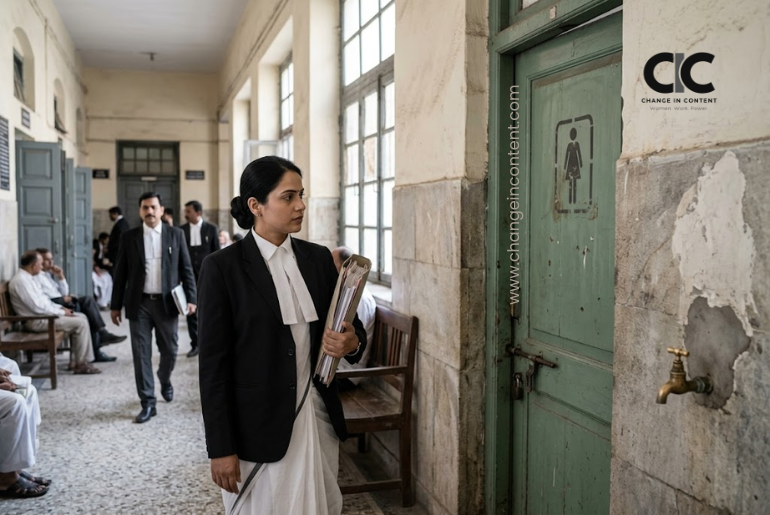
- The Supreme Court has directed States and Union Territories to ensure the immediate construction of washrooms for women lawyers in court complexes where adequate facilities are unavailable.
- The facilities must include running water, sanitation arrangements and regular maintenance.
- States have been asked to place proposals for special funding and submit comprehensive compliance reports within six weeks.
- The Court made its position unusually clear: a lack of funds will not be accepted as a reason for non-compliance.
- The direction is welcome. The uncomfortable part is that in 2026, India’s highest court still has to explain that women practising law need safe, usable toilets.
A woman can argue constitutional law before a judge, defend someone’s liberty, challenge the State and spend an entire working day inside a court complex. Apparently, asking whether she can use a clean washroom during that day has been a more difficult case to settle.
The Supreme Court has now directed the immediate construction of washrooms for women lawyers across courts where adequate facilities do not exist. States and Union Territories cannot respond with the familiar administrative refrain that there is no money. The Court has said that it will not entertain any plea of lack of funds.
It is a firm and necessary intervention. It is also difficult to celebrate without asking how the legal system reached 2026 while a toilet remained an infrastructure ambition for many of the women working inside it.
Washrooms for women lawyers: What has the Supreme Court directed?
The directions came while the Supreme Court was hearing Sarika Tyagi v. Union of India and Others. It is a petition concerning the inadequate infrastructure available to women advocates across the country.
The Court directed the States and Union Territories to ensure that suitable washrooms are constructed wherever they are missing from court premises. The facilities must include water and sanitation arrangements and should be properly maintained rather than merely constructed and forgotten.
Proposals are to be placed before the respective governments for the allocation of special funds. The court has also directed States and Union Territories to file detailed status and compliance reports within six weeks.
The refusal to accept a revenue deficit as an excuse is significant. Sanitation is not an optional beautification project that the system can postpone until a generous budget year arrives. It is part of the minimum infrastructure required for people to work with dignity.
Why was another Supreme Court intervention necessary?
That is the question beneath the order.
The condition of toilets in Indian courts was not newly discovered this month. In January 2025, the Supreme Court had already ruled that access to toilets and washrooms was a facet of human rights and part of the right to dignity under Article 21 of the Constitution.
In that judgment, the Court noted serious gaps in judicial infrastructure. Data placed before it showed that 19.7% of district court complexes did not have separate toilets for women. In addition, 73.4% lacked women-friendly washrooms with sanitation facilities, such as sanitary pad dispensers.
The Court directed States and Union Territories to provide sufficient funds for the construction, maintenance and cleanliness of toilet facilities in court premises. Separate and accessible toilets were to be available for men, women, persons with disabilities and transgender people.
Change in Content examined the ruling in its earlier report on the Supreme Court verdict on toilets in courts and tribunals.
The latest direction suggests that stating a right and delivering a facility remain two different stages of governance. In India, the first may take a judgment. The second may take another one.
The petition goes beyond a few missing toilets
The proceedings began with concerns about the absence of adequately equipped Ladies’ Bar Rooms and essential facilities across High Courts, district courts, taluka courts, revenue courts, tribunals and commissions.
In its order dated 19 June 2026, the Supreme Court recorded the petitioners’ argument that these infrastructure failures affect the accessibility, inclusion and long-term sustainability of women in the legal profession.
Women lawyers require more than a room with a label on the door. A functional professional environment may need clean washrooms, changing areas, seating, drinking water, nursing facilities, safe spaces for rest and sufficient privacy.
These are not extravagant demands from people requesting luxury lounges between hearings. They are routine workplace facilities.
The fact that the petition had to catalogue them reveals a broader institutional habit: workplaces often invite women into professions without redesigning spaces built when their presence was barely considered.
The legal profession may speak the language of equality. Its buildings do not always keep up.
An earlier Change in Content analysis of court facilities for women advocates found that infrastructure shapes whether women can participate in legal practice on equal terms. A profession cannot call itself inclusive while treating women’s physical needs as a logistical inconvenience.
A washroom is not separate from professional equality
It is tempting to dismiss the matter as a municipal issue. Build the toilets. Fix the plumbing. Close the file. But sanitation affects how long a woman can remain at work, where she can practise and whether she feels safe doing so.
Court schedules are rarely designed around predictable working hours. Lawyers may spend long periods waiting for matters to be called. Hearings may be delayed. Travel between courts can consume much of the day. Leaving the premises to find a clean washroom may mean missing a case or losing access to a client.
Some women reduce their water intake before long court days. Some plan their movements around the few usable toilets they know. Menstruation, pregnancy, urinary health conditions and menopause can make the absence of adequate facilities still more difficult.
None of this appears in a lawyer’s case record. Yet it influences who can work comfortably, remain visible and accept assignments across different courts.
A badly designed workplace sends a quiet message: you may work here, but the building was not expecting you.
What does dignity look like in practice?
Dignity is a powerful constitutional word. It can also become conveniently abstract. In practice, dignity may look like:
- A toilet that can be locked from the inside;
- Running water throughout the working day;
- Lighting that makes the space safe to use;
- Sanitary disposal facilities;
- Regular cleaning;
- Access for women with disabilities;
- Facilities located close enough to courtrooms to be usable;
- Accountability when something stops working.
Construction alone will not satisfy the spirit of the direction.
India has no shortage of facilities that exist in official records but fail in daily use. A locked toilet, a broken tap or an unclean room may allow an authority to report that infrastructure is available while leaving the user’s experience unchanged.
The Supreme Court’s emphasis on sanitation and maintenance is therefore as important as its instruction to build. A completed building is not the same as a functioning service.
“No funds” has always been an interesting answer
Administrative systems often encounter budgetary constraints when women request basic facilities.
There appears to be money for imposing structures, ceremonial openings and renovation plaques. A tap, a sanitary bin and a door that closes can somehow test the outer limits of public finance.
The Supreme Court’s refusal to entertain a shortage-of-funds plea cuts through that performance.
Governments set priorities through budgets. Saying that there is no money for sanitation does not mean that money has ceased to exist. It means sanitation was not placed high enough on the list.
That is why the Court’s wording matters. It turns a discretionary improvement into an obligation.
The same gap between formal commitment and physical delivery is visible elsewhere. In January 2026, the Supreme Court issued detailed directions on toilets, handwashing facilities and menstrual hygiene in schools. The Court required functional toilets, continuous water and soap, and access to sanitary napkins.
The issue was tied to education because the absence of sanitation can disrupt attendance, safety and dignity. Change in Content has also examined the infrastructure gaps behind the school education system in India.
Whether the location is a school or a courtroom, the pattern is striking. Women and girls are welcomed into institutions in principle. Their bodies are accommodated later, often after litigation.
Gender-sensitive infrastructure must not mean exclusion
The need for dedicated facilities for women does not conflict with the case for inclusive sanitation.
Court complexes serve lawyers, litigants, staff members, witnesses and visitors of different genders and physical abilities. Infrastructure planning should provide privacy, safety and access for everyone.
That includes adequate women’s toilets, men’s toilets, accessible facilities for persons with disabilities and appropriate options for transgender and non-binary users. The discussion around gender-neutral toilets in the workplace shows why inclusive design requires more thought than simply replacing a sign on a door.
One group’s dignity should not be used as a reason to overlook another’s.
At the same time, “gender-neutral” must not become a convenient substitute for building enough facilities for women. A single shared toilet in a distant corner cannot be presented as progressive inclusion when the real motive is to avoid investment.
Infrastructure must respond to actual numbers, safety considerations and patterns of use.
What must happen within the six-week timeline?
The compliance reports should do more than count toilets. States, Union Territories and High Courts should identify:
- court complexes without separate and functional washrooms for women;
- the number of women lawyers, staff members and daily visitors using each complex;
- the condition and accessibility of existing toilets;
- whether water, electricity and disposal facilities are continuously available;
- construction and repair timelines;
- the funds allocated;
- the authority responsible for maintenance;
- a complaint and inspection mechanism;
- arrangements for menstruation, nursing and changing;
- facilities for persons with disabilities and transgender users.
Photographs of newly painted doors will not be enough.
The reporting process should establish whether women can reliably use the facilities during court hours. Women lawyers and local Bar Associations should be included in inspections because they know which toilets technically exist and which ones people actually avoid.
Public disclosure would strengthen the exercise. Court-wise status information can make it harder for unfinished work to be buried in a consolidated compliance affidavit.
The order is about who belongs in a court
The presence of women in law is often discussed through figures of representation.
- How many women enter legal education?
- How many practice?
- How many become senior advocates, judges or office-bearers?
Those questions matter. But representation is also decided through ordinary working conditions.
A woman may possess the qualifications, professional ability and ambition to build a career at the Bar. If she must repeatedly leave the court complex to find a safe toilet, the institution has imposed an additional disadvantage unrelated to legal competence.
Over time, small exclusions become career filters.
They influence which courts women choose, how long they stay, whether they take on matters involving travel, and whether the profession feels sustainable after pregnancy, childbirth, or changing health needs.
Infrastructure cannot guarantee equality. Its absence can certainly obstruct it.
The Change Ahead
The Supreme Court’s direction is welcome because it is clear, time-bound and unwilling to treat funding as an escape route. Still, there is something profoundly revealing about the moment.
In 2026, the country’s highest court has had to direct governments to construct washrooms so women lawyers can work with dignity inside courts. The law has reached the point of confirming that women who practise it are human beings with bladders.
One hopes this settles the matter. One also hopes the compliance reports contain functioning toilets rather than elegant explanations of why they could not be built.
Women’s dignity does not require another committee to discover what a washroom is. It requires budgets, plumbing, maintenance and the administrative seriousness to finish an obvious job.
Editorial Note and Sources
This article is based on the Supreme Court’s orders in Sarika Tyagi v. Union of India and Others, its January 2025 judgment on sanitation facilities in courts, and contemporaneous reporting of the directions issued in July 2026. The latest signed order was not available in the Supreme Court’s publicly indexed search results at the time of writing; details of the July directions have therefore been sourced from legal reporting and should be read alongside the Court’s official case record when it is uploaded. The article includes editorial commentary and is not legal advice.
Principal sources
- Supreme Court of India: Order dated 19 June 2026 in Sarika Tyagi v. Union of India and Others.
- Supreme Court of India: Rajeeb Kalita v. Union of India, judgment on toilet facilities in court premises.
- Verdictum: Report on the Supreme Court’s latest directions concerning washrooms for women lawyers.
- Supreme Court of India: January 2026 judgment on school toilets and menstrual-hygiene facilities.
