The Quick Read
- International Women in Cyber Day 2026 falls on September 1. The global initiative was founded by cybersecurity professional Lisa Kearney and the Women CyberSecurity Society to recognise women’s contributions to cybersecurity and improve gender equity in the profession.
- Women remain significantly underrepresented. ISC2 research in 2025 found women accounted for an average of 22% of cybersecurity teams surveyed globally.
- There are encouraging signals too: ISC2’s latest research found 72% of women surveyed described cybersecurity as a welcoming career path, while job satisfaction among women rose to 71%.
- As AI, cloud systems, digital payments and connected infrastructure expand, cybersecurity needs broader talent pipelines and more women progressing into technical and leadership roles.
- For India, the day is also a reminder that cyber inclusion concerns both sides of the equation: women need opportunities to build digital security, while women online also need stronger protection from cyber abuse.
International Women in Cyber Day, 2026
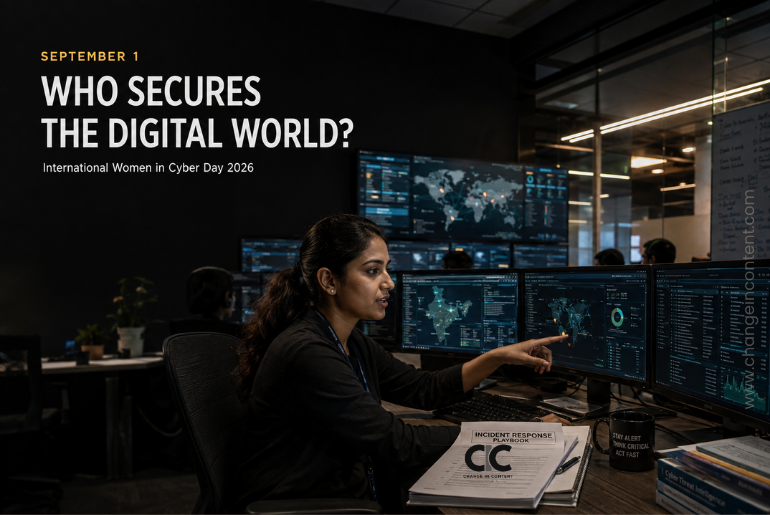
Some commemorative days require a little explanation. International Women in Cyber Day 2026, observed on September 1, is one of them.
The day was created to recognise women already working in cybersecurity and to encourage more women to enter, remain in, and progress in the profession. It was founded by Lisa Kearney, who also founded the non-profit Women CyberSecurity Society in 2018 after experiencing a lack of support for women and other underrepresented professionals within the industry.
That gives the day a useful dual purpose.
Celebrate the women securing networks, investigating threats, managing risk and designing cyber policy. And look closely at who still isn’t getting through the door.
Cybersecurity still has a numbers problem
Cybersecurity has long discussed a shortage of skilled professionals. It has also spent years drawing from a talent pool in which women remain a minority.
ISC2’s 2025 research found that women accounted for an average of 22% of security teams reported by respondents. 16% said their cybersecurity teams contained no women at all, while only 5% reported gender parity.
Those figures make International Women in Cyber Day more than a celebration of individual achievement. They raise a workforce question.
Cybersecurity is no longer a specialist concern tucked inside an IT department. It affects banks, hospitals, governments, manufacturing plants, retailers, workplaces, and almost every company that holds customer or employee data.
Artificial intelligence is widening that responsibility further.
Attackers can use AI to accelerate phishing, impersonation and other threats. Security teams, meanwhile, are learning to use AI for detection, analysis and response. The capabilities required inside cyber teams are evolving alongside the threats themselves.
Women should be part of shaping that evolution.
Change in Content recently examined a similar opportunity in the wider technology market, where women remain underrepresented in the AI jobs boom. Cybersecurity presents another fast-changing field where access to skills today could influence who occupies tomorrow’s senior technical positions.
International Women in Cyber Day, 2026: There are reasons for optimism
The data is not uniformly discouraging.
ISC2’s 2026 research found that 72% of women surveyed considered cybersecurity a welcoming career for women. Their reported job satisfaction increased from 67% in the previous study to 71%.
Women already working in the profession are also reaching positions of influence. In ISC2’s earlier women-in-cyber analysis, 55% of female respondents held managerial-level or higher roles, including women in C-suite positions.
That suggests the story should not be written as though cybersecurity is an industry closed to women. It is better described as one where entry and representation still lag behind the opportunities available. And entry routes are becoming less conventional.
Cybersecurity increasingly draws professionals from risk, compliance, law, business, intelligence, psychology and other disciplines alongside computer science and engineering. That matters because broadening the definition of a “cyber person” can also expand the pool of women who see themselves as belonging in the field.
Why September 1 matters in India
For India, the conversation carries an additional dimension.
The country’s cybersecurity workforce needs are growing as businesses digitise and threats become more complex. The latest India Cyber Security Skilling Landscape work from SANS Institute and the Data Security Council of India highlights how AI, cloud systems and hybrid technology environments are reshaping the skills required of cybersecurity professionals.
India therefore needs more cyber talent generally.
Leaving women on the margins would simply narrow the available workforce. But women and cybersecurity in India also intersect in another way: safety.
A Parliamentary Committee report released in 2026 examined cybercrimes targeting women and children, including cyberstalking, sextortion, deepfakes and online harassment. It cited NCRB data showing a sharp rise in recorded cybercrime against women between 2017 and 2022 and called for stronger investigation and forensic capacity.
This makes women’s participation in cybersecurity particularly interesting.
Women should not only be discussed as people who need protection online. They can be security engineers, threat researchers, investigators, CISOs, forensic specialists, policymakers and founders deciding how that protection works.
Our earlier analysis of India’s broader security ecosystem found overwhelming support for creating more opportunities for women in security roles, while leadership and workplace-culture gaps persisted. Cybersecurity belongs inside that conversation too.
What can organisations do beyond marking the day?
A September 1 LinkedIn post is easy. Building a stronger pipeline takes longer.
For employers, that can mean reviewing where women sit across cyber teams rather than reporting one diversity percentage. Are women concentrated in governance and compliance while engineering, offensive security or incident response remain heavily male? Are they progressing into security leadership? And are women returning after career breaks being considered for cyber reskilling?
Training providers can make entry routes clearer for women who do not have computer science backgrounds.
Universities and colleges can expose students to cybersecurity before career stereotypes become fixed. And women already inside the profession can matter enormously as mentors, hiring managers and visible technical experts.
There is another reason to keep flexibility in the conversation. ISC2’s research has consistently found that women value flexible and remote working arrangements, and these can support retention in a profession where organisations compete for scarce skills.
None of these interventions needs to wait for September 1. That is probably the most useful point of the day.
Change in Perspective: From Being Protected to Protecting
For years, technology conversations involving women have often focused on what the digital world does to them.
Cyber harassment. Fraud. Deepfakes. Privacy violations. Online abuse.
Those issues deserve attention.
International Women in Cyber Day offers another frame.
Women can also be among the people designing the defences.
The cybersecurity industry needs talent. Women need access to growing, skilled and influential careers. India needs stronger digital resilience. There is considerable overlap between those three goals.
September 1 gives the industry a reason to celebrate the women already doing that work. The more interesting measure will be how many more women are doing it when the date comes around again.
Editorial Note & Sources
This article is an informational feature marking International Women in Cyber Day 2026. It uses the Women CyberSecurity Society and ISC2 for the history and purpose of the observance, and for institutional research on the workforce and the Indian cybersecurity context. Workforce percentages refer to the populations covered by the respective studies and should not be read as a precise global census of every cybersecurity professional.
Sources
- Women CyberSecurity Society — International Women in Cyber Day and founder information: The organisation identifies IWCD as a global initiative that celebrates women’s achievements and raises awareness of the challenges they face in cybersecurity.
- ISC2 — International Women in Cyber Day: Background on the September 1 observance and its history.
- ISC2 — Women Comprise 22% of the Cybersecurity Workforce, 2025: Data on women’s representation, roles, flexibility and workplace experiences.
- ISC2 — Women in Cybersecurity Study, 2026: Latest findings on career perceptions, skills, AI and women’s experiences in cybersecurity.
- SANS Institute and Data Security Council of India — India Cyber Security Skilling Landscape 2025–2026: Research on India’s changing cybersecurity skills requirements.
- Parliamentary Committee on the Empowerment of Women — Cyber Crimes and Cyber Safety of Women, 2026: Summary covering cybercrime affecting women and recommendations for stronger capacity and response.