The Quick Read
- The Menstruation and Perimenopause at Work Report found that 50% of female employees surveyed experienced negative effects at work from menstrual symptoms during the previous 12 months. Another 39% reported an impact from perimenopause or menopause symptoms.
- The burden varies sharply with age. Menstrual symptoms affected 80% of respondents aged 18–24 and 73% of those aged 25–34, while perimenopausal symptoms affected 73% of women aged 45–54.
- Absence tells only part of the story. Around two in five respondents had taken time off, yet 77% had worked through symptoms on at least one day, and 44% on more than ten days.
- Only 16% had some form of workplace support, while 43% wanted support but did not have it. Just 23% knew their employer had a menstrual-health or menopause policy.
- The most requested interventions were remarkably practical: flexible working and better manager understanding, both at 40%, followed by hybrid/home working at 34%, free period products and rest spaces at 30% each.
- There is a retention consequence too. 28% had considered leaving their job because of menstrual or perimenopausal symptoms.
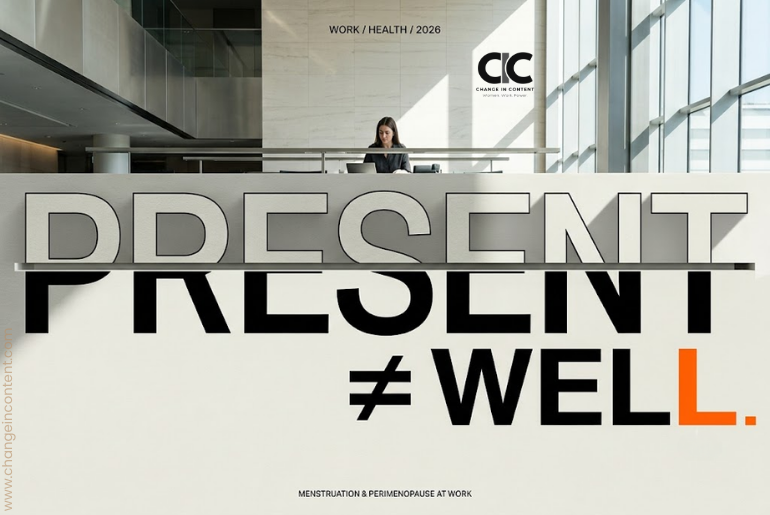
The employee is at work. That does not mean she is fine.
At 10.15 am, she joins the meeting.
At 11, she answers emails.
Then at 12.30, she presents the numbers.
At 2, she takes another painkiller.
At 4, she wonders whether the air-conditioning has suddenly become unbearable or whether it is another hot flush.
And at 6, the attendance system records something uncomplicated: Present.
The new Menstruation and Perimenopause at Work Report from the Autonomy Institute is useful. That is precisely because it reveals everything that one word can conceal. 50% of the female employees surveyed said menstrual symptoms had negatively affected them at work during the previous year. 39% said perimenopause or menopause symptoms had done the same.
Those are striking numbers. But the most revealing finding may be that most women frequently carried on working anyway. That is where workplace health becomes harder to measure.
First, what exactly did the research examine?
The Autonomy Institute worked with Survation to poll a representative weighted sample of 1,025 female employees aged 18 and above in the UK between 2 and 4 May 2026.
The sample was weighted by age and region to the Office for National Statistics profile, with a reported margin of error of ±3.28 percentage points for the full sample at a 50% response rate. This is therefore UK research, not a global prevalence study.
Its usefulness extends further, however, because the underlying workplace problem is familiar across labour markets. Menstruation and menopause are routine parts of millions of women’s working lives. Still, workplace systems often continue to treat them as unusual personal interruptions.
Autonomy puts the scale plainly. Around 15.8 million women are employed in the UK. Roughly half of the workforce will menstruate, experience perimenopause, or both during their working lives.
These are not edge cases. They are workforce realities.
The health burden changes with age. It does not disappear.
The report’s age breakdown is particularly revealing.
Among women aged 18–24, 80% reported menstrual symptoms affecting them at work. And among those aged 25–34, the figure was 73%.
Then the health issue changes rather than vanishes. Among women aged 45–54, 73% reported being affected by perimenopausal symptoms, and the proportion remained high at 62% among employees aged 55 and over.
This makes the idea of “women’s health benefits” being mainly a maternity issue look increasingly outdated.
A woman can begin her career dealing with painful or heavy periods. She may move through pregnancy or fertility treatment. And she may live with endometriosis or another reproductive-health condition.
Later, perimenopause can affect sleep, temperature regulation, concentration, mood, energy and confidence at precisely the point when her professional responsibilities may be at their greatest.
Change in Content has examined this timing before in our analysis of menopause and working women. Menopause frequently overlaps with senior career years rather than arriving after the important professional work has been completed.
The body and the career are moving through time together. Workplace policy needs to catch up with both.
Absence is visible. Presenteeism is the larger blind spot.
If menstrual health affects work, employers might reasonably look at sickness absence. That would tell them surprisingly little.
Around 2 in 5 women in the survey had taken time off because of menstrual or perimenopausal symptoms during the previous year. 7% had taken more than ten days, roughly equivalent to a working fortnight.
But look at the other side of the data. 77% had worked through symptoms on at least one day. And 44% had worked through symptoms on more than 10 days. Among women aged 45–54, the latter figure rose to 51%.
This is presenteeism: someone is technically working but cannot function at their normal capacity due to illness, pain, or another health condition. It rarely announces itself. A woman may still answer the call. Still finish the spreadsheet. And still appear in the office.
What the organisation cannot easily see is the migraine, heavy bleeding, severe cramps, exhaustion, brain fog, anxiety, disrupted sleep or hot flushes behind the completed task.
Our earlier examination of endometriosis in working women reached a similar conclusion. Absence is measurable; the woman working through pain is much easier for an organisation to miss. That makes presenteeism a management problem as much as a health problem.
A workforce can look fully staffed while functioning below capacity.
Even when women take leave, the system rarely calls it what it is
When respondents did take time off, 60% recorded it as ordinary sickness leave. Another 19% used unpaid leave. Only 8% had access to dedicated menstrual-health leave. It does not automatically mean that every organisation needs a separate menstrual leave entitlement.
There is a legitimate debate about whether dedicated leave reduces stigma or risks making women appear more costly to employ.
The more useful finding is that many women are already taking time away from work. The cost already exists. Employers are simply recording it under other categories, or women are absorbing some of it financially through unpaid leave.
The practical question is therefore not whether menstruation should suddenly become visible in every HR system. It is about whether employees can get the flexibility they need without paying for it with lost income, embarrassment, or assumptions about commitment.
Only 16% have support. 43% want it.
This may be the report’s clearest organisational gap.
Only 16% of respondents reported having a support arrangement at work. Another 43% wanted support but did not have it.
Policy awareness was similarly weak. Just 23% knew their organisation had a menstrual-health or menopause policy. More than half (53%) said their employer did not have one. Another 23% did not know. That final group is important.
A policy nobody knows exists has limited operational value. Workplaces can sometimes confuse having a document with having support.
The first sits on an intranet. The second means that an employee knows she can ask her manager to work from home after a sleepless night, change her uniform, access a rest area, or adjust her hours without wondering whether the request will quietly alter how seriously she is taken.
Change in Content recently looked at this distinction through menopause action plans. The strongest plans establish responsibilities, adjustments and practical routes to support rather than simply declaring the organisation “menopause-friendly”.
Implementation is where inclusion becomes real.
Women are not asking employers to redesign capitalism around their periods
Look at what respondents actually requested.
The two most popular interventions were:
Flexible working: 40%
Greater manager understanding: 40%
- Next came hybrid or home working at 34%.
- Free period products: 30%.
- A quiet or rest space: 30%.
- A formal policy: 29%.
- Additional sick leave: 29%.
These are remarkably ordinary requests.
- A later start after a bad night.
- The ability to work from home when symptoms are severe.
- A manager who does not make the conversation humiliating.
- A place to sit down.
- Sanitary products in a washroom.
- Some control over temperature or uniform where relevant.
- Enough clarity to know what happens when help is requested.
Our broader guide to healthy workplaces for women has made a similar point: basic hygiene, flexibility and physical workplace design often matter more than elaborate wellness campaigns.
A workplace does not need to become a clinic. It needs to stop making ordinary health realities unnecessarily difficult.
Sometimes the manager matters more than the policy
The 40% asking for better manager understanding deserves special attention.
A company can buy period products tomorrow. Manager confidence takes longer. Imagine telling your manager:
“I have very heavy bleeding today.”
Or:
“My perimenopause symptoms meant I barely slept.”
Or:
“I need to change my shift because my period pain is severe.”
These are intimate conversations.
Now imagine the manager looks embarrassed. Makes a joke. Asks intrusive questions. Immediately sends you to HR. Suggests everybody gets tired. Or becomes so visibly uncomfortable that you decide never to mention it again.
The policy has now failed despite technically existing.
Autonomy therefore recommends practical training for line managers, including male managers, covering respectful conversations, available adjustments, confidentiality and absence management.
It does not require managers to become experts in menstruation or menopause. They need to know how to respond professionally.
“I’m sorry you’re dealing with that. What adjustment would help today?”
That sentence is within most management competencies.
One report also shows why women cannot be treated as one workforce category
The burden was not evenly distributed.
Autonomy found that 64% of Asian respondents and 59% of Black respondents reported menstrual symptoms affecting work, compared with 47% of White respondents. The researchers also found that younger and minority-ethnic workers were more likely to want support they did not have.
The sample sizes behind subgroup findings require appropriate caution, but the pattern reinforces an important inclusion principle.
A standard women’s-health policy does not automatically produce an equal experience.
- Income matters.
- Job type matters.
- Control over working hours matters.
- Ethnicity can matter.
- Whether a role can be done remotely matters.
- Whether someone can afford unpaid leave matters.
A senior professional who can move Friday’s calls home experiences severe period pain differently from a cleaner, factory employee, nurse, retail worker or hospitality worker whose job requires physical presence.
Flexibility is easiest to offer to people who already have more autonomy.
That creates another DEI challenge. The employees most exposed to rigid work may be the ones least able to negotiate around their health.
Then comes the number employers should show to their retention teams
28%. That is the proportion of respondents who said menstrual or perimenopausal symptoms had made them consider leaving their current job. 6% said they had often considered doing so; another 22% had done so occasionally.
This turns menstrual health into a retention issue.
An experienced employee rarely resigns and writes: Reason for leaving: workplace temperature + perimenopause + manager discomfort + six months of poor sleep.
The exit interview may record:
- Work-life balance.
- New opportunity.
- Personal reasons.
- Culture.
- Flexibility.
The health component disappears. Employers may therefore be losing women without recognising the system that helped push them out.
That is particularly costly around perimenopause, because women in their 40s and 50s can be carrying years of accumulated organisational knowledge, specialist skill, client relationships and leadership experience.
Ignoring midlife health can become an expensive way to lose senior talent.
What should employers change?
The report offers a useful hierarchy.
- Start with a clear, publicised menstrual-health and menopause policy.
- Make sure employees know what support actually exists.
- Train managers.
- Build flexibility where jobs allow it.
- Create workable hybrid options.
- Provide basic physical adjustments such as rest spaces, free products, uniform flexibility and temperature support.
- And measure presenteeism rather than focusing solely on sickness absence.
We would add one more principle: Do not build a policy that requires women to disclose more than necessary.
An employee should not have to narrate the intimate details of her cycle to prove she deserves an adjustment.
Good policy creates enough trust that women can ask for support. A great policy provides enough flexibility that some support can be accessed without any disclosure.
That could mean flexible start times available to everyone. Remote days. Reasonable sick-leave systems. Accessible rest spaces. Better temperature control. Predictable scheduling.
When inclusive design becomes ordinary design, people need fewer exceptional accommodations.
And governments have a role beyond telling employers to be supportive
Autonomy’s recommendations extend into public policy.
The report calls for a statutory ACAS Code of Practice on menstrual and menopausal health, clearer protections for severe menstrual and menopausal conditions, wider access to free period products, improved national data, and the use of public-sector employers as examples of best practice.
The report notes that the UK’s Equality Act can already protect some employees where menopause symptoms meet the legal definition of disability, following Rooney v Leicester City Council. But protection remains contingent on individual circumstances, and litigation is hardly an accessible workplace support strategy.
The larger policy question therefore mirrors the employer question. Should support depend on a woman proving that her health has become severe enough? Or can systems be designed around the predictable reality that large parts of the workforce will menstruate and experience menopause?
The second approach is considerably less dramatic. It may also be considerably more effective.
There has been progress. The vocabulary itself proves it.
10 years ago, a report explicitly joining menstruation, perimenopause and work would have struggled to enter mainstream management conversation.
That is changing.
- Employers are introducing menopause plans.
- Period products are appearing in more workplaces.
- Hybrid work has given some women greater control over symptom-heavy days.
- Manager training is growing.
- Women’s health is moving out of the maternity-benefits box.
Change in Content’s coverage of the Humm Care Women’s Health & Workplace Report showed similar expectations among women in India: respondents wanted accessible preventive care, specialist support and family-supportive workplace infrastructure rather than health benefits that existed only on paper.
Different country. Different study. A familiar direction.
Women increasingly expect organisations to acknowledge that health moves through an entire career.
The Change: Stop rewarding women for hiding the cost
There is a strange compliment workplaces sometimes pay women.
She never lets it affect her work.
Perhaps she doesn’t.
- Perhaps she has simply become exceptionally good at making sure nobody sees how much effort that requires.
- She works through the cramps.
- She carries spare clothes.
- She takes the call after another sleepless night.
- She sits beside the window because she is overheating.
- She uses ordinary sick leave.
- She works from the bathroom for ten minutes.
- She declines the bigger role because the current one is already difficult enough to manage.
The work gets done, and the system congratulates itself.
The Menstruation and Perimenopause at Work Report gives employers a different way to read that apparent normality.
Women are not necessarily absent. They are frequently present and managing. That is why the most useful response may not be a dramatic new benefit.
- A little more autonomy.
- A manager who understands.
- A flexible morning.
- A place to rest.
- A product in the bathroom.
- A policy people can actually find.
- A workplace where saying “I’m having a difficult symptom day” does not become a career event.
Those are modest changes. For the woman trying to get through Thursday, they may not feel modest at all.
Editorial Note
This DEI Insights article is based principally on the Autonomy Institute’s 2026 Menstruation and Perimenopause at Work report, authored by Dr Will Stronge and Prof Kate Sang. The underlying Survation poll covered 1,025 female employees aged 18+ in the UK and was conducted from 2–4 May 2026, weighted by age and region. Findings are therefore specific to the surveyed UK workforce and should not be treated as global prevalence estimates. The article discusses workplace implications and is not medical advice.
Source
The Autonomy Institute — Menstruation and Perimenopause at Work: Published August 2026. The report covers symptom prevalence, absence, presenteeism, workplace support, retention and recommendations for UK employers and government.