
The Brief
- India’s clean-energy targets could generate more than 44 lakh full-time-equivalent jobs, according to a 2026 CEEW–NRDC study.
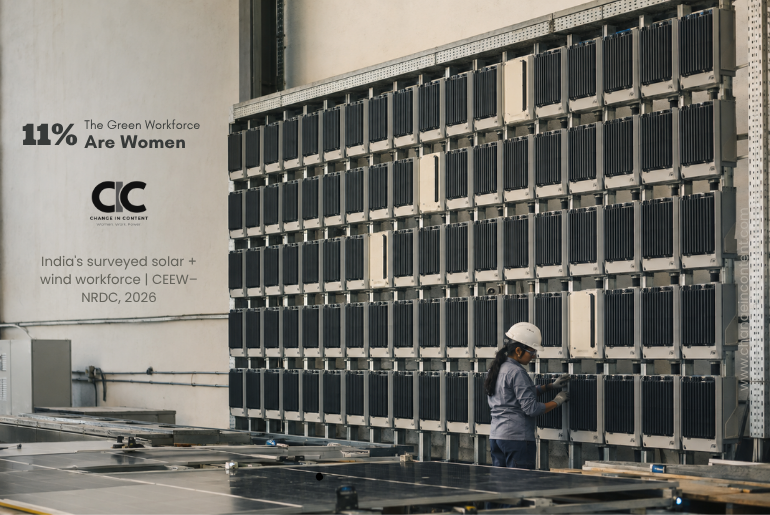
- Women account for only 11% of the surveyed workforce in solar and wind deployment and manufacturing.
- Among the women who are employed, around 62% work in non-technical functions such as HR, accounting and administration.
- This is happening while India’s overall female labour-force participation is rising, making green industries an important new source of employment rather than a niche concern.
- If women enter these sectors mainly after occupations, skills and leadership pipelines are already established, India risks carrying an old labour-market imbalance into a new economy.
Women in India’s Green Jobs
There is an awkward number sitting inside India’s otherwise exciting clean-energy story.
11%
That is the share women currently represent in the surveyed solar and wind deployment and manufacturing workforce, according to research released by the Council on Energy, Environment and Water (CEEW) and Natural Resources Defence Council (NRDC) India in June 2026. Women in India’s green jobs are therefore entering a sector that is expanding much faster than their presence within it.
For a country racing towards one of the world’s largest energy transitions, 11% deserves more than a passing mention under “gender inclusion”. Because everything else is getting bigger.
India ranked 3rd globally in renewable-energy installed capacity by the end of 2025. During FY 2025–26 alone, the country added 55.3 GW of non-fossil capacity. And if India meets its 500 GW non-fossil capacity ambition alongside its National Green Hydrogen Mission goals, CEEW–NRDC estimates that more than 4.4 million full-time-equivalent jobs could be generated across clean-energy sectors.
This is employment infrastructure being built almost in real time. And that makes the present moment unusually important.
India has an opportunity to decide who participates before the green labour market hardens into familiar occupational patterns.
11% should worry us for another reason
The figure is not especially new.
CEEW’s earlier research on India’s emerging clean-energy workforce had also placed women’s representation at about 11%. The latest research covers a considerably larger and more developed sector, but female representation in the surveyed workforce remains strikingly low.
That makes this harder to dismiss as an early-stage problem that growth will naturally solve. Growth by itself has not solved it yet.
And the headline number hides another layer. Among women in the surveyed solar and wind workforce today, roughly 62% work in non-technical positions such as human resources, accounting, and administration.
There is nothing secondary about those professions. Every serious industry needs them.
The imbalance appears when women are substantially less visible in the technical, manufacturing, deployment and operational work around which a large part of the industry’s skills, experience and future leadership will be built.
India therefore needs to ask a more precise employment question. Not merely whether green jobs are being created. What kind of green jobs are women getting?
That question fits into a much wider shift in India’s labour market. Female labour-force participation has risen substantially, from 23.3% in 2017–18 to 40% in 2025 under the PLFS usual-status measure. Change in Content recently examined how this rise creates an opportunity to move from participation towards better income, formal work, ownership and career mobility.
Read our analysis of the rise in women at work in India
Green employment should become one route towards precisely that kind of mobility.
The jobs are becoming more skilled
There is another reason to act early. Green work is becoming technically demanding.
CEEW–NRDC estimates that around 60% of jobs in clean-energy project deployment require highly skilled or semi-skilled workers. In manufacturing, that share rises to approximately 80–90%. Future requirements increasingly include system design, power electronics, battery technologies, digital skills, project management and specialised manufacturing capabilities.
These are not peripheral jobs in India’s next economy. They are careers.
That means the gender equation will partly be decided much earlier than recruitment: in engineering colleges, ITIs, polytechnics, vocational programmes, apprenticeships and the messages girls hear about what kind of work belongs to them.
NITI Aayog’s June 2026 working paper on women in non-traditional livelihoods makes a similar case for expanding women’s access to occupations beyond conventional female employment patterns.
That should matter to the green sector. Otherwise, companies could spend the next decade complaining about an inadequate pipeline of women while drawing repeatedly from educational and training pipelines that were never designed to produce one.
A solar site can also be a workplace-design problem
Skills, however, explain only part of the 11%.
Renewable-energy jobs frequently take workers to industrial facilities, manufacturing plants and project sites far from major urban centres. Previous clean-energy research has identified remote locations and difficult working conditions as broader recruitment challenges.
For women, distance can interact with another set of constraints: safe transport, suitable accommodation, toilets, childcare, family expectations, shift systems, and the simple question of whether a workplace was designed with women in mind.
That is where generic calls to “skill more women” become inadequate.
You can train 10,000 women as technicians. If employers cannot safely place them at project sites, the certificate will not lead to a career.
You can recruit women into manufacturing. If shift policies make remaining impossible after marriage or motherhood, recruitment statistics will flatter a workforce that is leaking talent.
You can establish engineering scholarships. If technical women repeatedly find the leadership route closed while administrative women become the industry’s visible female face, representation will remain shallow.
India already knows what happens when women enter employment, but the quality and structure of that employment lag. Our analysis of India’s labour market has repeatedly found that higher participation does not automatically translate into secure, productive or well-paid work.
See why India’s missing-women workforce problem goes beyond the headline employment number.
The green economy has the advantage of being young enough to do better.
There are already models worth watching
This story need not be framed as though women were altogether absent from India’s energy transition. They are not.
Across India, women are working in decentralised solar systems, energy entrepreneurship, electricity services, research, sustainability and renewable-energy enterprises. The Ministry of New and Renewable Energy itself maintains a dedicated initiative highlighting women’s participation in renewable energy.
CEEW’s work on Uttar Pradesh’s Vidyut Sakhi model offers another useful direction. Women have been brought into electricity bill collection and community-facing energy services, connecting economic opportunity to the functioning of the power system itself.
These models matter because they replace an abstract promise of inclusion with concrete pathways. But the ambition now needs to widen.
A green economy in which women participate primarily through community-facing livelihood programmes, while men dominate engineering, manufacturing, project development, and technical operations, would still contain a hierarchy.
Women should have access to both.
- The local solar entrepreneur and the battery engineer.
- The field technician and the project director.
- The waste worker and the circular-economy founder.
- The sustainability professional and the plant head.
- The person servicing the technology and the person deciding where billions of rupees are invested.
Build women into the pipeline now
The good news is that policy has room to move.
In August 2026, the Ministry of New and Renewable Energy approved continuation of its Human Resource Development programme for renewable energy for FY 2026–27 to 2030–31. Its components include short-term training, scholarships, fellowships, internships, educational infrastructure, and a digital platform that connects trained workers with employers.
This creates an obvious opening to design gender into renewable-energy workforce development rather than treat it as a later corrective.
That could mean actively tracking women’s enrolment, placement and retention across technical courses. Employers could publish gender-disaggregated workforce numbers by function rather than a single company-wide percentage. Apprenticeships could target occupations where women remain particularly scarce. Project developers could treat safe transport, accommodation and sanitation as workforce infrastructure. Training providers could work backwards from actual jobs rather than simply counting certificates issued.
Companies have an equally important role. If 89% of today’s surveyed solar and wind workforce is male, the answer cannot be an annual Women’s Day photograph of the other 11%.
- Recruitment targets can help, but retention data will tell us more.
- Technical-function data will tell us more.
- Promotion data will tell us more.
- And eventually, the number of women running plants, projects, engineering teams and green businesses will tell us considerably more.
Change in Perspective: Let the new economy look new
India’s energy transition presents something rare in employment policy: the chance to shape a major labour market while it is still being created.
That chance should not be underestimated. It is much harder to dismantle an occupational hierarchy after thirty years than to stop one forming in the first place.
India will need engineers, installers, managers, entrepreneurs, researchers, technicians, manufacturers, financiers and millions of other workers to build its cleaner economy. It will also need far more women earning, advancing and owning within the country’s growth story.
Those ambitions belong together.
A solar panel does not become more sustainable because a woman installed it. Nor should a woman be hired simply to improve a diversity statistic.
But when an economy expects to create millions of new jobs and one half of its population remains seriously underrepresented in the workforce building it, there is a design problem worth fixing.
India is still early enough to fix this one.
Editorial Note & Sources
This is an opinion and analysis piece based on publicly available workforce, labour market, and clean energy research as of August 2026. The 11% representation figure refers specifically to the companies and the solar and wind deployment/manufacturing workforce covered by the CEEW–NRDC study; it should not be interpreted as a census of all green occupations in India. Employment projections expressed as full-time-equivalent jobs represent estimated labour requirements rather than a count of unique permanent workers.
Primary and institutional sources:
- Council on Energy, Environment and Water (CEEW) & NRDC India, 2026 — Driving Energy Transition: Workforce, Skills, and Gender in India’s Renewable Energy Sector: CEEW study and findings
- CEEW — Building a Green Economy for Viksit Bharat: New Opportunities for Jobs, Growth and Sustainability in India, 2025: This report provides the broader green-economy context, including women’s concentration in lower-paid stages of certain green value chains and barriers related to remoteness and entrepreneurship.
- Ministry of New and Renewable Energy — Human Resource Development Programme: MNRE HRD Scheme and Guidelines
- Ministry of New and Renewable Energy — Women in Renewable Energy: MNRE Women in Renewable Energy initiative
- NITI Aayog, June 2026: Girls and Women at the Centre: Advancing Non-Traditional Livelihoods in India
- Press Information Bureau: Women Powering India’s Changing Workforce, May 2026
