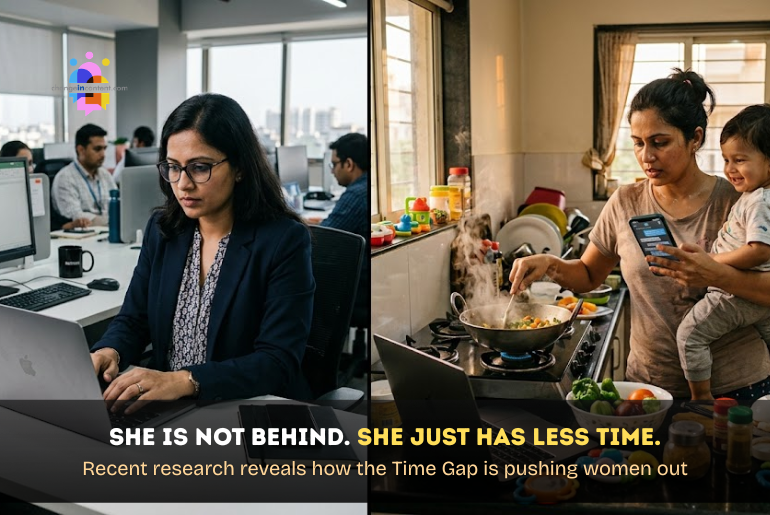
The conversation around workplace inequality has long focused on pay, promotions, and bias. But a new body of research introduces a deeper, more structural issue—the Time Gap. This invisible disparity is not about skill or opportunity. It is about access to time itself.
Women, across geographies and industries, are navigating careers while carrying a disproportionate share of unpaid work. That is creating a persistent gap that quietly shapes who progresses and who does not.
This article explores the findings of a recent study published in the International Journal of Management Reviews, co-authored by Professor Toyin Adisa of the University of East London. While the research draws insights from African workplaces, its implications stretch far beyond geography. It speaks directly to how work is designed globally, and why many systems continue to disadvantage women without explicitly intending to.
Understanding the Time Gap: What the research found
The study analysed 88 academic papers to understand how time influences women’s careers. The conclusion is both simple and uncomfortable:
Women are not falling behind because they lack ambition. They are falling behind because they have less time. Several factors drive this “time squeeze”:
- Unpaid care work
- Household responsibilities
- Cultural expectations
- Rigid work structures
The result is a constant balancing act that leaves women with less time for:
- Skill development
- Networking
- Visibility within organisations
- Career advancement opportunities
The Time Gap at Work: A double shift no one accounts for
The most ignored issue here is the consideration of this time gap. Most organisations and employers usually do not account for the double shift women manage.
Why does the time gap exist?
At its core, the Time Gap results from the unequal distribution of labour outside the workplace. Globally, women perform 2.5 times as much unpaid care and domestic work as men, according to the OECD.
It creates what researchers often call a “second shift.” That is a full set of responsibilities that begins after the formal workday ends.
What this means for careers
When time is limited, choices become constrained. Women often:
- Skip networking events scheduled after work hours
- Avoid high-visibility roles that demand extended availability
- Decline travel or relocation opportunities
- Delay or drop out of leadership tracks
The outcome is not a lack of ambition. It is a lack of bandwidth.
Why flexible work alone does not solve the time gap
Over the past few years, organisations have introduced flexible work policies to address this. But the research suggests that flexibility, on its own, is not enough. Why?
Because:
- Work expectations remain unchanged
- Output volume and availability are still the core measures of productivity
- Care responsibilities are not redistributed
In many cases, flexible work simply shifts the burden rather than reducing it. A woman working from home is often expected to work, care, and manage the household (all at the same time). That is not flexibility. That is compression.
The global reality of the time gap
Although the study focuses on African workplaces, its findings reflect a global pattern. Across regions:
- Workplace systems are designed for an “ideal worker”
- This worker is assumed to be always available
- This model ignores caregiving responsibilities
This “ideal worker” framework systematically excludes those (primarily women) who cannot meet these expectations.
The time gap and workplace design: A structural problem
The time gap is not a personal issue. It is a design flaw. Workplaces often reward:
- Long hours over smart work
- Visibility over efficiency
- Availability over outcomes
That creates environments where time becomes a currency, and those with more free time advance faster. The system does not explicitly exclude women. It simply fails to account for their realities.
What organisations must do to address the challenges?
Simple structural changes can make it easier for women in the organisation to be more productive while looking after their health and well-being.
1. Redefine productivity
Shift from: Hours worked to Outcomes delivered
Measure: Impact, Efficiency, and Results
2. Build care-aware work models
Organisations must:
- Provide childcare support
- Offer caregiving leave for all genders
- Normalise shared responsibilities
3. Rethink work timelines and expectations
Reduce:
- After-hours networking pressure
- “Always-on” culture
- Unrealistic deadlines
4. Make growth pathways visible and accessible
Women often miss opportunities because:
- Expectations are unclear
- Access is informal
Clear communication and structured pathways can reduce this gap.
5. Address cultural norms within organisations
Inclusion is not just policy. It is behaviour. Hence, leaders must:
- Recognise time constraints
- Avoid penalising flexibility
- Encourage equitable workload distribution
The Changeincontent perspective
At Changeincontent, we see the Time Gap as one of the most under-discussed barriers in workplace inclusion. For years, organisations have focused on:
- Hiring more women
- Offering flexible work
- Building diversity policies
But they have rarely asked: Do women actually have the time to succeed within our system?
We recently explored how ambition among women is rising globally. But ambition alone cannot drive progress if the system does not support it.
The research on the hidden time gap explains why women aspire and why women prepare, but too often, they are unable to sustain the pace required by existing workplace structures.
Conclusion: Understanding and addressing the challenge will define the future of inclusion
The time gap is not visible in salary slips or promotion charts. But its impact is everywhere. It shapes:
- Who stays
- Who leaves
- Who leads
If organisations want real inclusion, they must go beyond policies and address the root cause.
Because the question is no longer: Are women capable of leadership?
The question is: Are workplaces designed to give them the time to lead?
Until that changes, inclusion will remain incomplete.
Disclaimer: The views expressed in this article are based on the writer’s insights, supported by data and resources available both online and offline, as applicable. Changeincontent.com is committed to promoting inclusivity across all forms of content. We broadly define inclusivity in terms of media, policies, law, and history. It encompasses all elements that influence the lives of women and marginalised individuals. Our goal is to promote understanding and advocate for comprehensive inclusivity.