
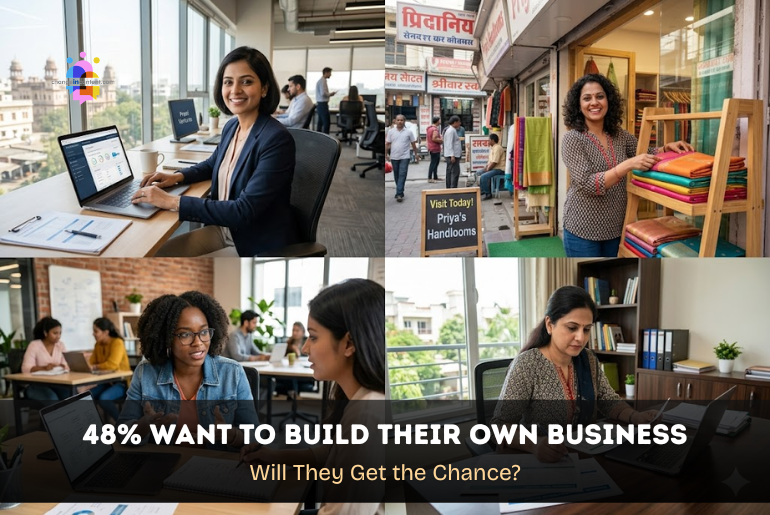
Entrepreneurial ambitions among women are no longer a fringe trend. They are fast becoming a defining force in the global workforce. According to early findings from ACCA’s Global Talent Trends 2026 report, 48% of women in finance and accountancy now aspire to become entrepreneurs, up from 45% the previous year.
This data comes from a survey of over 11,000 professionals across 175 countries, making it one of the most comprehensive signals of changing career intent in the modern economy.
What makes this shift important is not just the number. It is what the number represents. Women are no longer viewing careers purely as ladders within organisations. They are beginning to see them as launchpads for ownership, independence, and impact.
This article breaks down what drives these ambitions, why the gap between ambition and execution persists, and what must change for more women to move from aspiring founders to actual business leaders.
Entrepreneurial ambitions of women: What the 48% really means
The rise to 48% is not a random spike. It reflects a deeper transformation in how women perceive work, opportunity, and control over their careers.
ACCA’s data highlights three key shifts:
- First, finance and accountancy are becoming gateways to entrepreneurship. Professionals in these fields have skills in financial management, risk assessment, governance, and strategy. These are not just corporate tools. They are entrepreneurial foundations.
- Second, the ambition is generational. The report notes that nearly half of Gen Z and Millennial women express a desire to become entrepreneurs. It is not about escaping jobs. It is about designing careers on their own terms.
- Third, the ambition is global. Strong entrepreneurial intent is particularly visible in emerging markets, where we often see business ownership as a pathway to economic mobility and societal impact.
(Source: ACAA)
Why are the entrepreneurial ambitions of women rising now?
The timing of this shift is not accidental. It is the result of structural, economic, and cultural changes happening simultaneously.
1. Work is no longer seen as secure
The traditional promise of stable, long-term employment has weakened. Layoffs, automation, and restructuring have made even high-skilled roles uncertain. Entrepreneurship is increasingly seen as a way to regain control.
2. Skills have become transferable
Women today are not entering entrepreneurship blindly. They are entering with skill stacks. Knowledge of finance, digital tools, marketing, and operations is now widely accessible. That lowers the barrier to entry.
3. Purpose matters more than ever
ACCA’s findings also point to a growing desire among professionals to align their work with impact, sustainability, and social value. Entrepreneurship offers that alignment in ways corporate roles often cannot.
4. Visibility has changed the narrative
Women founders are no longer invisible. From startups to global brands, representation has improved. That visibility shapes ambition.
The gap: Ambition vs Execution
While entrepreneurial ambitions of women are rising, execution is not keeping pace at the same rate. That is where the real conversation begins.
Globally, women still own fewer businesses than men, raise less capital, and face higher barriers in scaling ventures. According to World Bank and IFC studies, women entrepreneurs receive a disproportionately small share of venture funding despite comparable performance outcomes.
So what is stopping ambition from becoming reality?
Access to capital remains uneven.
Women often start businesses with less funding and face bias in lending and investment decisions.
Networks are still male-dominated
Entrepreneurship thrives on networks. Access to mentors, investors, and industry connections is still unequal.
Unequal distribution of time.
Women continue to carry a disproportionate share of unpaid care work. That directly impacts their ability to build and scale businesses.
Risk perception is shaped by social conditioning.
Many women are conditioned to minimise risk rather than pursue it. Entrepreneurship demands the opposite.
What helps turn the entrepreneurial ambitions of women into reality
If ambition is rising, the next step is enabling execution. This requires deliberate action across three levels: individual, organisational, and systemic.
For women: Building with clarity and structure
Women looking to transition into entrepreneurship must treat it as a planned move, not an emotional leap.
- Start with financial literacy: Understand cash flow, funding, and runway.
- Build before you quit: Test ideas while still employed if possible.
- Leverage existing skills: Your current profession is your first business advantage.
- Seek mentorship early: Do not build in isolation.
For organisations: Enabling, not restricting
Companies often overlook their role in shaping entrepreneurship.
They can:
- Support intrapreneurship and innovation
- Offer flexible work that allows side ventures
- Create alumni networks that support founders
- Invest in women-led startups
The smartest organisations understand that even if employees leave to build businesses, they remain part of the broader ecosystem.
For policymakers: Fixing structural gaps
Governments must move beyond symbolic support.
Focus areas include:
- Access to credit and funding
- Skill development programmes
- Childcare and social infrastructure
- Simplified compliance for small businesses
India’s push towards women entrepreneurship through schemes and policy interventions has shown promise, but scale and consistency remain challenges.
For deeper context, read our analysis on how entrepreneurship drives sustainability outcomes.
Women’s entrepreneurial ambitions and the economic impact
It is not just a gender conversation. It is an economic one.
Studies by the World Bank and McKinsey have consistently shown that increasing women’s participation in entrepreneurship leads to:
- Higher job creation
- Greater innovation diversity
- Stronger community-level economic resilience
- Improved household financial stability
In simple terms, when women build businesses, economies grow differently. More inclusively. More sustainably.
What businesses must learn from this shift?
The rise in the entrepreneurial ambitions of women is also a signal to companies.
If nearly half of your female workforce wants to build something of their own, it means:
- They are seeking autonomy
- They are seeking ownership
- They are seeking impact
Organisations that ignore this shift will struggle with retention and engagement. Organisations that embrace it will build stronger ecosystems.
The Changeincontent perspective
At Changeincontent, we see this 48% not as a statistic, but as a turning point.
For years, the conversation around women and work has focused on participation. Now, it is moving toward ownership. That is a far more powerful shift. But ambition without infrastructure is a missed opportunity. If systems do not evolve, this 48% will remain a number rather than become a movement.
The real question is not whether women want to build businesses. The real question is whether the world is ready to let them.
Conclusion: Entrepreneurial ambitions of women need more than momentum
Entrepreneurial ambitions of women are clearly rising. The intent is visible, measurable, and global. But ambition alone does not build enterprises. Execution requires access, support, time, and belief systems that do not penalise women for choosing independence.
If governments, organisations, and ecosystems align around this shift, the next decade could see an unprecedented rise in women-led businesses. If they do not, this moment will pass as another statistic that looked promising but changed very little.
The ambition is already here. Now the system needs to catch up.
Disclaimer: The views expressed in this article are based on the writer’s insights, supported by data and resources available both online and offline, as applicable. Changeincontent.com is committed to promoting inclusivity across all forms of content. We broadly define inclusivity in terms of media, policies, law, and history. It encompasses all elements that influence the lives of women and marginalised individuals. Our goal is to promote understanding and advocate for comprehensive inclusivity.
