
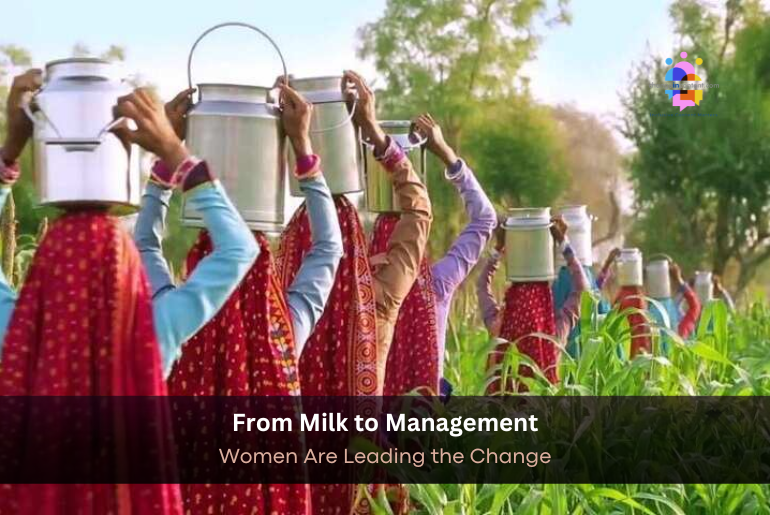
Banas Dairy has quietly achieved what many institutions still debate. It now has 33% representation of women on its Board of Directors. In a country where gender quotas are still being negotiated at the parliamentary level, this cooperative has already implemented them within its governance structure.
But the real story is not just about representation. It is about how a grassroots institution has aligned economic participation with leadership, turning women from contributors into decision-makers.
The scale behind this shift is equally significant. With over 36 lakh members, including nearly 11 lakh women, Banas Dairy’s ecosystem reflects a deep integration of women into the dairy value chain. It is not a top-down diversity initiative. It is a bottom-up transformation rooted in rural livelihoods, financial independence, and cooperative governance.
Banas Dairy and women’s representation: Beyond the 33% milestone
The 33% women’s representation on the board is not an isolated statistic. It is a structural outcome of years of women’s participation in dairy farming, milk collection, and livestock management.
Across Gujarat, women have traditionally been central to dairy operations, including feeding cattle, managing milk production, and ensuring a consistent supply. What Banas Dairy has done differently is acknowledge that contribution formally and elevate it into governance.
It aligns closely with India’s broader cooperative movement, particularly under the Amul model, where milk producers are also stakeholders. Banas Dairy, part of the Gujarat Cooperative Milk Marketing Federation ecosystem, has furthered this idea by ensuring that women are not just members but leaders.
Women’s power driving dairy growth
The success of Banas Dairy is directly linked to women’s participation at the grassroots level.
Key contributions of women in the dairy ecosystem:
- Managing livestock and ensuring a daily milk supply
- Participating in cooperative societies and decision-making
- Driving household income stability
- Supporting rural economies through consistent production
India is the world’s largest milk producer, contributing over 235 million tonnes annually, according to the National Dairy Development Board. A significant share of this production is driven by smallholder farmers, many of whom are women.
What makes Banas Dairy stand out is how it connects this participation with leadership. Women who were once seen as contributors to household income are now part of institutional governance.
Banas Dairy as a model of cooperative inclusion
Cooperatives in India have always had the potential to be inclusive. But most have stopped at membership-level participation. Banas Dairy has taken the next step: representation in decision-making.
This shift matters because governance determines:
- Pricing decisions
- Procurement policies
- Welfare initiatives
- Investment in infrastructure
When women sit at the table where these decisions are made, the outcomes change. Studies across sectors have shown that women leaders often prioritise long-term sustainability, community welfare, and equitable distribution of resources.
In rural economies, this translates into:
- Better household financial planning
- Improved access to education and healthcare
- Stronger community networks
From economic participation to decision-making power
The transition from participation to leadership is where real empowerment begins. Women associated with Banas Dairy have reported:
- Increased control over income
- Greater say in household decisions
- Higher confidence in public and institutional settings
It mirrors findings from multiple development studies that show women’s financial inclusion directly improves decision-making power at the household level.
Dairy cooperatives, by providing regular income, create a stable financial base. When that base is combined with leadership opportunities, the impact multiplies.
Banas Dairy’s broader inclusion journey
The 33% board representation is just one part of a larger inclusion strategy.
Key initiatives and impact areas:
- Mass membership inclusion: 11 lakh women members
- Livelihood creation: Stable income through milk procurement
- Skill development: Training in animal husbandry and dairy practices
- Community engagement: Awareness programmes and rural outreach
- Recognition platforms: Events that highlight women achievers
These initiatives reflect a long-term approach rather than a one-time diversity effort. Banas Dairy’s model shows that inclusion works best when it is:
- Embedded in operations
- Linked to economic outcomes
- Supported by institutional structures
What other organisations must learn from Banas Dairy
Banas Dairy’s approach offers a clear lesson for businesses, cooperatives, and policymakers.
- Representation must follow participation: Women were already part of the system. The organisation simply aligned governance with reality.
- Inclusion is not a CSR activity: It is a business strategy. Women’s participation improves productivity, consistency, and long-term growth.
- Grassroots inclusion builds stronger institutions: When inclusion starts at the bottom, leadership diversity becomes a natural outcome.
- Economic empowerment drives social change: Income stability leads to better education, healthcare, and decision-making.
The Changeincontent perspective
At Changeincontent, we believe Banas Dairy’s story is not just about a cooperative. It is about a shift in how India understands inclusion.
For years, conversations around women’s empowerment have focused on access: access to education, jobs, and finance. Banas Dairy shows what happens when access evolves into ownership and leadership.
It is particularly relevant to sectors such as agriculture and dairy, where women make up a large share of the workforce but remain underrepresented in decision-making roles. We explored similar themes in our earlier analysis of women farmers and policy gaps.
The takeaway is clear: Inclusion cannot stop at participation. It must reach the boardroom.
Conclusion: Banas Dairy and the future of inclusive leadership
Banas Dairy is not waiting for policy mandates to drive change. It is already operating with a governance model that many institutions are still debating. The 33% women’s representation is not just a number. It is a statement.
A statement that:
- Inclusion is practical
- Companies can redefine leadership
- Grassroots participation can shape governance
If India’s cooperative sector adopts this model at scale, the impact could extend far beyond dairy into agriculture, rural development, and even corporate governance.
The real question is no longer whether women can lead. The real question is: How many institutions are ready to follow what Banas Dairy has already proven?
Disclaimer: The views expressed in this article are based on the writer’s insights, supported by data and resources available both online and offline, as applicable. Changeincontent.com is committed to promoting inclusivity across all forms of content. We broadly define inclusivity in terms of media, policies, law, and history. It encompasses all elements that influence the lives of women and marginalised individuals. Our goal is to promote understanding and advocate for comprehensive inclusivity.
