
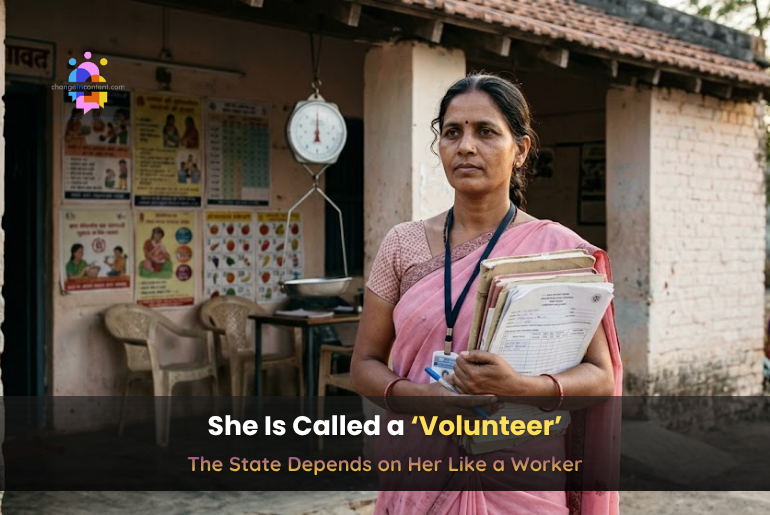
The term ‘Volunteers’ in Indian Labour Laws is not a neutral phrase. It is one of the clearest examples of how the state can use legal language to shrink rights without reducing work.
Across India, ASHA workers, anganwadi workers, anganwadi helpers, and several other scheme-based workers perform recurring, measurable, state-linked labour in health, nutrition, childcare, and public welfare. Yet many of them continue to be officially described as “honorary workers” or “volunteers.”
That classification helps governments sidestep wage protections, social security obligations, and employment rights, even while relying on their labour to provide essential services.
The Ministry of Women and Child Development still describes anganwadi workers and helpers as “honorary workers from the local community who voluntarily come forward.” The ministry also acknowledges fixed monthly honoraria and performance-linked incentives.
Why does it matter?
It matters because the scale is enormous. Government data placed the number of anganwadi workers and helpers at about 2.38 million in early 2024. At the same time, a parliamentary committee summary in 2026 described the anganwadi system as already supporting 2.6 million anganwadi workers and helpers in the care economy.
The National Health Mission’s ASHA programme counts well over one million ASHA workers across India. The PM POSHAN school meal system depends on a vast network of cook-cum-helpers, whose honorarium structure is also separately defined. Taken together, this is not volunteerism in the ordinary sense. It is a massive public workforce made legally blurry on purpose.
What the “volunteer” label in the Indian Labour Laws actually does
The label “volunteer” sounds benign. In legal practice, it is anything but. This label creates distance between the state and the worker. Once someone is labelled honorary or voluntary, the state can argue that she is not a regular employee or a standard wage-earner.
Therefore, these women are not automatically entitled to the architecture that labour law normally provides: minimum wages, provident fund, ESI, gratuity, maternity benefits, recognised industrial dispute mechanisms, or meaningful job security.
That is what makes the classification so powerful. It allows the state to keep the work and lose the duty. Yet the work itself is neither casual nor symbolic.
- ASHAs support immunisation drives and maternal and child health programmes. They also support disease surveillance, referrals, and primary care mobilisation under the National Health Mission.
- Anganwadi workers and helpers deliver nutrition, preschool education, health-related outreach, and community events under the anganwadi and Poshan systems.
The state counts on them because the work is necessary, recurring, and public in nature. That contradiction is the heart of the problem. It is unfair to term this workforce “voluntary” when the public system would visibly strain without it.
Volunteers in Indian Labour Laws and the contradiction of essentiality
One of the strongest arguments against the “volunteer” fiction lies in how governments behave when these workers stop working.
When ASHA workers, anganwadi workers, and similar scheme workers protest, governments and administrators do not respond as though a few informal community volunteers have paused their goodwill. They respond as though essential public systems are under threat. That practical reaction matters because it reveals the state’s real understanding of the work.
You cannot credibly claim both that these women are only voluntary helpers and that their absence disrupts the delivery of core health, nutrition, and welfare services. One of those positions is rhetorical, and the other is real. The real one is obvious: the work is essential, sustained, and deeply integrated into public service delivery.
Where the labour codes fail the scheme workers
The reasoning behind framing India’s four labour codes was a major rationalisation of labour law. But for scheme workers, they leave a silence large enough to keep the old ambiguity alive.
Code on Wages, 2019
Under the Code on Wages, 2019, Section 2(k) defines an employee as a person “employed on wages” for hire or reward. That phrase matters. If you treat the payment as “honorarium” or “incentive” rather than wages, you can keep the worker outside the legal protections that attach to wage employment.
That is why language is doing so much work here. The definitional line between honorarium and wage becomes the line between legal recognition and exclusion.
Code on Social Security, 2020
The Code on Social Security, 2020, also offers a partial framework without fully resolving their status. Section 2(86) defines an unorganised worker as a home-based worker, self-employed worker, or wage worker in the unorganised sector. It includes certain uncovered workers in the organised sector.
But scheme workers do not fit cleanly into this category either. They are not easily classifiable as self-employed, nor are they admitted into a straightforward employer-employee relationship by the state.
The result is a zone of legal uncertainty where social security remains patchy, discretionary, and scheme-dependent rather than rights-based.
Industrial Relations Code, 2020
The Industrial Relations Code, 2020, compounds the problem. That is because collective bargaining, dispute resolution, and industrial protections become harder to claim when there is no formally accepted employer-employee relationship.
If the state says it is not an employer in the ordinary labour-law sense, the worker’s ability to use labour-law remedies becomes severely weakened.
The numbers show how large this legal exclusion really is
It is not a marginal cohort.
- PIB data in February 2024 listed 13,48,135 anganwadi workers and 10,23,068 anganwadi helpers.
- A March 2026 parliamentary response reiterated that anganwadi workers and helpers are honorary workers and confirmed the current central honorarium framework: ₹4,500 per month for anganwadi workers and ₹2,250 for helpers, plus performance-linked incentives.
- PM POSHAN guidelines separately provide for cook-cum-helpers with honorarium support. It shows that the state routinely uses low-paid, scheme-linked labour to sustain welfare systems.
What about ASHAs?
For ASHAs, even conservative official counts run into the lakh-scale nationally. The NHM continues to treat incentives and support as a scheme-based architecture rather than a stable wage-and-rights model.
PIB’s 2024 note on welfare measures for ASHA workers said they received a fixed monthly incentive of ₹2,000 plus performance-based payments. At the same time, the later 2025 reporting suggested that the state has raised the fixed monthly component to ₹3,500.
Either way, the essential issue remains unchanged: whether the compensation is called incentive or honorarium, the legal ambiguity around worker status persists.
The state is, in effect, operating a gendered public workforce at scale while continuing to avoid a clear labour-law framework for it.
The courts are no longer entirely comfortable with this fiction.
For years, governments leaned on court rulings that kept anganwadi and similar workers outside ordinary employment structures.
In State of Karnataka v. Ameerbi (2006), the Supreme Court held that anganwadi workers were not holders of civil posts. The court described them as appointed under a scheme rather than regular service rules. That ruling became part of the legal basis for resisting broader recognition.
But later jurisprudence has become more uneasy with such blanket exclusion.
In Maniben Maganbhai Bhariya v. District Development Officer, Dahod (2022), the Supreme Court held that anganwadi workers and helpers were entitled to gratuity under the Payment of Gratuity Act, 1972. The significance of that judgment went beyond gratuity alone. It signalled that merely calling such workers honorary does not automatically erase the legal consequences of the work they perform.
That shift matters. It suggests the legal system is beginning to recognise what the welfare state has long depended on, while refusing to name it properly. These women are doing real, continuous, state-linked work.
Why this matters especially for women
This classification issue is not gender-neutral. The workers kept in this legal twilight are overwhelmingly women.
ASHAs, anganwadi workers, helpers, and school meal workers form the backbone of India’s care, nutrition, and community health architecture. They occupy the very sectors that states like to celebrate rhetorically as nation-building work. Yet those same sectors are often treated as moral service rather than labour deserving rights.
That is an old pattern. The closer work sits to caregiving, child development, nutrition, health outreach, and social reproduction, the easier it becomes for institutions to underpay it and wrap it in the language of service, commitment, sacrifice, or community duty.
The result is not just low remuneration. It is a structural lowering of dignity. A woman may be indispensable to the functioning of the public system and still be denied the status that would let her claim the most basic labour protections within it.
Volunteers in Indian Labour Laws and the constitutional problem
There is also a constitutional tension here that India cannot keep evading.
- Article 14 promises equal protection
- Article 21 aims to include dignity
If two people are doing functionally essential public work but one is kept outside labour protections because the state prefers a cheaper label, the question is no longer merely administrative. It becomes constitutional.
The line that the state seems to be drawing is not between work and non-work. It is between recognised work and convenient work. That distinction is difficult to defend once the work becomes perennial, state-dependent, and integral to public delivery systems.
What a workable path forward looks like
The solution is not mysterious. It is legislative and administrative.
First, Parliament and state governments need distinct statutory recognition for scheme workers who perform continuous and indispensable public functions. That recognition should not be left to scattered welfare notifications or state goodwill.
Second, the Code on Wages framework needs either an amendment or executive clarification. It ensures that payments made for this kind of work cannot be disguised out of wage protections simply by using softer words such as honorarium or incentive.
Third, the Code on Social Security must be operationalised with an explicit and dedicated route for scheme workers. It must include provident fund, maternity protection, injury compensation, and pension-like support as entitlements rather than concessions.
Fourth, dispute resolution and collective representation should not depend on the state first admitting what is plainly obvious. If these workers organise, bargain, and raise demands around public service delivery, the law should not pretend they lack standing merely because the employer hides behind scheme language.
What organisations and policymakers should learn from this
There is a larger lesson here that goes beyond welfare workers. When a system relies on women’s labour but refuses to recognise it, the result is not efficiency. It is an extraction.
Employers in the private sector often repeat similar patterns in softer terms: calling work developmental rather than billable, cultural rather than managerial, supportive rather than strategic. The state’s use of “volunteer” is a harsher, legalised version of the same problem. It names women’s labour in a way that lowers its cost and weakens its claims.
We explored related blind spots in India’s labour reforms earlier as well, and that conversation remains relevant here because these ambiguities are not accidental gaps. They are part of a larger pattern in how labour is valued and named.
The Changeincontent perspective
At Changeincontent, we think this issue cuts to the heart of what inclusion really means. It is easy to praise women’s contribution to the care economy, the nutrition ecosystem, or public health outreach. It is harder to build a law around that praise. But unless the law catches up, the praise becomes a performance.
The women sustaining India’s welfare state are not “helping out.” They are labouring at scale, under direction, for recurring public functions, with clear accountability and measurable outcomes. If the state can measure their targets, assign its duties, expand its workloads, and rely on them in crises, then it can also recognise them as workers.
That is the minimum standard of seriousness a modern care economy should demand.
Conclusion: Volunteers in Indian Labour Laws is not a description, but a loophole.
The term ‘Volunteers’ in Indian Labour Laws is not just a classification problem. It is a moral and legal test. That reveals whether India is willing to keep building a public care ecosystem on the under-recognised labour of women while refusing them the protections that labour deserves.
A state that depends on women for health, nutrition, childcare, and school feeding cannot keep pretending that these are informal acts of community spirit. They are public functions. They are recurring work. And the women doing them are workers in every meaningful sense.
The question now is whether the law is willing to say out loud what the system already knows.
Disclaimer: The views expressed in this article are based on the writer’s insights, supported by data and resources available both online and offline, as applicable. Changeincontent.com is committed to promoting inclusivity across all forms of content. We broadly define inclusivity in terms of media, policies, law, and history. It encompasses all elements that influence the lives of women and marginalised individuals. Our goal is to promote understanding and advocate for comprehensive inclusivity.
