
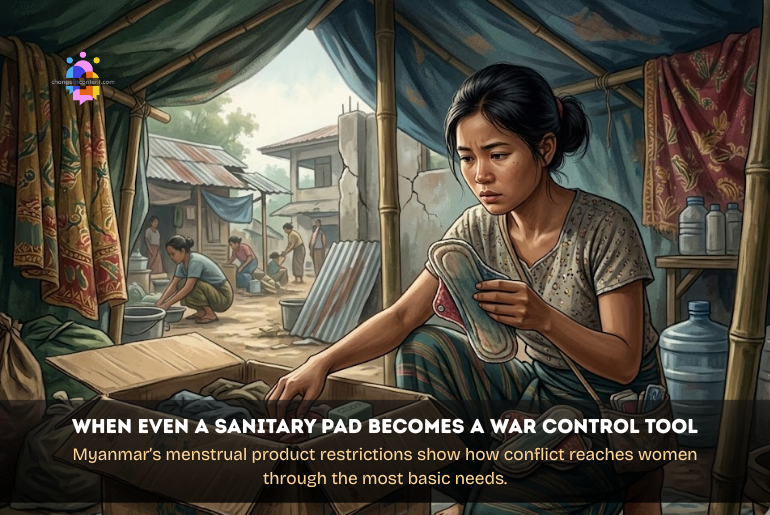
Women and girls suffer disproportionately in conflict zones, and this has been documented for years. A war does not have to directly target women’s bodies to make still those bodies carry its violence. Sometimes it does so by making the most basic acts of daily survival harder, dirtier, and more dangerous. That is what makes the menstrual product ban in Myanmar such a stark human story. It is not only about banning sanitary pads, but about what happens when menstruation itself becomes another site of siege.
Myanmar’s civil war has already devastated homes, livelihoods, health systems, and movement. Now, Myanmar’s military regime has tightened restrictions on the distribution of menstrual products, claiming they are being diverted to aid injured resistance fighters.
The latest restrictions reveal something more intimate and more chilling. When menstrual products are cut off under the logic of military strategy, women and girls are forced into a position where hygiene, mobility, dignity, and even participation in daily life become harder to sustain. In a conflict that has already displaced more than 3.5 million people, the burden of this kind of deprivation falls hardest on those with the fewest alternatives.
Myanmar’s women caught between sanitary pad restrictions and gendered tactics of war
Since 2021, Myanmar has been in a civil war after the military usurped the elected Aung San Suu Kyi government and carried out a violent crackdown on dissidents. Artillery attacks, the burning of townships and arbitrary arrests have since become common. A 2024 BBC investigation found that the military controlled around 21% of the territory.
Now, restrictions on menstrual products have been reported, especially in areas outside military control. Thinzar Shunlei Yi from Sisters2Sisters said the military claims the People’s Defence Force is using these products for medical purposes and to line boots to absorb sweat and blood.
Why activists call this gender-based violence
There has been no formal announcement, but activists say the restrictions began around August as part of the military’s “four cuts” strategy aimed at cutting off supplies to insurgents. Transport of menstrual products across key routes, including the Sagaing–Mandalay bridge, has reportedly been blocked. [The Guardian]
The restrictions have since increased, though activists warn the full extent may be underreported due to stigma around menstruation. Meredith Bunn, founder of the medical aid charity Skills for Humanity (SFH), said, “A sanitary pad wouldn’t stay in place, wouldn’t soak enough blood and wouldn’t keep the area clean.” She added, “The reasoning behind this ban comes from completely uneducated, misogynistic fools within the military.”
How the menstrual product ban in Myanmar is pushing women towards health risk and isolation
In Myanmar, these restrictions have pushed many women towards informal and hidden markets where menstrual products now cost far more than before. Prices have reportedly risen from around 3,000 kyat per pack to 9,000 kyat, while the minimum daily wage stands at about 7,800 kyat. For many, even basic hygiene has become unaffordable.
Moreover, the healthcare system has largely broken down. Access to treatment remains limited, and activists report increasing cases of untreated infections. Sisters2Sisters indicated they receive regular requests for antibiotics to treat UTIs, likely stemming from the women’s use of unsanitary materials. Some women now choose to stay indoors during menstruation, cutting themselves off from work, community life and even political participation.
Why menstruation can start shrinking public life
Aid workers and campaigners say that this product ban (blocked sanitary aid) is gender-based violence. The administration is using it to restrict women’s movement. They also intend to target female members of the resistance as well as civilians in displacement camps. Since the conflict began, more than 3.5 million people have been displaced. That is adding more vulnerability for women already dealing with restricted access to basic needs.
Women often face restrictions that go far beyond displacement or economic loss. Access to healthcare, hygiene, food and mobility gets controlled in ways that directly affect them. In many conflicts, these limits are a part of military strategies that aim to weaken communities by pressuring those already in vulnerable positions.
Gender-specific needs, whether related to health or safety, are frequently deprioritised or restricted, making survival harder for them.
Read Next: Women and Girls in Gaza: What war takes long after the headlines move on.
The Changeincontent perspective
What makes the menstrual product ban in Myanmar so disturbing is that it shows how easily war can enter the most intimate parts of women’s lives without ever needing to name them directly.
Menstrual care is not a luxury, and treating it as a suspicious or expendable supply reveals exactly how little women’s bodily realities count when military logic takes over. The result is not only discomfort. It is infection risk, shame, isolation, and reduced movement at a time when women already face enormous vulnerability.
That is why conflict reporting and humanitarian response cannot continue to treat women’s needs as a secondary layer of the crisis. Period care, reproductive health, toilets, water access, and safe mobility are core survival issues. Once the restrictions on them are in place, the violence becomes gendered even if no one uses that language.
Myanmar is a stark example, but it is also a warning about what happens whenever conflict systems make women’s daily survival conditional.
Conclusion: The menstrual product ban in Myanmar shows that conflict is never gender-neutral
When basic needs like menstrual care are restricted, it exposes how deeply gender is tied to conflict. A lack of safe toilets, menstrual products, or reproductive care affects women differently and more directly. After conflict, women are often left out of peace talks and rebuilding processes.
Decisions about land, law and recovery get made without their input, even though they have carried much of the impact. It means the same inequalities can continue even after the violence reduces. Myanmar is just one example of what continues to play out in different forms across the world.
Disclaimer: The views expressed in this article are based on the writer’s insights, supported by data and resources available both online and offline, as applicable. Changeincontent.com is committed to promoting inclusivity across all forms of content. We broadly define inclusivity in terms of media, policies, law, and history. It encompasses all elements that influence the lives of women and marginalised individuals. Our goal is to promote understanding and advocate for comprehensive inclusivity.
