
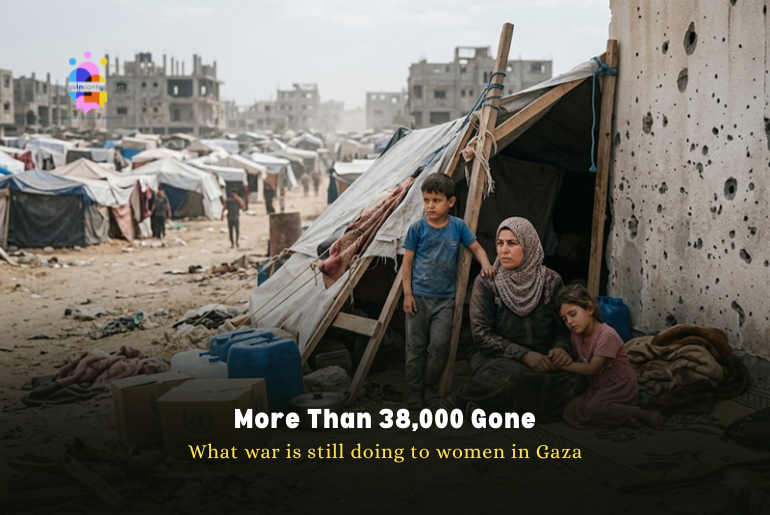
Women and girls in Gaza are living through the kind of war that does not end when the shelling slows or the world looks away.
According to a new UN Women analysis released on April 17, 2026, more than 38,000 women and girls, including over 22,000 women and 16,000 girls, were killed in Gaza between October 2023 and December 2025. That works out to an average of at least 47 women and girls killed every day.
Nearly 11,000 more suffered injuries in ways likely to leave them with lifelong disabilities. UN Women is explicit that the real toll is likely higher because bodies remain under rubble, and health information systems have collapsed.
But numbers, however staggering, still flatten what war actually does. A woman is not only a casualty figure. She is often the one earning, feeding, carrying, nursing, stitching, calming, and rebuilding. When war kills women and girls at this scale, it does not merely take lives. It alters the structure of families, the functioning of households, the survival of children, and the long-term stability of communities.
This article looks beyond the death toll to the wider cost of the war on women and girls in Gaza, including livelihood collapse, caregiving overload, food insecurity, reproductive health crises, and the burden of trying to survive inside systems that have almost entirely broken down.
Women and girls in Gaza are not only dying. They are carrying the war.
UN Women’s language is careful, but the pattern it describes is devastating.
The war has reshaped families so deeply that women now head tens of thousands of households. These women are not stepping into that role under stable conditions. They are doing so after the deaths or disappearances of husbands, fathers, brothers, and sons. These women are doing it all while living amid mass displacement, destroyed infrastructure, and collapsing access to food, shelter, and services.
UN Women Regional Director for the Arab States Moez Doraid said plainly that many women are now carrying the full burden of caregiving and survival without income, support, or access to essential services.
That is where the cost of war becomes harder to see and easier to ignore.
The cost of war for women
A woman who survives bombardment may still lose her income, her home, her support system, her access to healthcare, her child’s schooling, and any realistic route back to stability. Conflict reporting often treats those losses as separate humanitarian issues. In real life, they arrive all at once.
The result is a form of survival that is relentless, unpaid, and unspectacular. Women and girls in Gaza are not just caught in war. They are fighting to outlive it, absorb it, and continue holding everything together in its aftermath.
The war has made everyday life structurally unlivable
A ceasefire, even when announced, does not automatically restore conditions for life. UN Women said that six months after the October 2025 ceasefire, women and girls still faced severe and persistent risks. Reports indicated that killings had continued in recent months.
Reuters also reported that more than 750 Palestinians had been killed since the ceasefire. At the same time, UN Women says it lacks the full gender-disaggregated casualty data for the post-ceasefire months. That makes the impact harder to document, but no less real.
The uncertainty matters because war’s damage does not remain confined to moments of direct attack. It enters the systems people need to remain alive.
The access to health
Extensive infrastructure destruction has made it almost impossible for women and girls in Gaza to access basic needs, including healthcare. WHO figures show that more than 500,000 women lack access to essential health services such as antenatal and postnatal care and management of sexually transmitted infections.
That number alone should reframe the conversation. War is not just killing women and girls in Gaza. It is also dismantling the systems required to keep them alive after injury, pregnancy, childbirth, illness, or sexual violence.
Women and girls in Gaza are facing hunger as a gendered emergency.
The hunger crisis in Gaza is not gender-neutral. UN Women has repeatedly documented the differentiated burden borne by women and girls. It states that nearly a quarter of a million women and girls are starving. Over half a million more are facing extreme hunger and acute malnutrition.
A December 2025 statement from the Gender in Humanitarian Action Working Group, carried by UNISPAL, said nearly 790,000 women and girls were experiencing crisis-level food insecurity or worse.
These figures matter because women are often the ones expected to manage scarcity on behalf of everyone else. They queue for bread, search for water, ration meals, and breastfeed while malnourished. They also continue caring for children and older relatives even after the depletion of their own bodies.
What does it mean to be a woman in Gaza today?
UN Women’s feature “What it means to be a woman in Gaza today” puts that burden into human terms.
Women spoke of being unable to feed their families, of being displaced more than ten times, and of trying to function as mother, father, and head of household all at once. That sentence captures something data alone cannot: the war is not only depriving women of security. It is expanding women’s responsibilities under conditions where almost no support remains.
The hidden story is also about work, income, and the collapse of economic life.
War reporting often counts damage in buildings and bodies. It is less precise about careers interrupted, businesses lost, or professional identities destroyed. Yet these losses matter deeply, especially for women.
When households become female-headed overnight and local economies are shattered, women are forced into impossible arithmetic.
- They must care more while earning less.
- They must find food without income.
- They must parent through grief without medical support
- They must survive displacement while trying to protect children from further trauma.
UN Women’s latest brief makes this clear, stating that tens of thousands of women are sustaining families without income, support, or access to essential services. That phrase deserves more attention than it often gets. It tells us that the war is not only a humanitarian emergency. It is also an economic annihilation for women.
There can be no real recovery for women and girls in Gaza without income restoration, women-led enterprise support, safe cash assistance, access to local markets, and meaningful inclusion in reconstruction planning. Otherwise, “survival” becomes a long-term trap rather than a route back to life.
Health in Gaza has become a question of endurance, not access
The health crisis facing women and girls in Gaza is broader than casualty counts suggest. UN Women’s recent reporting shows a continuum of bodily risk.
On one hand are the 11,000 women and girls who have sustained injuries likely to result in lifelong disabilities. On the other hand is the slower violence of being unable to menstruate, give birth, heal, breastfeed, or access privacy and sanitation with dignity.
In June 2025, the United Nations Office at Geneva reported that around 700,000 women and girls of menstruating age in Gaza were struggling to manage menstruation in overcrowded and unsanitary conditions.
The menstrual hygiene emergency
A related UNFPA advocacy brief described a full menstrual hygiene emergency. It notes that 89% of WASH sector assets had been damaged or destroyed. Moreover, water insecurity affected 90% of households.
That is not a side issue. It is the texture of war as women live it. Dignity disappears in increments. Privacy disappears. The ability to recover from birth, to clean oneself, to treat infection, to care for a baby, to cope with miscarriage, to manage menstruation, all become contingent on a humanitarian system that has been repeatedly obstructed and degraded.
That is why discussions of women and girls in Gaza must include not only death and injury, but the collapse of the conditions that make ordinary bodily life possible.
Displacement turns safety into an illusion.
Women and girls in Gaza have not only lost homes. Many have lost the very idea of a safe place. Nearly one million women and girls were displaced in Gaza, often multiple times.
UN Women’s January 2024 gender alert said nearly 1.9 million people overall had been displaced. That includes nearly one million women and girls.
By September 2025, UN Women was still describing repeated displacement, unbearable rents, makeshift tents, and the sense that each move simply led to a different form of insecurity.
For women, repeated displacement changes risk in very specific ways. It raises exposure to harassment, sexual violence, poor sanitation, overcrowded sleeping arrangements, and unsafe routes to food or water. It also intensifies unpaid labour. Every move means rebuilding routines from nothing. Every move means re-establishing some minimum version of survival.
A woman who is displaced ten times is not merely relocated ten times. She is required to reconstruct domestic life ten times in conditions that make reconstruction almost impossible.
Women-led organisations are not peripheral. They are essential
One of the most important threads running through UN Women’s work, whether in Gaza, Sudan, or Ukraine, is the insistence that women-led organisations are not an optional layer of response. They are often the first, most trusted, and most effective responders.
In Gaza, UN Women says it remains on the ground working with women-led and women’s rights organisations. It aims to provide funding, coordination, and technical support. At the same time, it aims to ensure the representation of women’s organisations in decision-making and reconstruction efforts.
That matters because formal systems frequently fail first in war. Women-led groups are often the ones who continue to negotiate access, find survivors, distribute support, and keep local knowledge alive when institutional channels are frozen.
We have seen this pattern elsewhere, too, including in our earlier analysis of the gendered cost of conflict in Ukraine, where women-led responses became indispensable as systems broke down.
The real issue is not only emergency response. It is who gets to rebuild
There is a tendency in post-war language to move quickly from suffering to reconstruction, as if rebuilding were a neutral technical stage that simply follows destruction. It is not. Rebuilding is political. It decides who gets heard, who gets resources, who gets land, who gets contracts, who defines recovery, and which losses we count as urgent.
Women and girls must be at the centre of response and recovery. They must have full, equal, and meaningful participation in peacebuilding and reconstruction. That is not idealism. It is hard policy sense. If we leave women out of reconstruction decisions after carrying the heaviest survival burden during war, then we will end up building the next system on the same exclusions as the previous one.
For business leaders and administrators reading this from outside the region, that should sound familiar. Crises reveal who does the invisible work and who gets left out of formal decisions. War is simply the most brutal version of that logic.
The Changeincontent perspective
At Changeincontent, we keep returning to one uncomfortable truth: when people discuss conflict, women are too often counted only after they have died. But one cannot understand women’s suffering through casualty numbers alone, however horrifying those numbers are. The deeper story is the one that unfolds afterwards.
- Who holds the family together?
- Who feeds children when markets collapse?
- Who gives birth without transport?
- Who manages menstruation without privacy?
- Who tries to work without income?
- Who becomes head of household without any of the support systems that role usually depends on?
That is why the conversation on women and girls in Gaza must move beyond grief into systems. Protection must include food, health, sanitation, mobility, income, and decision-making. If the global response remains limited to outrage over death without serious support for life after survival, then it is not really a response. It is spectatorship.
Conclusion: Women and girls in Gaza are paying for war in ways the world still refuses to count properly
Women and girls in Gaza are paying for war through death, through injury, through hunger, through displacement, through caregiving, through economic collapse, and through the daily degradation of health and dignity. More than 38,000 women and girls killed is a devastating fact. But it is also the beginning of the story, not the end.
The harder part to acknowledge is that war does not stop hurting women when the cameras leave. It lingers in the body, in the household, in the empty chair at the table, in the child who still needs feeding, in the absence of work, and in the long line for water.
If we do not place women and girls at the centre of recovery, then recovery will be incomplete by design. And if the world continues to treat this as a humanitarian afterthought rather than a structural emergency, then it will keep failing the very people carrying the highest cost.
Disclaimer: The views expressed in this article are based on the writer’s insights, supported by data and resources available both online and offline, as applicable. Changeincontent.com is committed to promoting inclusivity across all forms of content. We broadly define inclusivity in terms of media, policies, law, and history. It encompasses all elements that influence the lives of women and marginalised individuals. Our goal is to promote understanding and advocate for comprehensive inclusivity.
