
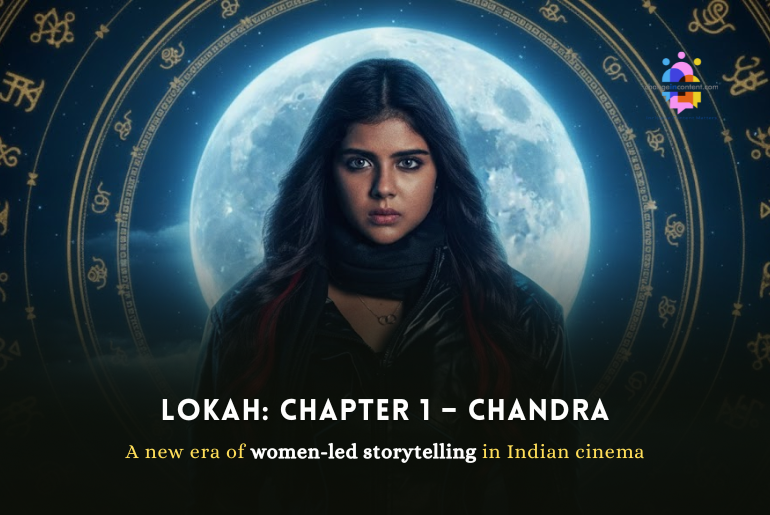
When a Malayalam film made on a ₹30 crore budget storms past ₹300 crore globally, it’s not just a box-office story, but a cultural moment. Lokah: Chapter 1 – Chandra has done precisely that. Directed by Dominic Arun and produced by Dulquer Salmaan’s Wayfarer Films, this female-led superhero saga starring Kalyani Priyadarshan and Naslen has become India’s highest-grossing Malayalam film of all time.
But the real power of Lokah lies beyond its earnings. It lies in what it represents. The movie represents a homegrown superhero universe where a woman is not a symbol, muse, or sidekick but the very core of the story. Rooted in Malayalam folklore and feminist reinterpretation, Lokah is not just redefining cinema. Instead, it is redefining who gets to save the world on screen.
Spoilers ahead about Lokah Chapter 1: Chandra
Chandra might just be the heroine Indian cinema has been waiting for
Lokah: Chapter 1 – Chandra has given India something it’s never really had before: the first true female superhero. The film is the first in what’s rumoured to be a five-part cinematic universe about a league of heroes protecting the world from evil. Fittingly, “Lokah” itself means the universe. Again, a quick spoiler alert. We’re getting into major plot details from here.
Kalyani Priyadarshan plays Chandra, the titular heroine, a centuries-old vampire with a mysterious past. If you’ve grown up watching the usual Western fare like Twilight or The Vampire Diaries, the concept might feel familiar at first. Immortals who outlive their time, drifting from one identity to another, forever moving before anyone notices they never age. But Lokah is not another Western retelling dressed in Indian flavour. This is a story that roots itself here, in our land, folklore, and local mythology.
When we first meet Chandra, she’s in a war-torn city, locked in a fierce battle with a female assassin, escaping just as the building around her collapses. A mysterious call summons her back to Karnataka, where she tries to blend into ordinary life, working night shifts and guarding her secret from the world. But fate, of course, has other plans. Her path crosses with three young men, who later become her allies, including Sunny, played by Naslen, who brings both heart and humour to the story.
What unfolds next pulls them into a dark world of organ trafficking, led by a corrupt policeman, Nachiyappa (Sandy Master), the film’s primary antagonist.
Rewriting Malayalam folklore as a tale of feminism and resistance
The backstory of how Chandra became a vampire bears the realities of caste oppression and social hierarchy. As the film explains, Chandra is the Kaliyankattu Neeli. For those unfamiliar with Malayalam folklore, Kaliyankattu Neeli is a figure that almost every Malayali child has heard of, a legendary yakshi (vampire) who appears in bedtime horror stories. Traditionally, the yakshi has been portrayed as a seductress, a femme fatale who preys on men walking alone at night.
In Lokah, Neeli is no longer just a scary, vengeful figure. Instead, the movie portrays her as a feminist and anti-caste figure, someone who fights against oppression and helps marginalised or vulnerable people.
Chandra was a tribal girl hailing from a marginalised forest tribe forbidden from entering upper-caste temples. Her village was destroyed by a king enforcing caste segregation. After a bat bite granted her supernatural abilities, and following the murder of her parents at the hands of the king’s men, she took revenge and transformed into a formidable protector. Rather than being a villain or a threat, she is now a superhero-like character, a protector of those who cannot defend themselves, using her power for justice.
Chandra breaks the ‘Pretty Heroine’ rule
Chandra isn’t your usual big-screen heroine. She is a superhero with red streak hair, a septum ring, who lives in black jeans, sneakers, and jackets. There’s no trace of the hyper-stylised, slow-motion glamour shots we’ve come to expect. No item songs, no over-the-top seduction sequences, just a woman who happens to save the day without worrying about how her eyeliner looks while doing it.
There’s only one scene where she wears a dress, a plain white one, at a small house birthday party. And even that isn’t about the male gaze. It’s just a quiet, human moment that becomes a turning point in the story, the one that brings Sunny (played by Naslen) and Chandra into each other’s orbit more often.
In the original folklore, Neeli was the quintessential siren, all beauty, mystery, and allure. But Chandra? She’s beautiful, sure, but her story isn’t built around it. The film gives her a character arc that moves far past her face, her clothes, or any dance numbers.
Let’s also discuss the makeup, or rather, the lack thereof. How many times have we seen female action characters with perfect contour and not a drop of sweat? Chandra looks scruffy, a little rough around the edges, like someone who actually runs, fights, and bleeds. Of course, she’s no ordinary woman, but that’s not the point. The point is, for once, the film lets her be.
No more century-old heroes and naive heroines
And yes, the romance arc, obviously. Chandra is centuries old, while Sunny is in his early twenties. Usually, we get the opposite, where an ancient, brooding male hero charms a wide-eyed young woman in some grand fantasy love story. Lokah flips that cliché.
This isn’t your typical “forbidden age gap” saga. In fact, it’s not even really a romance. There are a few cute, awkward moments that make you smile, and it’s clear Sunny is smitten. But Chandra knows where to draw the line. She has lived long enough to understand what boundaries mean. Also, there’s the fact that Sunny looks exactly like her past lover from the British colonial era.
Even casting-wise, Lokah subtly breaks a tired pattern. Kalyani Priyadarshan is in her early thirties, Naslen is twenty-five. That, in itself, feels new, considering we still see fifty-year-old heroes romancing women half their age on screen. And just to be clear, there is no steamy song or forced chemistry in Lokah. What we get instead is warmth, connection, and a hint of nostalgia wrapped in a sci-fi glow.
Some may say that Lokah’s plot feels familiar, and perhaps it does. But that familiarity has always been through a male-centric lens. The one you would have seen on the screen would be a Chandran, not a Chandra. In Lokah, however, we see a woman who is more than a damsel in distress. She is the one who actually saves the hero and the day!
The final thoughts
There is much to discuss, and this is only the beginning. Lokah could very well be the signal we’ve been waiting for in how women are written on screen. Lokah reminds us that heroism, cleverness, and courage are not confined to gender. May we have more films like this, more stories centred on women, more worlds where they are superheroines, thinkers, and makers in their own right.
Co-writer Santhy Balachandran shared a post on her Instagram highlighting how the success of India’s first female superhero film was led by a team of talented women behind the camera. “This is to celebrate the army of women who worked on Lokah, both before and behind the screen. Our film would not be what it is without the talent, commitment and energy you brought to the table each day,” she wrote.
Changeincontent perspective
Cinema mirrors society, and Lokah might just be holding up a long-overdue reflection. The success of Lokah isn’t just about a woman-led film breaking the ₹300 crore mark. Instead, it is about audiences finally embracing a female protagonist whose strength is not defined by glamour, but by grit.
For decades, Indian cinema has given us gods, gangsters, and geniuses. However, nearly all are men. Lokah disrupts that lineage by reimagining the folkloric “yakshi” not as a cautionary tale but as a story of rebellion, justice, and reclaiming identity. Through Chandra, we see a woman whose power comes not from being perfect but from surviving, fighting, and owning her space.
If India’s cinematic universes have always been built around male mythology (from Baahubali to KGF), Lokah could be the first to build one around the feminine mythos. It’s not just about representation; it’s about rewriting the grammar of heroism itself.
Also Read: Women whom we remember: Devika Rani – The first lady of Indian cinema.
Disclaimer: The views expressed in this article are based on the writer’s insights, supported by data and resources available both online and offline, as applicable. Changeincontent.com is committed to promoting inclusivity across all forms of content. We broadly define inclusivity as media, policies, law, and history. It encompasses all elements that influence the lives of women and marginalised individuals. Our goal is to promote understanding and advocate for comprehensive inclusivity.
