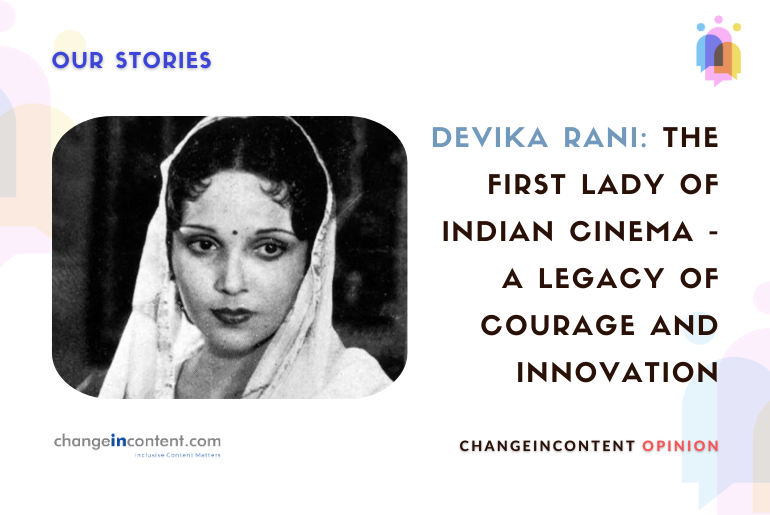
In 1934, Devika Rani and her husband Himanshu Rai founded Bombay Talkies, one of India’s first major studios. It was through Bombay Talkies that stars like Dilip Kumar, Ashok Kumar, and Madhubala made their debut on the silver screen. Today, it’s not surprising to see women owning production houses or leading films as directors or producers. But in the 1930s, when society heavily oppressed women and equal opportunities were rare, Devika Rani’s involvement in the celluloid world sparked considerable debate in patriarchal circles.
Devika Rani excelled in every aspect of filmmaking, from art direction and production to costume design and acting. This shows her versatility and expertise. Her legacy continues to inspire future generations of women filmmakers and artists. It proves that women can excel in various roles behind and in front of the camera, even in a male-dominated field.
Devika Rani: The first lady of Indian cinema
Devika Rani is known as the first lady of Indian cinema. It is not only because she transformed Bollywood’s early days in the 1930s but also because of her fearless and confident personality. Her journey shows the ongoing fight for women to get the respect they deserve in the workplace. In a time when her male peers brushed her off as just Himanshu Rai’s wife, Devika Rani proved herself. She was not just a talented actress but also a capable leader of a film studio. Yet, achieving financial independence was challenging for her.
Despite Bombay Talkies’ founding in 1934, it wasn’t until 1943 that Devika Rani’s salary and bonuses started seeing regular increases. The fact that she had to wait nearly a decade for regular salary increases shows that her contributions were undervalued. And the major cause of this was her being a woman.
Devika Rani’s contribution as the writer of their breakthrough film, “The Song of the Serpent or Karma,” never received public recognition. Despite her collaborative efforts with Himanshu Rai, society mainly saw her as an actress. Moreover, society didn’t believe she could also be a good scriptwriter.
It shows the deep-rooted biases of that time, the biases that sadly still linger today.
Challenging society through cinema: The Devika Rani legacy
Devika Rani’s approach to filmmaking was not merely about entertaining audiences. It was also about using the medium to highlight injustices and advocate for social change. In her own unique way, Devika shaped her career as an actress and leader of Bombay Talkies. She challenged the conservative rules and beliefs in society.
In 1933, Devika Rani and Himanshu Rai starred in ‘Karma,’ her debut film. It caused a commotion upon release with a four-minute kissing scene, quite bold for its time. In India, showing affection in public or on screen was strongly disapproved of for many years. However, unlike actresses who often faced scandal and criticism, Himanshu Rai did not face any negative consequences for his role in these scenes.
Devika Rani was aware of this double standard but chose to challenge what patriarchy thought was right. Her decision to follow her love for making movies instead of following what society wanted made her stand out in Indian cinema.
Acchut Kanya
Devika Rani produced Achhut Kanya, in which she starred alongside Ashok Kumar in a love story between a Brahmin boy and an untouchable girl. This film made a significant impact during a time when society was deeply divided by the caste system. In Jeevan Prabhat (1937), Devika took on a surprising role reversal. She played a Brahmin woman accused of having a relationship with a lower-caste man, played by Kishore Sahu.
[penci_video url=”https://www.youtube.com/watch?v=VJ9Wu1LmVqo” align=”left” width=”” /]
In movies, it’s pretty rare to see a storyline where a woman is upper caste or rich and the man is lower caste or poor. Instead, the usual favourites are tales of wealthy boys with poor girls or high-caste boys falling for lower-caste girls. Devika Rani’s bold storytelling and dedication to addressing social issues through film inspired future filmmakers to use cinema to make a difference.
Disclaimer: The views expressed in this article are based on the writer’s insights, supported by data and resources available both online and offline, as applicable. Changeincontent.com is committed to promoting inclusivity across all forms of content, which we define broadly to include media, policies, law, and history—encompassing all elements that influence the lives of women and gender-queer individuals. Our goal is to promote understanding and advocate for comprehensive inclusivity.