India’s gig economy has often been described as both its greatest opportunity and its most enormous contradiction. Here, millions of people contribute to a trillion-dollar ecosystem, yet few enjoy the benefits of formal employment. Now, the Government of India has taken a decisive step to bridge that gap.
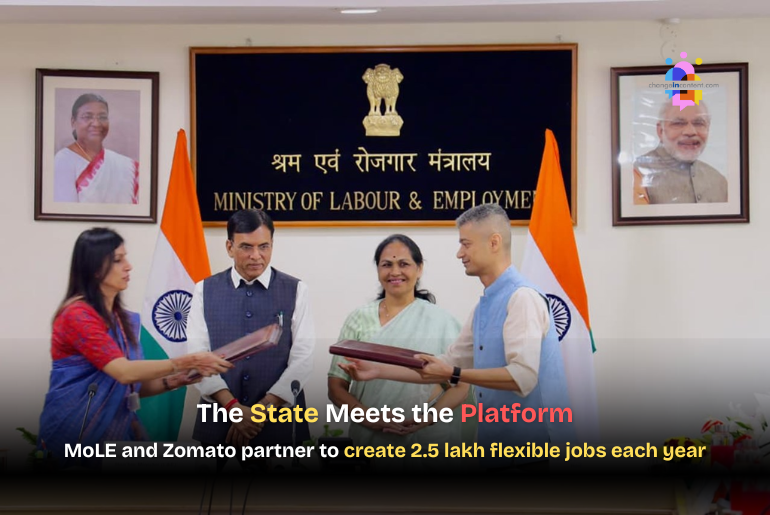
The Ministry of Labour and Employment (MoLE) has signed a Memorandum of Understanding (MoU) with Zomato. Zomato is one of India’s leading digital platforms. The association aims to expand access to technology-enabled livelihood opportunities through the National Career Service (NCS) portal.
In the words of Union Minister Dr Mansukh Mandaviya, this partnership marks a milestone. It strengthens the government’s mission to connect youth and women job seekers to dignified, flexible, and secure forms of work. For India’s growing gig workforce, this could be the beginning of something long overdue. It can be the beginning of recognition within the formal employment ecosystem.
A partnership rooted in inclusion and reform
The collaboration between MoLE and Zomato reflects a policy-level shift in India’s approach to the gig economy. Once seen as peripheral, gig work is now being woven into the framework of formal employment and social protection.
Under the MoU, Zomato will list approximately 2.5 lakh flexible livelihood opportunities annually on the National Career Service portal. It is a digital platform launched in 2015 that already connects millions of job seekers to employment opportunities.
For a sector often defined by instability, this move represents structure and visibility. It integrates platform-based jobs (such as delivery, logistics, and operations) into the government’s employment registry. It creates a traceable and accountable system that can link gig workers to welfare schemes and social security benefits.
The MoU also supports the Pradhan Mantri Viksit Bharat Rozgar Yojana (PM-VBRY) and contributes to the broader Viksit Bharat 2047 vision. This vision emphasises inclusive economic growth and formalisation across sectors.
A policy step with real people at its centre
The signing ceremony, held in New Delhi, was attended by Union Minister Dr Mansukh Mandaviya, Minister of State Ms Shobha Karandlaje, and Secretary Ms Vandana Gurnani.
Dr Mandaviya underscored that the NCS platform has become a “vital bridge” between job seekers and employers, both nationally and internationally. With over 7.7 crore vacancies mobilised since its inception, the portal now acts as a gateway for connecting traditional and modern job markets.
Ms Shobha Karandlaje, speaking at the event, reminded the audience that social security must cover every worker, whether organised or unorganised. She urged businesses to partner with the government in ensuring that flexible jobs do not translate to insecure livelihoods.
Meanwhile, Secretary Vandana Gurnani drew attention to an often-overlooked statistic — that social security coverage in India has risen from 19% in 2015 to 64.3% in 2025, reaching 94 crore citizens. The collaboration, she said, is an extension of that progress, expanding access to protection for gig and platform workers who have long remained on the margins of formal welfare.
What the MoLE–Zomato MoU means for India’s workforce
MoLE signed an MOU with Zomtao. However, what does it mean for India’s workforce? Let us find out.
1. Formalising the gig economy
Gig work has often operated outside the formal structures of labour laws and benefits. By bringing Zomato onto the NCS platform under the new ‘Aggregator’ category, MoLE acknowledges gig platforms as legitimate contributors to India’s employment landscape. It also sets the stage for data-backed policymaking that recognises gig workers as part of the national workforce.
2. Expanding flexible job opportunities
Zomato alone is expected to create 2.5 lakh opportunities annually. Other MoUs are already in place with Amazon, Swiggy, Rapido, Zepto, TeamLease and others. The NCS platform is emerging as India’s largest job ecosystem. Collectively, these partnerships have mobilised over five lakh employment opportunities in the last year.
3. Women and youth at the core
This collaboration could especially benefit women and young workers seeking part-time or flexible income avenues. Many women who exit the formal workforce after marriage or maternity can now re-enter through structured, location-based digital opportunities listed on the NCS portal.
4. Bridging technology and dignity
By aligning a platform company with a government employment portal, this partnership creates a unique opportunity. It creates dignity through design. Gig workers, often invisible in policy discussions, gain both visibility and validation as part of India’s formal employment narrative.
The bigger picture: Why this matters
India’s gig economy is projected to employ over 23 million workers by 2030. It spans delivery, logistics, content creation, and on-demand services. Yet, without formal frameworks, most workers remain excluded from pensions, health insurance, or accident coverage.
This MoU is more than a jobs announcement; it is a signal of systemic inclusion. It acknowledges that flexible work and formal employment are not opposites. The future of work lies in combining both: flexibility with security, independence with protection.
If executed well, this partnership could become a blueprint for how governments and private platforms collaborate to humanise the gig economy. It can turn an often-precarious form of labour into a sustainable livelihood system.
Conclusion: MoLE signed an MoU with Zomato: A step towards equal dignity for all work
When the Ministry of Labour and Employment partners with a gig platform like Zomato, it symbolises something larger than policy: a shift in values. It recognises that in the future of work, every job (whether coded in an app or listed on a portal) deserves the same dignity, protection, and recognition.
This partnership, grounded in numbers but powered by intent, moves India closer to that vision. For the 2.5 lakh workers who may find livelihoods through this initiative each year, it is not just about employment. Instead, it is about entry into the nation’s story of progress.
At ChangeInContent, we see this as a pivotal moment where the State and the platform economy meet halfway. We do not see it as an initiative to replace one another, but to build together. The gig economy, once viewed as informal, is now officially part of India’s inclusive growth story.
Also Read: New Labour Code 2025: A 4-day workweek may sound great—But what will it really take?
Disclaimer: The views expressed in this article are based on the writer’s insights, supported by data and resources available both online and offline, as applicable. Changeincontent.com is committed to promoting inclusivity across all forms of content. We broadly define inclusivity as media, policies, law, and history. It encompasses all elements that influence the lives of women and marginalised individuals. Our goal is to promote understanding and advocate for comprehensive inclusivity.