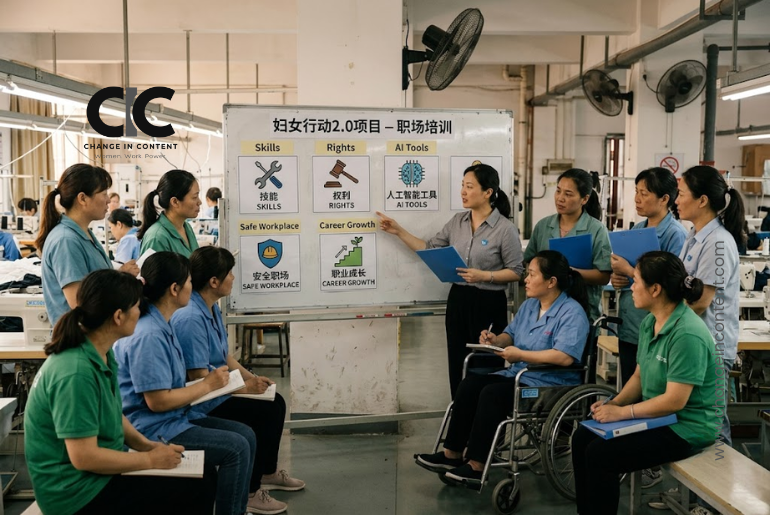
The Quick Read
- Women in Motion 2.0 is a four-year programme jointly launched by UN Women and the European Union in China on 15 July 2026, World Youth Skills Day.
- The programme will support women’s economic empowerment and promote gender-responsive, inclusive workplaces, with special focus on young women and women with disabilities.
- It will expand access to skills development, lifelong learning, and labour rights awareness, while also supporting employers in building safer and more family-friendly workplaces.
- Baseline findings from over 60 enterprises in Shaanxi and Jiangsu show progress, but gaps remain in promotion equality, parental leave use and anti-sexual harassment systems.
- The first phase of Women in Motion, from 2023 to 2025, supported 63 enterprises across the textile, ICT and automobile sectors, reaching around 200,000 employees and directly benefiting 11,886 women workers through skills development.
Women in Motion 2.0 launched in China
UN Women and the European Union have launched Women in Motion 2.0, a four-year programme aimed at advancing women’s economic empowerment and promoting gender-responsive workplaces in China.
The programme was announced in Beijing on 15 July 2026, coinciding with World Youth Skills Day. It will be funded by the European Union and implemented by UN Women in partnership with multiple organisations in China.
For Change in Content, this is a workplace story with global relevance. It connects women’s economic participation, skills, labour rights, inclusive employer practices and the future of work.
The programme arrives at a time when digital transformation and AI are reshaping workplaces across economies. Its focus on young women and women with disabilities makes the intervention more targeted than a general gender equality campaign.
What Women in Motion 2.0 will do
Women in Motion 2.0 will work on both sides of the employment equation.
For women workers, it will expand access to skills development, lifelong learning and labour rights awareness. For employers, it will support gender-responsive policies, safer workplaces and family-friendly practices. The programme will also engage stakeholders to challenge discriminatory norms and attitudes affecting women and girls.
It is important because workplace inclusion cannot rely only on women becoming more skilled. Employers must also build systems in which women can enter, stay, grow, and be treated fairly.
That includes transparent promotion, equal access to training, stronger anti-harassment mechanisms, flexible work arrangements and workplace support for caregiving responsibilities.
The China programme adds another global example of how women’s workplace participation is increasingly being linked to systems, not only individual ambition.
Why China’s workplace context matters
Women are already a major part of China’s labour force. According to the programme announcement, women account for over 43% of the labour force and play a central role in the country’s economic growth. Yet young women and women with disabilities continue to face barriers to decent work and career advancement, including stereotypes, discriminatory hiring practices and limited workplace support.
That mix of high participation and persistent barriers is worth noting.
A country can have many women in work and still have unequal workplaces. Representation alone does not guarantee fair promotion, safe systems, equal pay, career support, or access to leadership.
The programme’s focus on AI-relevant skills also reflects a newer workplace concern. As AI and digital tools reshape jobs, women need access to skills and opportunities early, not after new gaps have already formed.
Our earlier analysis of Women in Tech Stats 2026 made this point clearly: women should not only use the future. They should help build it.
What the baseline findings show
The programme’s baseline findings covered more than 60 enterprises, mainly in Shaanxi and Jiangsu provinces.
The findings show encouraging movement. More than two-thirds of enterprises provide women with access to industry exchanges and training opportunities. Basic family-leave provisions are also widely in place.
The gaps are equally important.
The majority of enterprises still need to do more to prohibit gender discrimination in promotion decisions. Parental and family care leave is often underused. Anti-sexual harassment mechanisms are described as largely reactive rather than preventive.
A related survey of more than 3,000 employees found that employees want fair and transparent promotion and pay, flexible working arrangements for work-life balance, and stronger career development support, including AI-relevant skills.
These findings make the programme practical. They point to what workers are asking for, and where employers need to act.
Who is involved in the programme?
UN Women will implement Women in Motion 2.0 in partnership with the China Enterprise Confederation, the China Disabled Persons’ Federation, the International Labour Organisation and the Inno Community Development Organisation. Caixin Video will serve as a strategic media partner.
The programme will also work with sector associations, women’s organisations, organisations of persons with disabilities and academia.
This multi-partner structure matters because a single organisation cannot deliver workplace change. Skills, employer policy, labour rights awareness, disability inclusion, media visibility, and industry engagement require different actors to work together.
What came before Women in Motion 2.0?
Women in Motion 2.0 builds on the first phase of the EU-funded Women in Motion programme, which ran from 2023 to 2025.
The first phase supported 63 enterprises across the textile, ICT, and automobile sectors in establishing gender-responsive workplace mechanisms. It reached around 200,000 employees and directly benefited 11,886 women workers through skills development.
That gives the new phase a base to build on. The second phase now appears to widen its reach, with more attention to vulnerable groups, new regions and new industry challenges.
The Change in Content View
Women in Motion 2.0 is a useful global policy signal. It recognises that women’s economic empowerment needs three things at once: skills for women, better systems from employers and wider change in workplace attitudes.
The programme’s focus on young women, women with disabilities, AI-relevant skills and inclusive workplace practices makes it especially relevant to the future of work. Its success will depend on what changes inside enterprises.
- Do promotion systems become more transparent?
- Do women use family leave without fear of career penalty?
- Do anti-harassment systems become preventive?
- Do women gain AI-relevant skills before the next opportunity gap widens?
- Do women with disabilities find safer, more inclusive pathways into work?
Those answers will decide whether Women in Motion 2.0 becomes another programme announcement or a model worth watching.
For now, the launch places one message clearly on the table: inclusive workplaces are no longer a side conversation. They are part of economic growth, skills policy and the future of work.
FAQs
Q: What is Women in Motion 2.0?
A: Women in Motion 2.0 is a four-year programme launched by UN Women and the European Union in China to advance women’s economic empowerment and promote gender-responsive, inclusive workplaces.
Q: When was Women in Motion 2.0 launched?
A: The programme was launched in Beijing on 15 July 2026, coinciding with World Youth Skills Day.
Q: Who will Women in Motion 2.0 focus on?
A: The programme will focus on women’s economic empowerment, with particular attention to young women and women with disabilities. It will also support employers in building inclusive, safe and family-friendly workplaces.
Q: What workplace issues does the programme address?
A: The programme addresses skills development, labour rights awareness, gender-responsive employer policies, workplace safety, family-friendly practices, fair promotion, flexible work, anti-harassment systems and AI-relevant skills.
Q: What did the first phase of Women in Motion achieve?
A: The first phase, from 2023 to 2025, supported 63 enterprises across the textile, ICT and automobile sectors, reached around 200,000 employees and directly benefited 11,886 women workers through skills development.
Editorial Note and Sources
This article is based on the official announcement by the Delegation of the European Union to China and UN Women’s Asia-Pacific communication on the launch of Women in Motion 2.0. It explains the programme through the Change in Content lens of women, work, skills and inclusive workplaces. The article is intended for editorial and informational purposes only and should not be read as legal, labour policy, funding, HR compliance or workplace advisory guidance.
Sources used:
- Delegation of the European Union to China: UN Women and the European Union drive action for gender equality and inclusive workplaces in China
- UN Women Asia and the Pacific: UN Women and the European Union drive action for gender equality and inclusive workplaces in China