
The Quick Read
- Feminist foreign policies apply gender equality and human rights to diplomacy, development assistance, trade, security, climate action and humanitarian policy.
- Sweden introduced the first formally named feminist foreign policy in 2014. The approach has since spread across Europe, the Americas and Africa, although some governments have later withdrawn the label.
- Canada has linked its feminist approach to international assistance, while France, Germany, Spain, Mexico, Chile, Colombia and Liberia have developed broader foreign-policy frameworks.
- In June 2026, 28 governments backed a Madrid declaration connecting feminist foreign policy with peace, democracy, bodily autonomy, inclusive economies and accountability for gender-based oppression.
- The approach matters only when it changes budgets, arms decisions, peace negotiations, migration policy and who receives diplomatic influence.
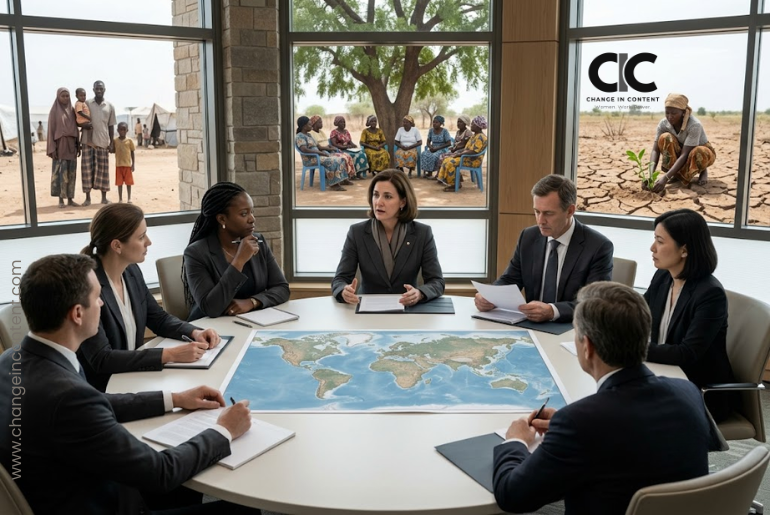
Foreign policy is usually presented through presidents, borders, military alliances and rooms full of serious men studying maps. The people living with those decisions often appear later.
A woman displaced by war, a girl unable to return to school, a migrant care worker separated from her family, or a local women’s organisation rebuilding a community with a fraction of the money allocated to international consultants.
Feminist foreign policies begin with a simple challenge to conventional diplomacy: foreign policy should be judged not only by what states secure, but also by whose security counts.
This approach has gained ground during a difficult political moment. Wars are expanding, multilateral institutions are under strain, military expenditure is rising, and gender rights face organised resistance. Yet governments from different regions continue to experiment with foreign policy built around equality, rights, representation and the redistribution of power.
The movement has survived. Whether it can become more than progressive diplomatic language remains an open question.
What are feminist foreign policies?
A feminist foreign policy places gender equality and human rights across the full range of a country’s international actions. That can include:
- Diplomacy and diplomatic appointments;
- Development assistance;
- Conflict prevention and peace negotiations;
- Defence and arms exports;
- Trade and economic agreements;
- Climate finance;
- Migration and asylum;
- Humanitarian response;
- Sexual and reproductive health;
- Cooperation with women-led civil-society organisations.
The principle is broader than adding more women to foreign ministries. Representation matters, but a room can contain women and still make decisions through the same old hierarchy.
A serious feminist approach asks different questions.
- Who helped set the agenda?
- Who controls the resources?
- Who bears the risk?
- Whose knowledge is treated as expertise?
- Does the policy reduce inequality or merely manage its consequences?
UN Women has described feminist foreign policy as a framework that connects gender-responsive diplomacy with peace, development and the wider 2030 Agenda. The Feminist Foreign Policy Collaborative assesses national approaches through five recurring dimensions: rights, resources, representation, research and reporting, and reach.
That makes it a method of examining power, not a women-only branch of diplomacy.
How did the movement become global?
Sweden became the first country to describe its foreign policy as feminist in 2014 formally. Its original framework focused on women’s rights, representation and resources, supported by analysis of the realities in which women lived.
The Swedish government later dropped the label in 2022. That reversal exposed one of the movement’s central weaknesses: an international policy associated closely with one political government can disappear when power changes hands. Still, the idea had already travelled.
Canada introduced its Feminist International Assistance Policy in 2017. The policy positioned gender equality as central to poverty reduction and committed Canada to integrating or targeting gender equality across most bilateral development initiatives. It also gave greater attention to sexual and reproductive rights, women’s organisations and women’s participation in decision-making.
France began practising feminist diplomacy in 2019 and launched a 2025–2030 international strategy covering rights, decision-making, peace, climate, development and economic inequality.
Mexico became the first Latin American country to adopt a feminist foreign policy in 2020. Chile and Colombia followed with approaches shaped partly by the region’s strong feminist movements, concern about structural inequality and the need to bring indigenous, racial and social justice into the conversation.
Germany issued feminist foreign-policy guidelines in 2023. Spain has embedded the approach in its foreign-action strategy. Liberia has become an important African voice, developing a gender-responsive foreign-policy framework and helping to broaden a movement once viewed largely as a European project.
The result is not one shared model. Countries have adopted different levels of ambition, legal form, funding and accountability. That flexibility has helped the idea spread. It has also made it easier for governments to use the label without changing difficult policies.
Why did the 2026 Madrid declaration matter?
Spain hosted the Fifth Ministerial Conference on Feminist Foreign Policy in Madrid on 2 and 3 June 2026.
The event brought together more than 700 participants and 60 ministerial delegations. 28 governments endorsed a political declaration connecting feminist foreign policy with peace, democracy, human dignity and social justice.
The declaration matters because its scope went beyond appointing women diplomats. It addressed:
- Democratic backsliding;
- Gender-based oppression;
- Bodily autonomy;
- Unequal global financing;
- Racism and colonial legacies;
- Inclusive economies;
- The protection of women’s human rights and land defenders;
- Accountability through international institutions.
This places feminist foreign policy within a wider progressive response to authoritarianism, inequality and the weakening of multilateral cooperation.
It also reflects an evolution in the movement. Early conversations often centred on how many women reached diplomatic posts. The current debate increasingly examines how global institutions define security, allocate money and legitimise force.
That distinction is essential. A foreign ministry can reach gender parity while supporting policies that harm women elsewhere. Feminist representation without feminist scrutiny is only a more diverse administration of existing power.
What difference can feminist foreign policy make?
The strongest contribution is that it widens the definition of national interest.
Traditional foreign policy often treats military strength, territorial control, trade access and strategic alliances as hard issues. Health, care, reproductive rights and gender-based violence are pushed into the softer category of development or humanitarian concern. But these issues shape whether societies remain stable.
When conflict destroys maternity services, blocks girls’ education and increases sexual violence, that is a security failure. When climate shocks expand women’s unpaid work and force girls out of school, that is an economic and foreign-policy issue. And when migration rules leave domestic and care workers vulnerable to exploitation, that is part of international labour governance.
Feminist foreign policy brings these consequences into the original decision rather than adding women as a final paragraph.
It can redirect development money
Canada’s policy offers one practical example. Rather than treating gender equality as a small specialist programme, it sought to integrate gender analysis across health, governance, climate, economic development and humanitarian assistance.
The important question is not whether an aid project includes women as beneficiaries. It is whether women helped design it, control resources and influence how success is measured.
It can strengthen women’s role in peace
Women frequently organise ceasefires, community dialogue, documentation and recovery at the local level. They remain under-represented in formal peace negotiations.
A feminist foreign policy can make women’s participation a diplomatic requirement, fund women-led peacebuilding and challenge agreements that distribute power among armed actors while excluding the communities that must live with the settlement.
Change in Content has examined why women in peacekeeping and conflict resolution are a strategic necessity rather than a symbolic addition. Their inclusion can improve community access, trust and the quality of post-conflict decisions.
It can build alliances around rights
Countries adopting feminist approaches have created new diplomatic networks and regional cooperation.
Mexico and Chile have worked together on feminist diplomacy and training. Chile, Colombia, Germany and Mexico have supported a community of practice. The 2026 Madrid declaration brought states from five continents behind shared language at a time when references to gender equality are increasingly contested in multilateral forums.
This alliance-building matters. Rights can be weakened internationally one negotiated sentence at a time. Coordinated states are better placed to defend them.
Where do feminist foreign policies fall short?
The sharpest criticism is inconsistency.
A government may promote women’s rights through development aid while selling weapons used in conflicts that devastate women and children. It may celebrate feminist diplomacy while adopting migration rules that expose women to detention, trafficking or family separation. And it may call for women’s participation in peacebuilding while increasing military spending without applying the same gender scrutiny to defence decisions.
These contradictions are not side issues. They are the test.
The Netherlands, Argentina and Sweden have stepped back from previous feminist commitments. Other countries retain the language but face criticism over arms exports, border policy and the gap between international promises and domestic action.
A feminist foreign policy cannot be judged by the number of conferences carrying the word “feminist”.
It must be visible in choices governments would otherwise prefer to keep separate:
- Which countries receive weapons?
- Whose deaths affect diplomatic relations?
- Do trade agreements protect women workers?
- Are women-led groups funded directly?
- Are refugees treated with dignity?
- Does climate finance reach women who manage land and food systems?
- Are reproductive rights defended when politically inconvenient?
The framework loses credibility when feminism is used to polish foreign policy rather than question it.
Can the policy survive political change?
This may be the movement’s defining challenge.
Foreign-policy doctrines are vulnerable when they are attached to ministers, electoral coalitions or branding exercises. A new government can remove the name even if some programmes remain.
Countries are therefore beginning to explore stronger institutional safeguards.
Colombia moved to embed its feminist approach through a state-policy mechanism before a change in political leadership. France has placed abortion rights in its Constitution while building a longer-term feminist diplomatic strategy. International declarations and cross-country networks create additional pressure against silent retreat.
Durability will require more than protection from conservative governments. Policies need:
- Public budgets;
- Measurable objectives;
- Independent reporting;
- Parliamentary oversight;
- Civil-society participation;
- Diplomatic training;
- Local women’s organisations with direct access to funding;
- Scrutiny of trade, migration and defence alongside aid.
Without these, feminist foreign policy remains easier to announce than to institutionalise.
What can countries without a formal feminist policy learn?
A country does not need to adopt the label before improving its foreign policy.
India, for example, has significant experience through women peacekeepers, development partnerships, disaster response and advocacy for women-led development. Yet these strands do not amount to a declared feminist foreign policy.
The more useful question is what any country can apply now:
- Conduct gender-impact assessments of foreign-policy decisions;
- Increase women’s authority in diplomacy and security;
- Fund women-led organisations directly;
- Examine the gender consequences of trade and migration agreements;
- Include care, health and bodily autonomy in economic diplomacy;
- Measure whether women influence peace processes rather than merely attend them;
- Publish results and contradictions openly.
Recent coordination through the Australia–UK Strategic Dialogue on Gender Equality shows that governments can advance gender priorities through bilateral and multilateral cooperation even without using identical policy labels.
The label can be politically valuable. The discipline behind it matters more.
The Change Ahead
Feminist foreign policies are gaining relevance because conventional foreign policy is failing too many people.
Wars continue without durable settlements. Humanitarian systems are overstretched. International law is applied unevenly. Global decisions remain concentrated among a narrow group, while those carrying the consequences are consulted afterwards.
A feminist approach does not guarantee better diplomacy. It does force diplomacy to reveal its assumptions.
- Who is considered worth protecting?
- What is counted as security?
- Which forms of violence attract international action?
- Whose labour sustains recovery?
- Who controls the money when peace finally arrives?
The progressive power of feminist foreign policy lies here. It moves gender from the edge of global affairs to the examination of power itself. Its future will depend on whether governments are willing to apply that examination when it becomes uncomfortable.
A policy is not feminist because it says the right things about women. It becomes feminist when it changes what a country is prepared to fund, defend and refuse.
Editorial Note and Sources
This Policy Pulse report draws on official foreign-policy strategies, government announcements, UN Women research and the Feminist Foreign Policy Collaborative’s comparative work. Countries use different definitions and policy instruments, and inclusion in this article does not imply that every action of a government is consistent with feminist principles. The report distinguishes between formally adopted feminist foreign policies, feminist development policies and broader gender-responsive diplomatic commitments.
Principal sources
- Ministry of Foreign Affairs, Spain: Fifth Ministerial Conference on Feminist Foreign Policy
- Ministry of Foreign Affairs, Spain: Political declaration endorsed by 28 states at the 2026 conference
- UN Women: Feminist foreign policies: An introduction
- Feminist Foreign Policy Collaborative: Defining Feminist Foreign Policy 2025
- Government of Canada: Canada’s Feminist International Assistance Policy
- Government of France: International Strategy for a Feminist Foreign Policy 2025–2030
