
The Quick Read
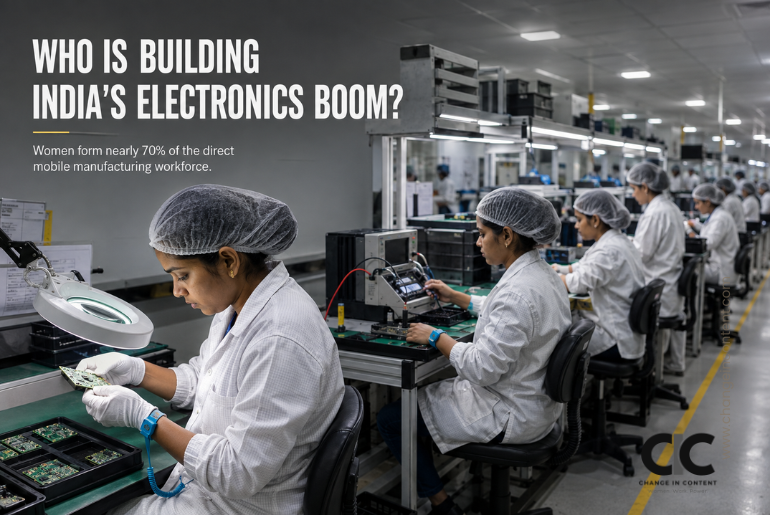
- Women account for nearly 70% of the direct workforce in India’s mobile-phone manufacturing segment, according to the Ministry of Electronics and Information Technology.
- Electronics manufacturing has created approximately 25 lakh jobs, including around 12 lakh direct and indirect jobs in mobile manufacturing.
- The sector gives young women access to formal wages, technical experience and factory work that is often unavailable in their home districts.
- High participation has emerged most visibly where employers provide transport, accommodation, food, training and secure workplaces.
- Hiring women in large numbers is only the beginning. India must now create routes into technical, supervisory, engineering and leadership positions.
Women in electronics manufacturing: An introduction
A smartphone moving along an assembly line in Tamil Nadu or Karnataka carries more than circuitry, glass and metal. It also carries a quiet change in India’s employment story.
Thousands of young women are now assembling devices, fitting components, inspecting parts, operating machinery, testing products and managing production quality. Many are entering formal employment for the first time. Some have travelled from villages and smaller towns. Others are the first women in their families to work inside a factory.
Women in electronics manufacturing are becoming central to one of India’s fastest-growing industrial sectors. Government figures released in July 2026 indicate that women comprise nearly 70% of the direct workforce in mobile-phone manufacturing. Across electronics manufacturing as a whole, they account for close to 30% of the employment created over the past decade.
These numbers deserve attention for two reasons. They record a significant expansion of women’s industrial employment. And they also reveal what happens when a growth sector creates jobs that women can realistically enter.
Electronics is offering a glimpse of a different labour market: one in which women are recruited into formal manufacturing at scale rather than treated as an occasional diversity hire. The more important question concerns where these jobs eventually lead.
India’s electronics boom now has women at its centre
India’s electronics industry has expanded rapidly over the past decade. Electronics production increased from ₹1.90 lakh crore in 2014–15 to an estimated ₹13.11 lakh crore in 2025–26. Exports rose from ₹38,263 crore to ₹4.24 lakh crore over the same period. Electronic goods are now India’s third-largest export category.
Mobile phones have been one of the strongest engines of this growth.
Factories and supplier networks have expanded across Tamil Nadu, Karnataka, Uttar Pradesh and other states. Government production incentives, global supply-chain diversification and growing domestic demand have encouraged companies to establish or enlarge manufacturing operations in India.
Jobs have followed.
The electronics sector has generated nearly 25 lakh employment opportunities, while mobile manufacturing supports approximately 12 lakh direct and indirect jobs. Government schemes administered by MeitY have reportedly created more than 5.3 lakh jobs, including around 1.8 lakh through Production Linked Incentive schemes.
Women are unusually visible within this employment expansion.
Some large electronics manufacturers report workforces in which women form well over half of all employees. Mobile-phone assembly plants have gone further, with women comprising nearly seven out of every ten direct workers across the segment.
That scale separates electronics from many other parts of Indian manufacturing, where women still appear in small numbers or remain concentrated in limited functions.
The development also complicates an older assumption: that factory growth will naturally produce jobs for men, while women will remain in agriculture, home-based work or a narrow group of service occupations.
Electronics shows that the composition of industrial employment can change when companies recruit deliberately and build the infrastructure needed to sustain that recruitment.
India’s wider manufacturing ambitions should learn from it.
What brings young women to an electronics factory?
For a young woman living in a small town or village, an electronics job can offer something that local labour markets often cannot: a clearly defined role, a predictable wage and visible separation between work and unpaid family labour. The attraction is practical.
Formal factory employment may include an appointment letter, fixed shifts, regular payment, provident fund coverage, meals, transport, accommodation, and work experience that can be documented. Even where wages remain modest, the structure of the job can offer greater personal and financial visibility than irregular agricultural or home-based work.
A salary paid into a woman’s account also changes her position within the household. She may contribute to family expenses, pay for a sibling’s education, build savings or make purchases without seeking money each time.
Work can expand her social world as well. Living or commuting alongside other employees introduces new friendships, information and ambitions. A woman who had rarely travelled outside her district may begin navigating an industrial township, dealing with supervisors and learning how a large production system operates.
These changes should not be romanticised. Factory work can be repetitive, closely monitored and physically demanding. Young workers may live far from their families and operate under tight production targets. Their bargaining power can remain limited. Yet formal industrial work can still represent a meaningful movement away from invisible and poorly recognised labour.
Change in Content has previously examined how women’s growing employability in the electronics sector is linked to apprenticeship performance and shop-floor readiness. The current expansion confirms that women are not waiting to be made suitable for manufacturing. Many already possess the discipline, accuracy and learnability these operations require.
Electronics and agriculture tell two very different employment stories
The contrast with agriculture helps explain why this shift deserves more than celebratory headlines.
Agriculture continues to employ the largest share of India’s workers. The Periodic Labour Force Survey for 2025 placed agriculture’s overall employment share at 43%, while manufacturing accounted for 12.1%. Among rural women, dependence on agriculture remains particularly high. Official monthly data for June 2025 found that nearly 70% of rural female workers were engaged in the sector.
Millions of women perform essential agricultural work: sowing, transplanting, weeding, harvesting, tending animals, processing produce and maintaining household farms. Their contribution is enormous. Their economic identity is often weak.
A woman may work throughout the agricultural season without receiving an individual wage. She may be recorded as an unpaid family helper, work on land she does not own or have little influence over the sale of produce. Her work is productive, yet the income and assets attached to it may remain controlled by somebody else.
Electronics manufacturing presents a different arrangement.
The worker enters a named enterprise. Her hours are counted. Her attendance is recorded. And her wages are paid to her. She acquires experience attached to an occupation and an employer.
The contrast does not make every factory job superior to every agricultural livelihood. Agriculture can provide autonomy, local employment and opportunities for ownership when women have access to land, credit, technology and markets. Factory work can involve insecure contracts, migration pressures and limited advancement.
The useful comparison lies in economic recognition. A woman in agriculture can remain indispensable to production while being absent from ownership and pay. A woman on an electronics assembly line is more likely to be recognised as an individual worker.
For women’s employment policy, that difference is consequential.
The infrastructure around the job is doing much of the work
Women have not entered electronics manufacturing at scale because one sector suddenly became free of social restrictions. Participation has grown most strongly where employers have reduced the practical risks surrounding employment.
Large manufacturing campuses and industrial employers have used combinations of:
- Company-operated or verified transport
- Secure hostels and residential facilities
- Meals and subsidised food
- Clearly managed shifts
- On-site medical support
- Workplace sanitation
- Technical induction and apprenticeship routes
- Communication with workers’ families
- Formal attendance and wage systems
This infrastructure makes a job acceptable and possible for women who might otherwise be unable to travel long distances or relocate.
The regional pattern is revealing. Women’s participation has been especially strong around major electronics clusters in southern India, where large employers and supplier ecosystems have developed campus-style arrangements. In regions where housing, transport and worker support remain weaker, participation has generally been lower.
Safe housing deserves particular attention. A job offer in an industrial cluster has little value when a woman cannot find a secure and affordable place to live nearby. High rent can consume much of an entry-level salary, while distant accommodation creates long journeys and greater safety concerns.
Our earlier analysis of safe and affordable housing for women argued that housing, mobility and employment belong within the same growth conversation. Electronics manufacturing supports that argument. Employers attracting women from other districts are participating in a migration system, whether or not they describe it that way.
The job begins before the factory gate.
Why employers are hiring women in large numbers
Women’s recruitment is sometimes presented as corporate generosity. That explanation undersells both the workers and the business case.
Electronics production involves operations that require process discipline, dexterity, concentration, consistency and careful quality control. Women are being recruited because employers believe they can perform these jobs effectively.
Recent employability findings reinforce this. Women entering electronics manufacturing recorded an employability rate of 54%, compared with 51.5% among men, according to TeamLease data reported earlier in 2026. Female participation in entry-level apprenticeship routes has also been rising.
Employers may also value attendance, workforce stability and retention. However, such claims require care.
Descriptions of women as naturally more patient, obedient, precise or willing to remain in repetitive jobs can quickly become gender stereotypes. They may help women enter a factory while simultaneously confining them to the least powerful part of it.
A company that hires women because they are considered “better suited” to repetitive assembly may hesitate to train the same women for maintenance, automation, engineering or line management.
That is where an apparent advantage becomes an occupational boundary. Women should be hired because they can learn and perform industrial work, not because employers expect them to accept lower bargaining power or narrower ambitions.
Entry-level strength must produce career mobility
Walk into a highly feminised assembly unit, and women may dominate the production line. Move upward through technical supervision, plant management, engineering leadership, supply-chain control or executive decision-making, and the picture can become more male. This is the next test for the sector.
High female participation at entry level is valuable, but headcount alone cannot tell us whether women are accumulating power.
Companies should publish gender-disaggregated information across:
- Employment level
- Job function
- Contract type
- Wage band
- Training participation
- Promotions
- Attrition
- Supervisory positions
- Technical roles
- Plant and business leadership
A factory employing 70% women on its lines but very few women in management has created access without fully creating mobility.
Change in Content recently examined the wider gap between women’s recruitment into industrial roles and their representation near the top of manufacturing organisations. India’s 2047 industrial ambitions will require women to progress from operating production systems to designing and leading them.
Electronics companies can begin by creating transparent skill ladders. An assembly operator should be able to see how she might become a quality technician, line leader, equipment specialist, trainer, production planner or supervisor.
Training cannot be reserved for workers already considered management material. Women need access to machinery, digital production systems, industrial automation, maintenance and problem-solving roles early in their careers.
The sector’s gender story will mature when women are visible wherever technical authority and operational decisions sit.
A young workforce will eventually become a workforce with care responsibilities
Much of the current electronics workforce is young. That can make retention look easier than it will be over a full career cycle.
Marriage, pregnancy, childcare and eldercare often alter women’s employment possibilities. A hostel and transport arrangement may help an unmarried worker relocate at 20, but the same system may not support her at 28 when she has a child or dependent family member.
If companies build their employment model around a continuous supply of young women who leave after a few years, high participation can coexist with weak career continuity. The sector therefore needs to prepare for the next demographic stage of its own workforce.
That means:
- Functional crèches aligned with factory shifts
- Maternity protection without career penalties
- Predictable scheduling
- Return-to-work pathways
- Parental leave that includes men
- Transfer options where feasible
- Health support appropriate to women workers
- Protection from sexual harassment and retaliation
- Supervisors trained to manage a gender-diverse workforce
- Promotion systems that do not reward uninterrupted availability alone
Companies such as Kirloskar Brothers have demonstrated how transport and childcare can support women in manufacturing over longer periods. Such measures should become ordinary industrial design rather than exceptional corporate stories.
The quality of these jobs must remain under scrutiny
Rapid hiring figures can conceal differences in job quality.
Women may be employed directly by a company, through a contractor, as apprentices or on fixed-term arrangements. Each category can carry different wages, benefits, protections and possibilities for advancement.
India should pay closer attention to:
- Contract status: Are women moving into stable employment or repeatedly cycling through temporary arrangements?
- Pay: Are women receiving equal wages for comparable work, including incentives and overtime?
- Working hours: Are shifts predictable enough to manage transport and care?
- Voice: Can workers report unsafe conditions, harassment or unfair targets without risking their jobs?
- Health: Are ergonomic risks, repetitive strain, menstrual health and occupational exposure being monitored?
- Skill value: Does experience in one factory translate into recognised credentials elsewhere?
- Freedom: Can a worker leave company housing, change jobs, form associations and retain control over her documents and wages?
The International Labour Organisation has noted that electronics is a major global employer and that technological change, supply-chain pressure and production restructuring will shape its future workforce. Automation may remove some routine tasks while increasing demand for workers with digital, technical and problem-solving skills.
Women need access to that transition from the beginning. Otherwise, they may enter during a labour-intensive phase and lose ground when production becomes more automated.
What India can take from the electronics example
Electronics manufacturing offers several lessons that can travel beyond the sector.
- First, women’s participation responds to job design. Employers cannot cite a shortage of female candidates while locating factories far from public transport, operating unsafe shifts and providing no accommodation.
- Second, recruitment pipelines can be created. Partnerships with schools, Industrial Training Institutes, polytechnics, colleges and apprenticeship programmes can introduce women to manufacturing before they make occupational choices.
- Third, families influence employment decisions, particularly for young women migrating for their first jobs. Transparent information about safety, housing, wages and career prospects can reduce resistance more effectively than an employer-branding campaign.
- Fourth, industrial policy should measure who receives the jobs it helps create. Production, investment and export targets can be accompanied by reporting on women’s employment, retention, wages and technical progression.
- Fifth, supporting infrastructure is productive infrastructure. A bus, hostel or crèche may appear outside the manufacturing process, but it determines who can participate in that process.
The employment gains visible in electronics were built through a combination of industrial growth and practical support. Other sectors do not need to copy every campus model. They do need to understand the underlying principle: a job becomes inclusive when women can reach it, perform it safely, remain in it and progress from it.
The Change in Content Perspective: Let the factory floor become a starting point
Women are helping India assemble products sold across the world. The next chapter should allow them to assemble lasting careers.
Electronics manufacturing has opened a significant door into formal industrial employment. It has shown that large numbers of women will enter factory work when employers provide real opportunities and reduce the obstacles surrounding those opportunities.
India should protect this progress from becoming a short-lived phase built around young, inexpensive and replaceable labour.
Women who begin on assembly lines must be able to acquire recognised skills, negotiate better wages, move across employers, enter technical functions and rise into plant leadership. Their careers should survive marriage, motherhood, automation and changes in production.
The most valuable outcome will not be a factory photograph filled with women workers. It will be an industry in which a woman can enter at 20, build expertise at 30 and exercise operational power at 40.
India’s electronics boom has already changed who stands on the factory floor. It now has the opportunity to change who leads from it.
Editorial Note and Sources
This article is an independent editorial analysis by Change in Content. It draws on official employment, labour-force and electronics-sector information, along with research on the future of industrial work. Sector-wide figures may include direct and indirect employment and should not be interpreted as applying uniformly to every company, factory or employment contract.
Principal sources
- Press Information Bureau: Electronics Revolution—Mobiles Powering Exports and Giving High-Value Jobs
- Ministry of Statistics and Programme Implementation: Periodic Labour Force Survey
- Periodic Labour Force Survey Annual Report 2025
- Ministry of Electronics and Information Technology: Annual Report 2025–26
- International Labour Organisation: The Future of Work in the Electronics Industry
- Invest India: Electronic Products Sector Overview
