
The Brief
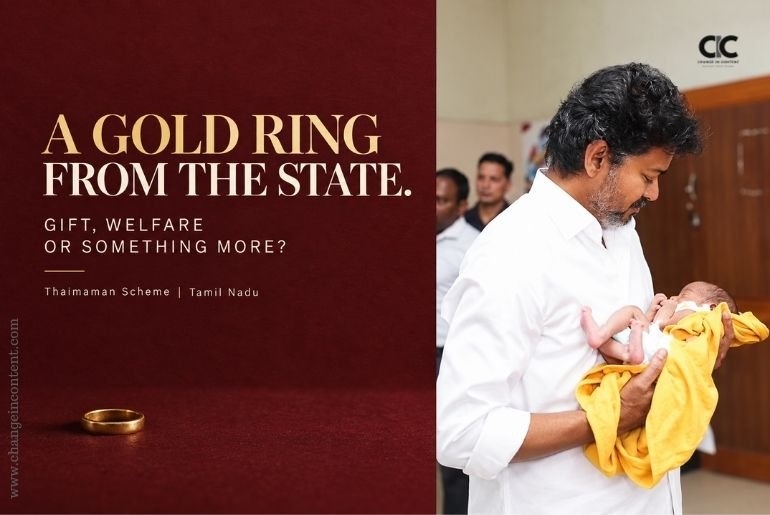
- Tamil Nadu’s Thaaimaaman Thanga Mothira Thittam provides a one-gram gold ring to eligible babies born in government hospitals to permanent residents of the state. The government has allocated ₹755.83 crore annually to the programme.
- The scheme draws its name from the Tamil custom of “thaimaman seer”, in which a maternal uncle presents gifts to his sister’s child. The State has explicitly positioned itself symbolically as that maternal uncle.
- Procurement has been approved for 4,41,667 one-gram gold rings, with work orders already issued for the first tranche.
- Change in Content’s concern is not with supporting mothers or newborns. It is whether welfare should be framed as familial generosity and cultural gifting when women’s maternity, health and economic security can instead be understood through rights, public services and citizenship.
The Thaimaman Scheme, Tamil Nadu
Tamil Nadu has earned the right to be taken seriously when it talks about welfare. This is a state that has helped normalise public meals in schools, invested deeply in public health, built a relatively extensive social-protection architecture and frequently treated welfare as something governments are expected to deliver rather than something citizens should be grateful to receive.
That history is precisely why its newest scheme deserves a closer look.
The Thaaimaaman Thanga Mothira Thittam, or Maternal Uncle’s Gold Ring Scheme, promises a one-gram gold ring to babies born in government hospitals in eligible Tamil Nadu families.
The annual allocation: ₹755.83 crore.
The State says the scheme celebrates the arrival of the child, honours the mother and draws from a Tamil cultural tradition in which the mother’s brother welcomes a newborn with gifts.
At first sight, that can sound warm. Familial. Culturally familiar. And that is exactly where our question begins.
Why is the State a “maternal uncle”?
Governments use language deliberately. Calling a programme Thaimaman is not merely branding. It creates a relationship.
The State is not presenting the ring simply as a publicly funded benefit. It is adopting the symbolic role of a male relative who comes bearing a gift. Official descriptions say the government will assume the role of the maternal uncle and present the ring as a gesture of affection and welcome.
There is something undeniably culturally recognisable about that. There is also something worth examining.
A democratic State is not a benevolent uncle. Women are not younger female relatives waiting for generosity from somebody occupying a protective male role. They are citizens.
The distinction may sound semantic. It is not. Words influence how welfare itself is understood.
A right is owed. A public service is funded collectively. An entitlement exists because citizens have a legitimate claim on the State. A gift comes from generosity. And generosity can always sound as though it belongs to the giver.
The problem is not the ring
Let us get one thing out of the way. There is little value in mocking a one-gram gold ring. For many families, gold has monetary, cultural and emotional value. A family receiving it may genuinely appreciate it.
The scheme also gives the same newborn benefit regardless of whether the child is a boy or girl, which differentiates it from programmes that attach benefits to the birth of a daughter. And if government hospitals gain greater trust among families because people associate childbirth there with care and recognition, that can have value too.
The question is different: What exactly are we asking public welfare to accomplish?
If ₹755.83 crore is being spent every year, should its primary achievement be a symbolic gift? Or should a maternal and child welfare programme first be judged by how strongly it expands women’s health, recovery, income security and agency?
Those are not rhetorical questions with easy answers. But large welfare expenditure deserves them.
Tamil Nadu already knows how to frame maternity as entitlement
This is what makes the comparison particularly interesting.
Tamil Nadu has long operated the Dr Muthulakshmi Reddy Maternity Benefit Scheme, one of India’s older maternity-support programmes. Its logic is much more structural.
Pregnancy and childbirth impose health needs and economic costs. Women can lose income. They require nutrition. They require antenatal and postnatal healthcare.
Public policy can recognise those costs directly. That language is very different from ceremonial gifting. It says, effectively: pregnancy creates material needs, and the State has obligations around them.
That is closer to the direction Change in Content believes women-centred welfare should continue moving.
Not away from warmth. Away from dependency as the organising metaphor.
Motherhood is important. A woman is still more than a mother.
There is another reason to look carefully at the scheme’s public narrative. Women occupy a very familiar place inside Indian welfare politics.
Mother. Wife. Daughter. Sister. Widow. Female head of household.
Many schemes are routed through those identities because those identities correspond to real vulnerabilities and responsibilities. There is nothing inherently wrong with recognising motherhood. Pregnancy and childbirth need public support.
The danger begins when the State repeatedly understands women primarily through their relationships to other people.
- She is someone’s mother.
- Someone’s sister.
- Someone’s wife.
- Someone’s daughter.
- Someone’s beneficiary.
Less often a worker, an entrepreneur, a landowner, a taxpayer, a political decision-maker, a person with reproductive autonomy, or a citizen with claims on public resources in her own right.
We confronted a similar issue during the Tamil Nadu election when analysing the gap between women as welfare voters and women as political representatives.
There is a meaningful difference between politics for women and politics with women. The same distinction applies to welfare.
A welfare State can be generous without becoming paternal
Tamil Nadu’s broader record makes this especially possible. The State does not need to prove that welfare matters. It has been doing that for decades.
That gives it the opportunity to evolve the language of welfare too. Imagine the same public expenditure described differently.
Not: “The State is your maternal uncle and has brought a gift.”
But: “Every woman giving birth in our public health system deserves strong maternal care, economic protection and a dignified start for her child.”
One model invokes kinship. The other invokes citizenship. Both can be compassionate. Only one avoids assigning government a patriarchal family role.
Gold also carries cultural baggage
Gold in India is not a neutral object. It is savings. Security. Ceremony. Inheritance. Adornment. Marriage. Status.
For women, it has historically carried another dimension as well: gold is often one of the few assets culturally imagined as belonging to her, even while larger property and wealth remain disproportionately controlled elsewhere.
That history makes the ring symbolically complicated.
On one hand, gold is tangible value. On the other, governments should be cautious about repeatedly expressing women’s welfare through the same cultural objects that surround marriage, fertility and family honour.
Women’s progress cannot be measured in grams of gold any more than it can be measured only in monthly transfers.
Our earlier analysis of cash schemes for women raised precisely this wider concern.
Relief can be real while still leaving deeper structures untouched. The right question is not whether a woman should receive the benefit. It is what larger freedom the benefit helps create.
₹755.83 crore deserves an outcomes question
The annual allocation is significant. The State’s procurement process has authorised 4,41,667 one-gram rings, and the implementation apparatus includes public-health systems, storage arrangements and distribution through government facilities.
That brings us to a straightforward public-policy question: What outcome will Tamil Nadu measure?
- More institutional deliveries?
- Greater trust in public hospitals?
- Improved maternal-health follow-up?
- Higher antenatal registration?
- Better continuity of postnatal care?
- Lower out-of-pocket spending?
- Or simply the number of rings distributed?
A welfare scheme becomes stronger when its intended outcome is measurable beyond the delivery of the benefit itself.
If the government’s argument is that the gold ring encourages families to use public hospitals, then that objective can be evaluated. If the objective is primarily cultural recognition, that should be stated honestly too.
Public money deserves clarity about what success looks like.
And welfare should not end where the symbolism does
Tamil Nadu has already demonstrated a more structural approach elsewhere. Its women-focused employment and safety initiatives have increasingly connected jobs with safety, care infrastructure, mobility and health.
That is much closer to the model Change in Content would like to see expanded.
Our earlier report on the Tamil Nadu Women Employment and Safety Project examined a programme that treats women’s economic participation as something requiring systems around them, not just an individual incentive. That is an important contrast.
One kind of policy gives women something. Another changes something around women. India needs both relief and structural reform. But we should be clear which one we are looking at.
There is also a question about who gets to define “culture”
Governments routinely invoke tradition. Sometimes for good reason.
Culture can create belonging. It can make policy comprehensible. And it can help people see themselves inside public institutions. But culture is not automatically beyond criticism because it is old or familiar.
Some traditions emerge from social arrangements in which gender roles were considerably more rigid than those we aspire to today.
That does not mean every cultural custom must be discarded. It means governments should ask what they reproduce when they institutionalise one.
- Does the symbolism expand women’s autonomy?
- Is it neutral?
- Does it reinforce an idea of women as dependants within male kinship systems?
- Could the same cultural warmth be retained without assigning the State a masculine family identity?
Modern public policy is allowed to reinterpret tradition. In fact, sometimes it should.
The bigger test: What does Tamil Nadu want women to be?
This may be the most interesting policy question underneath the gold ring. Tamil Nadu has long invested in girls’ schooling, public health, nutrition and welfare. Its next generation of women-centred policy can go further.
- Women as workers.
- Women as business owners.
- Women controlling assets.
- Women using public transport safely.
- Women accessing healthcare without financial dependence.
- Women sharing care rather than automatically inheriting it.
- Women represented politically.
- Women making decisions over their own fertility.
- Women receiving maternity support because reproductive labour carries real economic and health costs.
These are not less compassionate than gifting a newborn gold. They are simply a different conception of welfare.
One built less around what the State gives a woman. And more around what enables her to decide.
Change in Perspective: A Ring is a Gift. Welfare Should Be Bigger Than Gifting.
It is easy to turn this argument into something harsher than it needs to be.
Tamil Nadu is giving families something of value. Many will welcome it. There is no reason to sneer at that. And there is no contradiction in believing that governments can celebrate childbirth while also providing serious maternal welfare.
Our concern is with the imagination behind the policy.
A woman giving birth in a government hospital does not need the State to become her maternal uncle. She needs the State to be an excellent State.
A hospital that works. Nutrition. Income protection. Safe maternity care. Postnatal support. Childcare. Public services. Economic opportunity. And the assurance that her value to society did not begin when she became a mother.
That is the standard against which welfare for women should increasingly be measured. Not whether the State was generous. Whether the woman became more secure, more capable of exercising choice and more fully recognised as a citizen.
Gold can be part of a celebration. Rights should remain the foundation.
FAQs
Q: What is the Thaimaman scheme in Tamil Nadu?
A: The Thaaimaaman Thanga Mothira Thittam is a Tamil Nadu government scheme under which eligible babies born in government health facilities receive a one-gram gold ring. The scheme is based on the Tamil cultural tradition of thaimaman seer, in which a maternal uncle welcomes a newborn with gifts.
Q: How much has Tamil Nadu allocated to the Thaimaman scheme?
A: The State has approved an annual allocation of ₹755.83 crore. Procurement has been authorised for 4,41,667 one-gram gold rings.
Q: Who is eligible for the Thaimaman gold ring?
A: Official information indicates that eligible children must be born in government health facilities and belong to families permanently residing in Tamil Nadu. The benefit applies to eligible births from 22 June 2026.
Q: Why is the scheme called Thaimaman?
A: Thaimaman means maternal uncle. The State has said the scheme draws on the tradition of a mother’s brother welcoming and blessing a newborn through gifts, with the government symbolically taking on that role.
Q: Why is the scheme being debated from a gender perspective?
A: The debate is not necessarily about whether families should receive the ring. The gender question concerns the scheme’s framing: whether public welfare should be presented through patriarchal family roles and ceremonial generosity, or increasingly through rights, services and women’s agency as citizens.
Editorial Note & Sources
This is an opinionated Policy Pulse analysis. Change in Content supports public investment in maternal and child welfare and does not suggest that receiving a gold ring harms individual beneficiaries. The argument concerns the policy’s symbolism, nomenclature, opportunity cost and the distinction between welfare framed as a gift and welfare framed as a right.
Sources
- Tamil Nadu Government Gazette: Thaaimaaman Thanga Mothira Thittam notification, August 2026. Official notification from the Department of Public Health and Preventive Medicine establishing the scheme within the State’s benefit-delivery architecture.
- Directorate of Information and Public Relations, Government of Tamil Nadu: Press Release No. 570, 21 August 2026. Official information on procurement of 4,41,667 gold rings, eligibility from 22 June 2026 and award of supply orders.
- Government of Tamil Nadu / official state announcement: Vetri Thamizhagam vision document. Government information on the one-gram gold ring benefit, ₹755.83-crore annual allocation and maternal-and-child-welfare rationale.
- Government of India / constitutional framework: Article 42, Constitution of India. The Directive Principles require the State to make provision for just and humane conditions of work and maternity relief. This provides the broader rights-based context for maternity policy.
