
The Brief
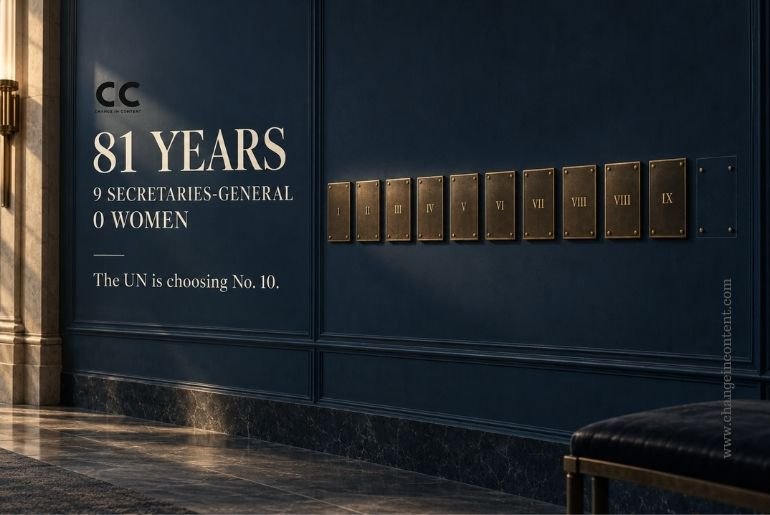
- The United Nations has existed since 1945, but none of its nine Secretaries-General has been a woman. António Guterres, the ninth, completes his second term on 31 December 2026.
- The 2026 BRICS New Delhi Declaration explicitly noted that no woman has ever been elected UN Secretary-General and also called for greater participation of women, particularly from emerging and developing countries, in leadership across international organisations.
- The UN itself has recognised the gap. The joint letter launching the 2025–26 selection process said Member States should “strongly consider” nominating women.
- As of 16 September 2026, the UN’s published candidate list includes four active women and three active men, after two earlier female candidacies were withdrawn.
- The gender gap is not uniform across the UN. The organisation says it has achieved parity among senior leaders and at professional levels in parts of the system, making the absence of a woman Secretary-General even more conspicuous.
The gender gap in the UN and the 81-year history
There is something unusually stark about the number 81.
The United Nations has survived wars, geopolitical realignments, decolonisation, economic crises, technological revolutions and repeated debates about what global leadership should look like. It has had 9 Secretaries-General. Every one of them has been a man.
That record was pulled into the centre of the global-governance debate at the 18th BRICS Summit in New Delhi, where leaders adopted a declaration that stated plainly that no woman has ever been elected to the UN’s top office.
The line could easily have disappeared inside a long diplomatic document. It should not. Because the gender gap in the UN is now colliding with a rare institutional moment: the organisation is choosing its next leader.
What exactly did BRICS say?
Paragraph 9 of the New Delhi Declaration addresses the ongoing selection of the next UN Secretary-General. It records two forms of underrepresentation.
- First, no woman has ever been elected Secretary-General.
- Second, only a small number of office-holders have come from Latin America and the Caribbean, Africa and Asia.
That wording places gender and geography inside the same argument about global governance.
The previous paragraph goes further. BRICS calls for greater representation of emerging and developing countries in international decision-making and specifically seeks an increased role and share for women, especially women from emerging markets and developing countries, at all levels of leadership and responsibility.
Our recent report on the BRICS Summit 2026 and women-led development looked at the wider agenda around women, trade, finance, leadership and decision-making. This one sentence on the UN deserves its own examination because it moves the conversation into the highest office of the multilateral system.
9 men have held the job
The historical record is straightforward.
- Trygve Lie.
- Dag Hammarskjöld.
- U Thant.
- Kurt Waldheim.
- Javier Pérez de Cuéllar.
- Boutros Boutros-Ghali.
- Kofi Annan.
- Ban Ki-moon.
- António Guterres.
9 Secretaries-General since the first appointment in 1946.
The pattern spans different regions and political periods. But not gender. That does not mean qualified women never existed. Nor does it prove that individual selections were made simply because candidates were men.
It tells us something narrower and still significant: Across nine appointments, the system has never produced a woman at the end of the process.
How is a UN Secretary-General actually chosen?
The appointment is not a direct global election.
Under Article 97 of the UN Charter, the Secretary-General is appointed by the General Assembly on the recommendation of the Security Council.
Member States nominate candidates. Those candidates now participate in public interactive dialogues before the General Assembly, where they present their vision and answer questions from governments and civil society. But the Security Council still plays the decisive recommending role before the General Assembly makes the appointment.
A more transparent public process has emerged over time, but the eventual appointment still depends heavily on negotiations among states, particularly within the Security Council. The gender question therefore cannot be answered simply by saying, “Let more women apply.”
Member States must nominate them. Governments must support them. And the selection machinery must ultimately advance one.
The UN itself has acknowledged the problem
When the current selection process was formally opened in November 2025, the President of the General Assembly and President of the Security Council included an unusually direct statement in their joint letter.
They noted with regret that no woman had ever held the position and encouraged Member States to strongly consider nominating women.
That matters because this is no longer only an external critique of the organisation. It is part of the UN’s own framing of the selection process.
Then-General Assembly President Annalena Baerbock repeated the point in March, saying all 193 Member States had agreed to encourage nominations of women.
The institution knows the gap exists. The 2026 process will show what Member States do with that knowledge.
There are women in the race this time
As of 16 September 2026, the UN’s official candidate list shows seven active candidates. 4 are women:
- Ivonne A-Baki, nominated by Tonga;
- María Fernanda Espinosa Garcés, nominated by Antigua and Barbuda;
- Rebeca Grynspan Mayufis, nominated by Costa Rica;
- and Carolyn Rodrigues Birkett, nominated by Guyana.
3 active candidates are men:
- Rafael Mariano Grossi, nominated by Argentina;
- Olara Otunnu, nominated by Uganda;
- and Macky Sall, nominated by Burundi.
2 earlier female nominees, Michelle Bachelet and Virginia Gamba, were withdrawn in March.
This is an important change in the pipeline. It is not a prediction of the outcome. The selection remains ongoing. But the candidate field itself shows that the argument “there are no women to choose from” does not fit the 2026 process.
Yet the UN’s wider gender picture is more complicated
It would be misleading to treat the Secretary-Generalship as evidence that women are absent from the UN entirely. They are not.
Under António Guterres, the organisation introduced a system-wide gender-parity strategy. In March 2026, Guterres said the UN had reached parity among its senior leaders at headquarters and globally, among top representatives around the world and at professional levels. He said women had risen from around 30% of roughly 160 high-level officials a decade earlier to slightly more than half.
A 2026 UN progress report similarly found women at 48% across staff and non-staff categories in the participating entities, with parity reached at several professional and Assistant Secretary-General levels, although gaps persisted at some senior grades.
That creates a more interesting picture. The organisation can point to genuine progress in gender balance. And still say: the final office has remained untouched.
Why does the Secretary-Generalship matter so much?
The Secretary-General is often described as the UN’s chief administrative officer.
That description is technically correct. It also undersells the role.
The Secretary-General represents the organisation publicly, shapes international agendas, uses diplomatic influence during crises, appoints senior officials and can bring matters threatening international peace and security to the Security Council under Article 99 of the Charter.
The office is symbolic and operational at the same time. That is why the identity of the office-holder matters.
Not because a woman Secretary-General would automatically transform the UN. She would not. Women leaders are not interchangeable. They do not automatically share the same politics, priorities or management style.
Representation does not guarantee policy outcomes. But an institution that repeatedly argues that women should participate fully in political and public life cannot reasonably treat 81 years of male-only leadership at its own summit as insignificant.
The gap is also about who gets imagined as a global authority
Leadership patterns become normal through repetition.
9 men in succession can gradually stop looking like nine separate appointments. It becomes the visual vocabulary of the office.
- Secretary-General looks male.
- Diplomatic authority looks male.
- The person mediating conflict looks male.
- The person speaking for the international system looks male.
That is one reason first appointments still matter even when they do not solve structural inequality.
When Anda Filip became the first woman Secretary General of the Inter-Parliamentary Union in July 2026, we wrote about a wider shift in women’s leadership in global institutions. Women now lead institutions spanning trade, migration, telecommunications, climate and development.
The UN Secretary-Generalship remains one of the most visible exceptions.
There is another contradiction inside global diplomacy
The pipeline to multilateral leadership is itself unequal.
In March, the President of the General Assembly noted that only around a quarter of Permanent Representatives at the UN were women, with just 40 women serving in those roles at that point. That matters because global institutions do not manufacture senior leaders from nowhere.
Future candidates come from diplomacy. Government. International organisations. Foreign ministries. Political leadership.
If those pipelines remain disproportionately male, the very top remains harder to diversify.
The problem therefore cannot be solved only once every five or ten years when the Secretary-General selection begins. It starts much earlier.
BRICS has made the gap harder to ignore
The New Delhi Declaration does not require the UN to appoint a woman. Nor can BRICS itself decide the result.
What it has done is place the historical record into an official declaration signed by a major group of states at precisely the moment the succession process is active.
That gives the issue diplomatic weight. It also connects to a larger argument BRICS made in New Delhi: International institutions should better reflect the countries and populations they represent.
Gender belongs inside that reform conversation. A more geographically representative UN that continues to reserve its highest symbolic office, in practice, for men would still leave one form of representation unresolved.
2026 is not simply another anniversary year
António Guterres’s second term ends on 31 December 2026. The 10th Secretary-General is due to take office in January 2027 for a five-year term. That makes the present discussion unusually concrete.
For decades, “the UN has never had a woman Secretary-General” was a historical fact with no immediate selection under way. Now there is one.
Women have been nominated. They have undergone the same public interactive dialogues. The process has explicitly acknowledged gender representation. BRICS has now added its voice.
What happens next remains for Member States to determine. But whatever the outcome, the 81-year record can no longer be treated as an invisible feature of the institution.
Conclusion: Parity below the top is still not parity at the top
The United Nations has changed. Women lead major parts of it. Gender parity has improved materially across senior appointments and professional ranks.
That deserves recognition. But institutions reveal something about themselves through the positions that remain exceptions. For the UN, the Secretary-Generalship is one of them.
9 men. 81 years. No woman.
The 2026 selection process may or may not change that history. It would be irresponsible to presume the result before Member States complete the process.
The useful question is broader. How long should the world’s most visible multilateral institution be comfortable with its highest office looking unlike half the people it exists to serve?
BRICS has now put that question into an international declaration. The UN itself has acknowledged it. And the current candidate pool proves that qualified women are not absent from the conversation.
The next part belongs to the selection process.
FAQs
Q: Has a woman ever been UN Secretary-General?
A: No. All nine Secretaries-General appointed since 1946 have been men. António Guterres is the ninth Secretary-General, and his second term ends on 31 December 2026.
Q: What did BRICS say about the gender gap in the UN?
A: The 2026 New Delhi Declaration noted that no woman has ever been elected Secretary-General and called for an increased role and share of women, especially from emerging and developing countries, across leadership positions in international organisations.
Q: How is the UN Secretary-General selected?
A: Under Article 97 of the UN Charter, the Security Council recommends a candidate and the General Assembly appoints the Secretary-General. Member States nominate candidates, who now also participate in public interactive dialogues.
Q: Are women candidates running for UN Secretary-General in 2026?
A: Yes. As of 16 September, four active women candidates were listed by the UN: Ivonne A-Baki, María Fernanda Espinosa Garcés, Rebeca Grynspan Mayufis and Carolyn Rodrigues Birkett. Three active male candidates were also listed.
Q: Does the UN have gender parity elsewhere?
A: In several areas, yes. The UN says parity has been achieved among senior leadership and at professional levels in parts of the system, although gaps remain across some grades, locations and categories.
Editorial Note & Sources
This article focuses on the absence of women from the office of UN Secretary-General. It should not be read as suggesting that women are absent from UN leadership generally. The United Nations has reported substantial progress towards gender parity across senior management and professional categories. The 2026 Secretary-General selection remains ongoing, and Change in Content does not predict or advocate for any individual candidate.
Sources
- BRICS New Delhi Declaration, 12 September 2026: Government of India. Primary source for the BRICS statement that no woman has ever been elected UN Secretary-General and for its call for stronger representation of women in international organisations.
- United Nations: Selection and Appointment of the Next Secretary-General. Official 2026 candidate list, nomination status, withdrawals and interactive-dialogue process.
- President of the UN General Assembly and President of the Security Council: Joint Letter, 25 November 2025. Official initiation of the selection process and statement encouraging Member States to strongly consider nominating women.
- United Nations Charter: Article 97. Primary legal source explaining that the Secretary-General is appointed by the General Assembly on the recommendation of the Security Council.
- United Nations Archives: Secretaries-General. Official historical record of the nine office-holders since 1946.
- United Nations: Gender parity reporting, 2026. Official material showing progress towards parity in senior leadership and professional categories, alongside remaining gaps.
