
The Brief
- Among workers making qualifying work trips, 16.3% of women use buses or rail as their primary mode, compared with 7.6% of men.
- In urban areas, the bus shares are 21.7% for women and 6.9% for men. The category includes private and company buses.
- Walking is the main mode for 64.8% of rural women commuters.
- The survey describes travel patterns; it does not assess toilets or the effectiveness of safety services.
- Transport agencies and employers should examine the whole route to work, with clear responsibility for facilities and responses.
National Household Travel Survey 2026, and the revelations
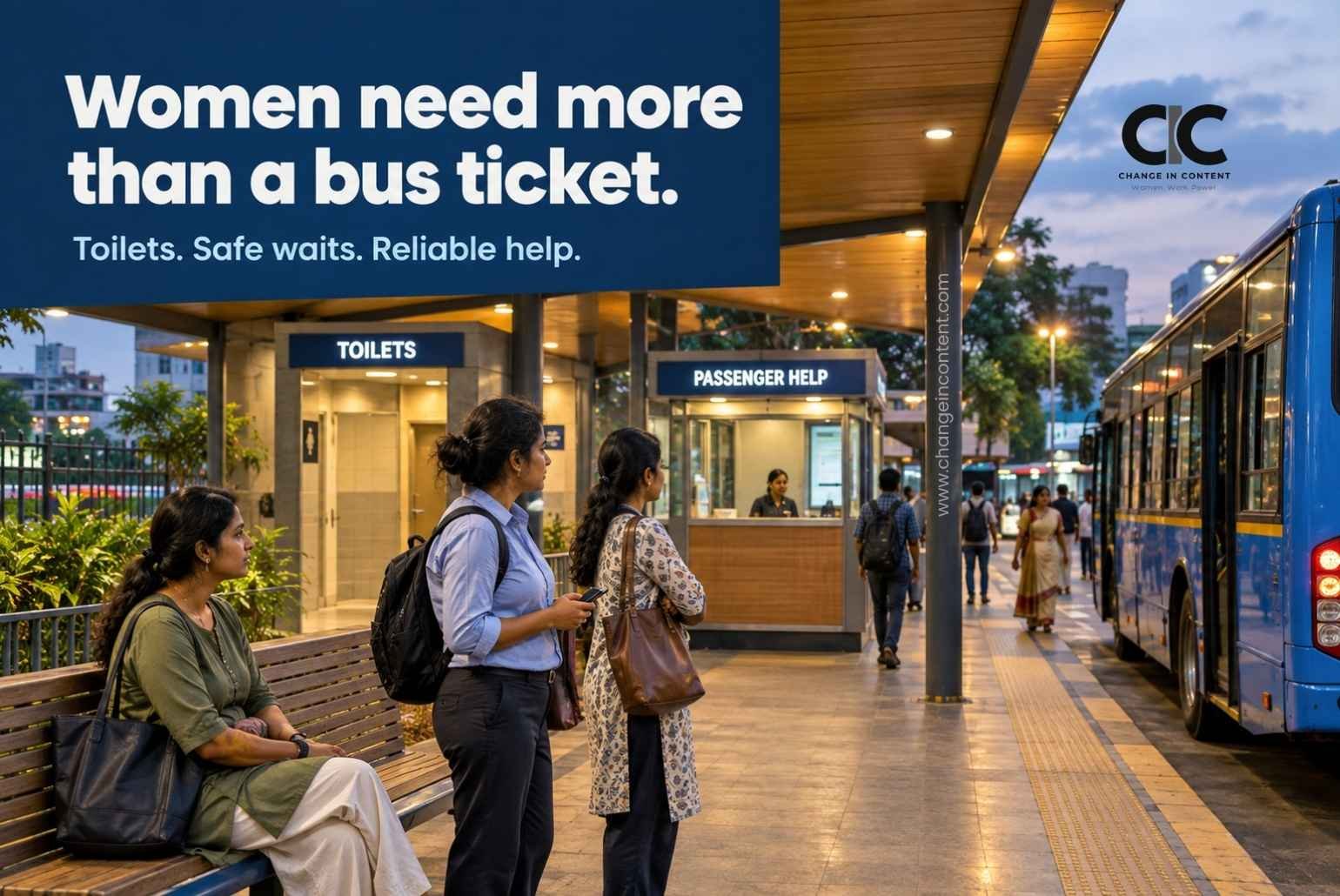
A toilet at a bus stop needs water, a working lock and opening hours that match the buses. Without those, the sign outside promises more than the facility delivers. The National Household Travel Survey 2026 gives transport planners a reason to take such details seriously: women depend much more heavily than men on buses and rail for their work journeys.
Change in Content’s calculation from the survey’s Table 5 puts the combined bus-and-rail share at 16.3% for women and 7.6% for men. These are shares of workers aged 15 and above making the qualifying commute, not counts of all passengers. Women’s share is just over twice men’s.
The category needs explaining. The survey counts journeys of at least one kilometre and identifies the primary mode by the longest distance travelled. Buses include public, private, company and inter-city services. The comparison therefore concerns bus-and-rail reliance, rather than government bus use alone.
Released by the National Statistics Office on 5 October, the survey covered July 2025 to June 2026. Its value goes beyond describing who boards which vehicle. It gives authorities a basis for asking whether the route to work serves the people who use it.
The bus is only one part of the commute
Among urban women commuters, 21.7% use a bus as their main mode, against 6.9% of men. In rural areas, 64.8% of women commuters primarily walk. A transport response that concentrates entirely on the vehicle would miss much of that second journey.
That is where cities designed for and by women become a practical concern. The pavement, road crossing, interchange and waiting area all belong to the commute. A well-run service can still be difficult to use if reaching its stop requires an unsafe crossing or waiting without shelter.
Two other findings deserve care in interpretation. The survey records qualifying work travel for 41.9% of female workers, compared with 61.9% of male workers. It also reports lower average monthly spending on fixed-workplace journeys for women: ₹533 against ₹835 for men.
Neither result proves that women prefer to stay close to home or that cheaper travel serves them better. The figures do not explain individual choices, and short journeys or work done at home can fall outside the measured commute. They invite further questions about available jobs, routes, costs and household circumstances.
Driving ability cannot answer those questions on its own. A licence does not establish access to a vehicle, and using a bus says nothing reliable about confidence. Public transport deserves to be a good option for someone who can drive as well as someone who cannot.
A toilet needs an operating budget
The survey is not an inspection of bus stops. We should not use it to declare that every stop lacks facilities. We can use the travel patterns to ask where facilities are needed, whether they work and who keeps them working.
The World Bank’s guidance on gender-responsive transport in India includes toilets at stations, terminals, depots and rest stops. Turning that recommendation into something useful requires decisions about location, water, cleaning, accessibility and opening hours.
- At major interchanges, a facility should be checked while commuters are actually travelling, including early departures and late returns.
- Smaller stops may need clear directions to a nearby usable toilet rather than a building that nobody can maintain.
- Provision should account for disability, women’s health needs including menstrual hygiene, privacy and the route between the stop and the facility.
A contract could specify cleaning checks, repair responsibilities and a way to report faults. These are proposed operating measures, not findings from the survey. The measure of success would be a facility passengers can use consistently.
A safety number needs someone on the other end
India already has 112, the national emergency response number. It would be wrong to suggest that no helpline exists. The transport question is whether someone at a particular stop can find the right help, identify her location and receive a response. 112.gov.in
Display the stop name or identification number, emergency information and a separate operator contact for service complaints. Explain what happens after a report. Provide an option beyond a QR code: a passenger may have no mobile data, a low battery or difficulty using the interface.
- Lighting should cover the approach and waiting area, not just the shelter roof.
- Staff need procedures for responding to harassment, including escalation and preserving relevant evidence.
- Cameras and emergency buttons need maintenance and a response process. Their installation alone cannot demonstrate safety.
These details also shape the expense of arranging a safer journey. An alternative ride after a missed connection may cost more; a poorly timed last service can narrow the shifts someone is willing to accept. Those are possibilities to investigate locally, rather than consequences quantified by this survey.
Put the commute on the employment agenda
Transport authorities should test routes with women travelling at different hours, including disabled passengers and people making transfers. Ask those who avoid a service what would make it usable. Publish what will change, which agency is responsible and when the work will be checked again.
Employers have a smaller but concrete role.
- Compare shift changes with actual bus and rail timings.
- Check the walk from the workplace gate to the nearest stop.
- Where gaps exist, consider a shared feeder service, coordinated shift timings or safe arrangements for late departures.
- Include contract workers in the assessment.
That belongs in a serious discussion of helping women stay in work. Hiring someone does not make her daily journey manageable. Equally, employers cannot repair a transport network alone; operators, municipalities and relevant public agencies need to agree on responsibilities.
Women’s Transportation: Change in View
Women’s reliance on buses and rail should influence where money goes and what gets maintained. A route should be judged from the first walk to the stop through the final journey home. The next conversation about women’s employment could usefully begin at a bus interchange, during a shift change, with the toilet unlocked and the service timetable in hand.
Editorial note and sources
This article uses the original NSO factsheet, Household Travel in India 2025–26, and its linked Table 5. The 16.3% and 7.6% figures are Change In Content’s sums of the published bus, monorail/tram and rail categories, using rounded shares. These are primary-mode shares among qualifying worker commuters, not passenger totals. Facilities and safety recommendations draw on World Bank guidance and CIC’s analysis; no site inspection was conducted.
Sources
- NSO/MoSPI: Original factsheet: Household Travel in India 2025–26
- NSO/MoSPI: Table 5: work-commute modes by sex and sector
- MoSPI/PIB: Official release, 5 October 2026
- World Bank: Safe and inclusive public spaces and transport for women in India
- Government of India: Emergency Response Support System: 112
