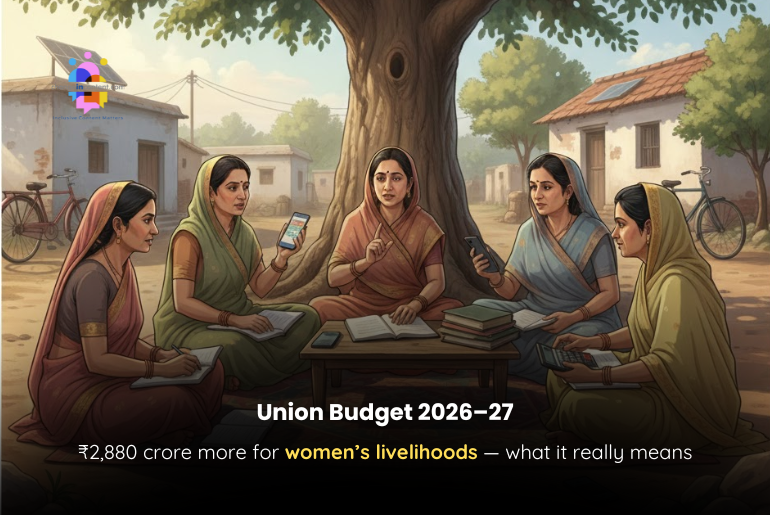
In Budget 2026–27, Finance Minister Nirmala Sitharaman announced a 20% increase in allocations for the Deendayal Antyodaya Yojana–National Rural Livelihoods Mission (DAY-NRLM). It strengthens one of India’s most extensive programmes aimed at women’s economic empowerment. The programme component of DAY-NRLM has been enhanced by ₹2,880 crore. This increase in the budget raises the allocation from ₹14,400 crore in the Revised Estimates (RE) for 2025–26 to ₹17,280 crore in the current financial year.
For a mission that touches millions of rural women through Self-Help Groups (SHGs), the increase under Budget 2026–27 has drawn attention not only for its scale, but also for what it signals about the government’s approach to women-led livelihoods.
What does the budget 2026–27 change for women’s livelihoods?
The headline number is clear. The programme component of DAY-NRLM now stands at ₹17,280 crore. That marks a 20% rise over last year’s Revised Estimates. It is also worth noting that the original allocation for 2025–26 was ₹17,104 crore, which was later reduced during the RE stage. The current increase, therefore, restores and marginally exceeds the earlier level, but this time with renewed political emphasis.
In her Budget speech, the Finance Minister framed the increase as a step towards helping women move beyond subsistence livelihoods. The focus, she said, is on enabling women to transition from debt-based activities to enterprise ownership. It is an ambition that places women not merely as workers, but as economic decision-makers within rural markets.
Understanding DAY-NRLM: Why this Mission matters
Launched in June 2011, the Deendayal Antyodaya Yojana–National Rural Livelihoods Mission was designed to organise poor rural households (particularly women) into Self-Help Groups. At the same time, it aims to federate them at higher levels and provide sustained support for income generation. The Mission targets nearly 100 million rural women. That makes it one of the most extensive women-centric livelihood programmes globally.
DAY-NRLM operates on a community-driven model. SHGs receive Revolving Funds (RF) and Community Investment Funds (CIF) to support livelihood activities. These activities include agriculture, livestock, micro-enterprises, and services. Over the years, the programme has become the backbone of rural women’s collective economic participation. It is especially beneficial in states where SHG federations are deeply embedded in local governance and markets.
Budget 2026–27 and the Lakhpati Didi narrative
A significant portion of the political narrative around DAY-NRLM now centres on the Lakhpati Didi programme, which was formally integrated into the Mission on 15 August 2023. According to government data, India currently has 41.1 million Lakhpati Didis. These are women whose annual income consistently exceeds ₹1 lakh.
The Prime Minister has repeatedly cited the initiative as a flagship example of women’s empowerment. In August 2024, over 1.1 million new Lakhpati Didis were felicitated in Jalgaon, Maharashtra. The Finance Minister echoed this emphasis in Budget 2026–27. She positions the increased allocation as a means to help women take “the next step” towards entrepreneurship.
From SHGs to enterprises: What the budget signals
Beyond numbers, the budget outlines a structural shift. The proposal to establish Self-Help Enterprise (SHE) Marts as community-owned retail outlets under cluster-level federations aims to integrate rural women’s production directly into markets. These marts will receive the support through enhanced and innovative financing instruments. That will move SHGs closer to formal retail and supply chains.
If implemented well, this could address one of the long-standing challenges within rural livelihoods programmes. The challenge is the gap between production and sustainable market access. However, the success of such initiatives will depend heavily on local capacity, financial literacy, and the ability of federations to manage enterprises at scale.
Budget 2026–27 in context: Intent vs Ground Reality
While the 20% increase under Budget 2026–27 sends a strong signal, allocations alone do not guarantee transformation. Rural women continue to face structural constraints. These constraints are limited asset ownership, care responsibilities, uneven access to credit, and market volatility. In several regions, SHGs function effectively as social safety nets but struggle to break into higher-value economic activities.
There is also a broader political context. Women-centric schemes have increasingly become central to electoral narratives across states and at the Centre. The challenge is to ensure these programmes do not remain symbolic. Instead, they must translate into durable economic security, particularly for women in the lowest-income brackets.
How does this fit into the larger Budget 2026–27 picture
The increase in DAY-NRLM allocations complements the broader women-focused announcements in the Union Budget. We examined these measures in detail in our earlier analysis, “Union Budget 2026: What It Really Means for Women in India.” It explores how fiscal priorities intersect with women’s lived realities.
Read the complete Budget analysis here.
The changeincontent perspective
At changeincontent, we see the Budget 2026–27 allocation to DAY-NRLM as an important milestone but not a final answer. Livelihood missions have the potential to reshape women’s economic agency only when funding aligns with accountability, local capacity building, and honest evaluation of outcomes.
As a platform, we will continue to track how these allocations translate on the ground. We will continue to identify who benefits, who is left out, and whether women are truly moving toward stable, dignified livelihoods. Budgets reflect intent; lived outcomes reflect commitment. Our role is to keep that distinction visible.
The final thoughts
The 20% increase in allocations for DAY-NRLM under Budget 2026–27 places women’s livelihoods firmly within the fiscal spotlight. It reinforces the government’s stated commitment to women-led development, particularly in rural India. Yet the objective measure of success lies beyond budget documents. It will lie in whether rural women experience sustained income growth, reduced precarity, and greater control over their economic futures.
As with many such initiatives, the story of this allocation will be written not in Parliament, but in villages, SHG meetings, and local markets across the country.
Disclaimer: The views expressed in this article are based on the writer’s insights, supported by data and resources available both online and offline, as applicable. Changeincontent.com is committed to promoting inclusivity across all forms of content. We broadly define inclusivity as media, policies, law, and history. It encompasses all elements that influence the lives of women and marginalised individuals. Our goal is to promote understanding and advocate for comprehensive inclusivity.