
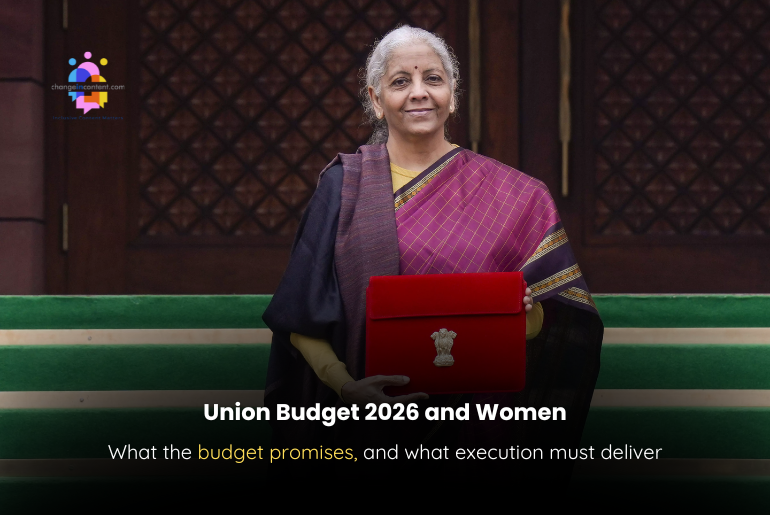
On 1 February 2026, Finance Minister Nirmala Sitharaman presented the Union Budget 2026, marking her ninth consecutive budget. That is a milestone in itself. While the budget was anchored in fiscal discipline and strategic manufacturing priorities, it also carried a distinct focus on women’s education, entrepreneurship, and participation in emerging sectors such as technology and artificial intelligence.
Union Budget 2026 focuses on women’s education and economic participation
Against a backdrop in which women continue to face gaps in access, safety, credit, and opportunity, the Union Budget 2026 introduced several targeted measures to bring more women into formal education systems, enterprise ecosystems, and future-ready jobs. These announcements signal intent, but intent alone is never enough.
Girls’ Hostels in every district: Removing barriers to higher education
Highlighting the hurdles women face in science and technology courses, Finance Minister Nirmala Sitharaman said that long study hours and extended laboratory work often make it harder for female students to continue their education.
“In higher education, especially in STEM institutions, prolonged hours of study and laboratory work pose certain challenges for girl students. Through our scheme, one girls’ hostel will be established in every district to promote astrophysics and astronomy through immersive experiences,” she said during her budget speech.
With over 700 districts across India, this move is expected to significantly improve access to higher education for young women, particularly those from smaller towns and rural areas. The hostels aim to provide safe, affordable, and supportive living spaces, making it easier for girls to pursue courses without worrying about accommodation or safety.
The government has allocated ₹10,000 crore for this nationwide hostel programme, which will fund the construction of girls’ hostels in every district using Viability Gap Funding (VGF). VGF is a government support model that helps fund projects which are socially important but may not be financially or commercially viable on their own.
She MARTs: Scaling women-led entrepreneurship at the community level
Finance Minister Nirmala Sitharaman also announced the launch of ‘She MARTS’, an initiative to set up self-help entrepreneur marts across the country. These marts will operate as community-owned retail outlets, managed by women and rooted in local self-help group networks.
Speaking about the programme, Sitharaman said the idea builds on the success of the Lakhpati Didi scheme. The government now wants to help women move beyond small, credit-based livelihoods and take the next step towards becoming full-fledged business owners.
Self-help entrepreneur marts will be set up as community-owned retail outlets within cluster-level federations, supported through enhanced and innovative financing. It will enable women to scale up and grow as entrepreneurs.
SHE-MARK and credit access for women entrepreneurs
The SHE-MARK initiative aims to improve access to credit for women entrepreneurs. The programme is designed as both a financing access tool and a growth-focused support system for women-led businesses.
SHE-MARK will serve as a branding and certification initiative, enabling women-owned enterprises to access credit-linked products more easily, secure loans, and connect with formal markets. Over time, this is expected to improve women’s participation in formal finance and help their enterprises scale sustainably.
Read here: Women entrepreneurs face a disadvantage in securing formal loans.
Supporting women and youth into the AI Tech future
The Finance Minister placed a strong focus on women in STEM and young people in technology through new initiatives. These initiatives include the AI Mission, the National Research Fund, and the Innovation Fund.
One of the major announcements was the ₹500 crore Centre of Excellence in AI for Education. That will strengthen research and expand the use of AI in teaching, learning, and curriculum development. The centre aims to help educational institutions adopt AI tools, improve learning outcomes, and prepare students for future jobs in technology-led industries.
In her budget speech, Finance Minister Nirmala Sitharaman said technology will drive the 21st century. And the government plans to prepare India’s workforce, infrastructure, and regulatory systems for this shift.
Adoption of technology is for the benefit of all people—farmers in the field, women in STEM, youth keen to upskill and divyangjan (people with disabilities) to access newer opportunities.” ~ Nirmala Sitharaman
The changeincontent perspective
At Changeincontent, we see the Union Budget 2026 as one that speaks the right language. However, language must translate into lived outcomes. The fact that the budget was presented by a woman Finance Minister for the ninth consecutive year matters symbolically. However, symbols do not replace systems. India has never lacked policy announcements; what it consistently struggles with is execution.
Girls’ hostels, women-led marts, and AI skilling programmes will only succeed if states, institutions, and workplaces actively advance these ideas. Employers must align with policy intent. Financial institutions must reduce bias in credit access.
Monitoring mechanisms must ensure that funds reach the women they are intended to support. Budgets create frameworks, but nations progress only when we implement these frameworks with urgency, accountability, and political will.
The final thoughts on the Union Budget 2026
It is a brief overview of how Budget 2026 positions women within its economic and social priorities, primarily through education, entrepreneurship, access to credit, and emerging technologies. Initiatives such as girls’ hostels, She MARTS, SHE-MARK, and the AI mission signal a clear intent to bring more women into growth sectors and the formal economy.
The initiatives point in the right direction, but they represent only a slice of what women need from public policy. Many key issues remain unaddressed, particularly those linked to health, employment, unpaid care work, and long-term economic security. The next section examines the missing pieces and where the budget still falls short.
Disclaimer: The views expressed in this article are based on the writer’s insights, supported by data and resources available both online and offline, as applicable. Changeincontent.com is committed to promoting inclusivity across all forms of content. We broadly define inclusivity as media, policies, law, and history. It encompasses all elements that influence the lives of women and marginalised individuals. Our goal is to promote understanding and advocate for comprehensive inclusivity.
