
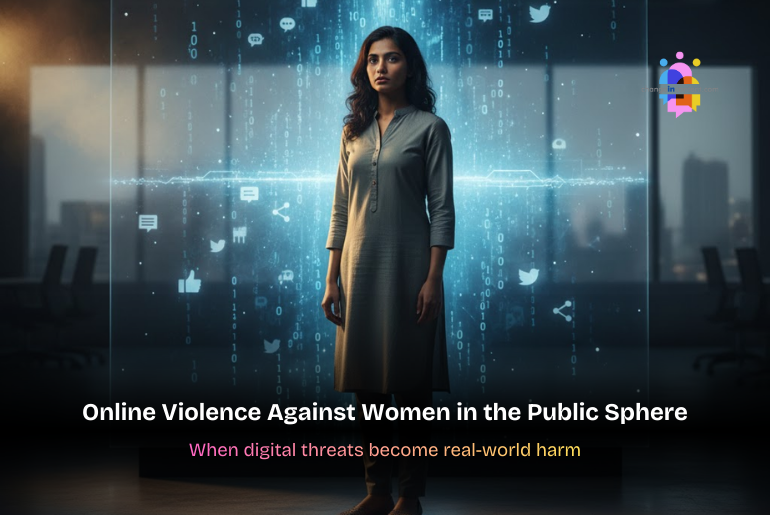
In the age of digital communication, where ideas, aspirations, and identities must flourish, there lurks a darker parallel reality. That reality is the escalating online violence against women in the public sphere. Let’s be honest: it would be wrong to mistake it as fleeting insults or trivial harassment.
According to Tipping Point: The Chilling Escalation of Violence Against Women in the Public Sphere, a global report developed by UN Women under the EU-funded ACT programme, online violence is now a systemic and escalating threat. It drives women out of public discourse, jeopardises democratic participation, and increasingly manifests in real-world danger.
For those of us who have lived, worked, or spoken in public spaces (online or offline), this should not be a surprise. But the scale, and especially the seriousness of the consequences, demands our full attention.
Online violence against women in the public sphere: Understanding the scale of the crisis
The Tipping Point report draws on a global survey of women human rights defenders, activists, journalists, writers, influencers, and other public communicators across 119 countries. The data is stark:
- 70% of women surveyed report experiencing online violence in relation to their work in the public sphere.
- More than 41% say they have experienced offline harm that they link directly to online abuse. It includes issues such as physical or sexual assault, stalking, or harassment.
- Among women journalists and media workers, the connection between online abuse and physical-world threat has more than doubled since 2020. It has increased from 20% to 42%.
- Nearly one in four respondents reports AI-assisted online violence, including deepfake imagery and manipulated content.
- For writers and public communicators focusing on human rights, exposure to AI-fuelled online violence reaches 30%, higher than other groups surveyed.
These numbers reveal more than a trend; they reveal a trajectory. They show that online violence is increasingly transforming into physical harm. What happens online no longer lives in a separate sphere. Instead, it bleeds into real-world violence in dangerous and sometimes deadly ways.
When screens become weapons: Forces amplifying online abuse against women in the public sphere
At first glance, the idea of online harassment might seem like an extension of societal misogyny. It appears to be hurtful, unfair, and disturbing. What the Tipping Point report makes painfully clear is that this is not just individual cruelty; it is systemic and structural.
Several forces are contributing to the escalation:
1. Generative Artificial Intelligence
Today, AI tools make it cheaper, faster, and easier to produce abusive content at scale. Deepfake videos, manipulated photos, AI-generated threats, impersonations, and automated harassment bots spread rapidly through social networks. It often happens without adequate platform safeguards.
Read more about the Grok AI Controversy for a deeper context of this issue.
2. Algorithmic amplification
Social media platforms prioritise engagement. Sadly, outrage and abuse often generate more engagement than normal discussion. It means misogynistic content rapidly reaches broad audiences. That escalates hostility toward women.
3. Rising authoritarianism and networked misogyny
In many contexts, online abuse is beyond just an expression of individual bias. In reality, it has become a tool of political power. People are using digital violence to intimidate, marginalise, and silence vocal women in public life. That is eroding democratic deliberation and shrinking civic space.
4. Weak legal and regulatory structures
Across most countries, existing laws either fail to address technology-facilitated violence explicitly or are too slow and fragmented to protect victims effectively. This legal vacuum gives impunity to harassers and makes accountability elusive.
The psychological and social toll: More than numbers
Statistical prevalence only tells part of the story. Behind every percentage point is a woman whose voice, presence, or agency has been threatened, undermined, or driven offline.
Women journalists, activists, and human rights defenders are disproportionately targeted. These women are the very voices who hold the power to account and expand public debate. In many cases, online abuse:
- triggers fear, anxiety, and trauma;
- leads to self-censorship or withdrawal from public platforms;
- damages professional opportunities;
- isolates women economically and socially;
- and sometimes it can cause physical harm or death.
The idea that someone’s advocacy or reporting could expose them to threats at their doorstep isn’t just chilling. Instead, it strikes at the heart of freedom of expression.
Accountability, awareness, and the path forward
If Online Violence Against Women is now a multi-dimensional crisis, then addressing it must be equally multi-dimensional. It is not a problem that any single entity (government, civil society, or the private sector) can solve. It requires a collective ecosystem response.
Legal and policy action
Governments must urgently revise and strengthen legal frameworks to explicitly recognise technology-facilitated violence as a form of gender-based violence. It means clear definitions, enforceable penalties, and cooperation across jurisdictions.
Platform accountability
Tech platforms must take responsibility for the ecosystems they create. It includes algorithm transparency, proactive moderation, robust reporting mechanisms, and design principles that prioritise user safety over engagement metrics.
Support systems for survivors
Survivors need accessible support that goes beyond content removal. It includes psychological support, legal aid, crisis response services, and rapid-response units to address threats before they escalate.
Education and Digital Literacy
Awareness (especially among young women and girls) about how online abuse operates, and how to protect themselves, is a critical component. But we must pair it with male allyship, encouraging users of all genders to challenge misogynistic norms rather than enabling them.
Data, Research, and Evidence
Closing evidence gaps is essential. The Tipping Point survey is a start, but longitudinal, intersectional research will help understand how online violence affects women differently based on race, class, sexuality, geography, and other identities.
The changeincontent perspective
At changeincontent, we view the UN Women Tipping Point report not as a standalone publication but as a warning that we can no longer ignore. Researchers and policy experts such as Sarah Hendriks and the UN Women Policy, Programme and Intergovernmental Support Division team document how online abuse spills into offline harm. By doing so, they are mapping a systemic failure. A failure of digital governance, of platform accountability, and of collective responsibility.
As a platform committed to gender equity, our role goes beyond reporting. We intend to use this evidence to drive sustained conversations with organisations, media houses, policy stakeholders, and workplaces. We are discussing issues like digital safety, gendered online violence, and the shrinking of civic space for women.
We will continue to amplify research-backed voices, publish explainers that translate data into lived realities, and create room for uncomfortable but necessary dialogue. Silence enables violence. Context dismantles it. That is where changeincontent stands.
Conclusion: The price of silence is too high
In the last few years, society has easily dismissed online abuse as a nuisance. Be it emoticons of hate, ugly words on a screen, or verbal abuse through AI, everything was tagged ‘nuisance.’ However, today the data make it clear that the narrative is obsolete.
Online violence against women is a real-world safety crisis. It threatens democratic participation, freedom of expression, and gender equality. When digital abuses silence women online, it is silencing them in public life. When it pushes them off platforms, it removes them from debates, decisions, and power.
Let us be clear about the fact that it is not merely about technology. In reality, it is about power and who gets to speak and be heard.
Recognising online violence against women for what it is (a public safety and human rights crisis) is the first step. Taking action is where the long journey truly begins.
Disclaimer: The views expressed in this article are based on the writer’s insights, supported by data and resources available both online and offline, as applicable. Changeincontent.com is committed to promoting inclusivity across all forms of content. We broadly define inclusivity as media, policies, law, and history. It encompasses all elements that influence the lives of women and marginalised individuals. Our goal is to promote understanding and advocate for comprehensive inclusivity.
