
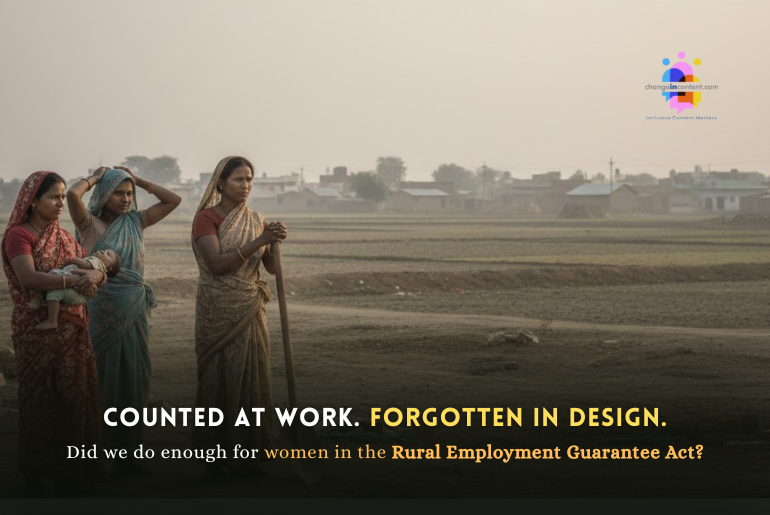
The inclusion of women in the Rural Employment Guarantee Act sounds reassuring. It suggests recognition, presence, and participation. On paper, it even looks convincing. Women account for more than half of all person-days under India’s rural employment guarantee programme. Few public policies anywhere in the world can claim that kind of female participation.
And yet, something is deeply wrong.
India’s latest iteration of its rural employment guarantee act (VB-G RAM G Act) extends the number of guaranteed workdays to 125 days. It speaks the language of Viksit Bharat, inclusion, and economic dignity. But when we look closer (not at totals, but at lives), the law still struggles to see women clearly. It counts them, employs them, and depends on them. It just does not design itself around them.
No, it is not a failure of intent. It is a failure of imagination.
Women were always central, just never the reference point
Women have never been marginal to India’s rural employment story. For over a decade, they have consistently formed around half the workforce. During the pandemic years, when migration reversed and households fractured under economic stress, women’s participation climbed even higher.
But participation has been mistaken for inclusion.
The programme treats women as a single category. It is interchangeable, uniform, and endlessly flexible. A 22-year-old mother with a toddler is recorded the same way as a 48-year-old woman with grown children. A pregnant woman lifting soil is statistically identical to a grandmother working to supplement household income. In data terms, they are all simply “female workers”.
In life terms, they are not.
When policy cannot distinguish between life stages, it cannot respond to reality. And when we ignore reality, the burden quietly shifts to women to adjust, absorb, and endure.
Care is NOT a side issue. It is THE issue.
Rural employment schemes work because they are close to home. But proximity alone does not free women. Time does. Predictability does. Support does.
For women in their prime working years (roughly ages 21 to 50), paid work coincides with the most demanding phase of unpaid caregiving. Childcare, elder care, household labour, and emotional labour. None of this pauses because a worksite opens nearby.
Are we doing enough for women in the Rural Employment Guarantee Act?
The law assumes availability. Women live with simultaneity.
This is why more workdays do not automatically translate into more inclusion. Without childcare, without flexible hours, without lighter tasks during pregnancy or lactation, the programme quietly selects for women who can afford to participate. These are older women, women without young children, women with family support.
Everyone else is counted out, without ever being counted wrong.
The data gap that shapes every other failure
One of the most striking contradictions of India’s rural employment system is that it is one of the most digitised workfare programmes in the world. Still, it knows almost nothing about the women who sustain it.
There is no age-disaggregated data for women workers. No visibility into how many are mothers of young children. At the same time, there is no tracking of pregnancy-related dropouts, and no insight into whether women leave because work is unavailable or because life makes participation impossible.
Women in the Rural Employment Guarantee Act: What’s missing?
We cannot plan for what we cannot see.
The new law repeats old assurances. We still have minimum quotas, inclusion of single women, and mention of persons with disabilities. But when women already constitute over half the workforce, the real question is no longer whether they are included. It is which women are being excluded, and why.
Work without care is not empowerment.
Employment guarantees were never meant to be charity. They were meant to recognise work as citizenship. But citizenship is incomplete when the care economy is invisible.
Simple interventions could transform outcomes. Some of them are aligning work hours with Anganwadi timings, extending childcare services during peak work seasons, enabling local self-help groups to run neighbourhood care collectives, or offering modest wage top-ups for women with young children. None of these ideas is radical. All of them already exist, in fragments, across India’s policy landscape.
What is missing is convergence and the political will to treat care as infrastructure.
Why this matters beyond rural India
India’s female workforce participation remains among the lowest globally. Rural women participate more than urban women. However, they often face harsher conditions, lower security, and greater unpaid burdens.
If India is serious about growth, inclusion, and demographic advantage, it cannot afford to design employment policies that rely on women’s labour while ignoring women’s lives.
Let us stop seeing the rural employment guarantee as just a wage programme. It is a statement about how the State understands work, care, and dignity. When that understanding remains partial, progress remains cosmetic.
Women in the Rural Employment Guarantee Act: Changeincontent perspective
At changeincontent, we do not measure inclusion by numbers alone. We measure it by design.
Women in the Rural Employment Guarantee Act deserve more than visibility. They deserve policies that recognise care, account for life stages, and refuse to treat unpaid labour as a private inconvenience rather than a public responsibility.
Rather than inventing new frameworks, India needs to see women clearly. It is time we stop seeing them as aggregates and quotas. Instead, we must see women as workers whose economic participation depends on whether we finally take the care economy seriously.
Viksit Bharat will not arrive by adding more workdays. It will come when we design work around the lives women actually lead.
Disclaimer: The views expressed in this article are based on the writer’s insights, supported by data and resources available both online and offline, as applicable. Changeincontent.com is committed to promoting inclusivity across all forms of content. We broadly define inclusivity as media, policies, law, and history. It encompasses all elements that influence the lives of women and marginalised individuals. Our goal is to promote understanding and advocate for comprehensive inclusivity.
